

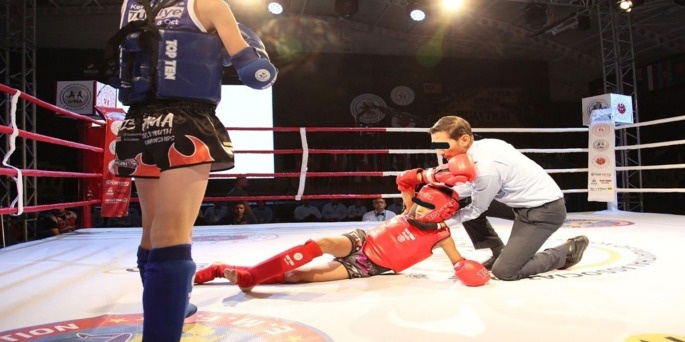
Is muay thai dangerous? The honest answer depends entirely on which door someone is walking through: a Tuesday evening class at a local gym, an amateur fight card at a regional show, or a professional bout on a card in Thailand where teenagers sometimes step in against grown men. Ask a parent standing on the mats watching their ten-year-old drill knee strikes, and the sport looks controlled, padded, coached, closer to a rigorous fitness class than a fight. Ask someone who has watched a stadium bout in Bangkok end with a fighter carried out on a stretcher, and the picture flips completely. Both pictures are true. The problem with most articles answering this question is that they collapse those two realities into one number, and no single number can hold them.
The Short Answer: Training vs Fighting
Most of what people picture when they hear that muay thai is dangerous comes from footage of professional stadium fights, not from what happens on a normal training night. Those are different activities wearing the same name. A structured class run by a competent coach looks a lot like other contact sports once padding, weight classes, and controlled sparring intensity enter the picture. Push the same person into an unsupervised, ego-driven sparring session with no coach watching, and the risk profile changes fast, regardless of the sport.
Injury rates tend to climb in a fairly predictable way as contact and competition level increase. This pattern shows up across combat sports generally, not just muay thai: recreational training carries the lowest exposure, amateur competition sits in the middle, and full professional fighting carries the highest. Nobody needs a single dramatic statistic to see that pattern; it holds true whether the sport is muay thai, boxing, or wrestling.
Can muay thai kill? At the extreme professional end, yes, on rare occasions, the same way boxing occasionally produces a fatality. When it happens, the mechanism is almost always severe head trauma accumulated over a fight or a career, not some unique hazard specific to Thai boxing. Deaths are uncommon relative to the number of fights held every year across Thailand, but professional fighting is not risk-free, and pretending otherwise would be its own kind of dishonesty.
What Actually Gets Hurt in Training
Ask any gym owner what actually sends people to urgent care, and shins come up first. Not from getting hit, from throwing kicks. A shin bone that has not been conditioned takes real punishment against a heavy bag or a training partner’s arm, and beginners routinely bruise or, in rarer cases, fracture a shin before their body adapts. This is one of the more manageable risks in the sport because conditioning is progressive and largely within the trainee’s control; a look at how shin conditioning actually works explains why the early weeks feel rough and later ones don’t.
Ankles come next, usually from checking a kick badly or rolling one on the pivot of a teep. Sprains are common enough that plenty of long-time practitioners tape or brace an ankle as routine maintenance rather than injury treatment; ankle support becomes less about recovering from something and more about not needing to.
Then there’s the obvious stuff: cut eyebrows and split lips from clinch work or careless sparring, jammed toes, the occasional hyperextended elbow from a bad block. Concussions happen in training too, though controlled sparring with headgear and reduced power keeps the frequency well below what shows up in an actual fight. Knees take a slower kind of damage, less dramatic than a sprained ankle but more consequential over years. The twisting load of pivoting kicks and low checks adds up, and it is the joint most long-time practitioners wish they had protected earlier.
None of this reads like a sport built to hurt people. It reads like what happens when a body absorbs repeated low-grade impact, which describes half of organized athletics.
Muay Thai vs Boxing vs MMA vs Team Sports
Comparing combat sports to each other, and to mainstream contact sports, gets murky fast because the numbers that exist were collected differently, at different competition levels, in different countries. What sports medicine broadly agrees on is the shape of the risk, not one precise shared figure. Boxing concentrates almost all of its risk in repeated head trauma, while MMA spreads injury more widely across joints, cuts, and strikes, with fewer sustained head shots per fight than a boxer typically takes over a bout. Team sports look different again. Rugby and American football rack up enormous injury counts overall, mostly from collisions rather than intentional strikes, and concussion sits right alongside torn ligaments and fractures as a routine cost of playing either one.
Where Muay Thai Actually Sits
Is muay thai more dangerous than boxing, then? Not in any simple more-or-less sense. Muay thai training sits closer to the low end of that spectrum than most people assume. Competition, especially the professional Thai stadium version, sits meaningfully higher, largely because of the sheer number of leg and body strikes a fighter absorbs over a career and how often Thai fighters compete compared to boxers or MMA athletes, who often fight only a handful of times a year.
| Setting | Typical contact level | Common injuries | General risk pattern |
| Muay thai training (recreational) | Controlled, padded, coached | Shin bruising, ankle sprains, minor cuts | Comparable to or lower than many mainstream contact sports |
| Muay thai competition (amateur to pro) | Full contact, sanctioned bouts | Cuts, fractures, joint trauma, concussion | Rises with competition frequency and contact level |
| Boxing | Full contact, head-focused | Concussion, facial cuts, hand injuries | Concentrated head-trauma risk |
| MMA | Full contact, striking plus grappling | Joint injuries, cuts, concussion | Spread across strikes and grappling |
| Rugby / football (team sport) | Full contact, collision-based | Concussion, ligament tears, fractures | High overall injury volume from collisions |
Reading that table honestly means resisting the urge to rank sports by a single danger score. A weekend rugby player racks up more overall injuries across a season than a weekend muay thai student. A career Thai stadium fighter absorbs more repeated trauma over a decade than most boxers who fight only a handful of times a year. Both statements are true, and neither settles the argument, because “dangerous” depends on frequency, duration, and what actually counts as damage.
The Child Fighter Controversy
No honest article on this subject skips the part that makes people uncomfortable: children fighting professionally in Thailand for money, sometimes as young as eight or nine, taking repeated blows to the head in a sport whose regional economy has historically depended on their labor. This is real and well documented, not a fringe rumor invented by outsiders. Thai medical associations and child welfare groups inside the country have raised concerns for years about the neurological risk of repeated head impact in developing brains. Reform efforts, including age and weight restrictions on headshots for younger fighters, have moved slowly and unevenly.
It would be dishonest to wave this away as ancient history that only happens in a few remote provinces. It would be equally dishonest to pretend it represents what happens at a muay thai gym anywhere outside Thailand, or even what happens to most Thai fighters, many of whom start young in supervised systems with far more oversight than the worst reported cases suggest. The controversy is specific: professional child fighting under financial pressure. It is not an indictment of the martial art itself, and it is not what the overwhelming majority of practitioners, of any age, actually experience in training.
How to Train Safely for Years
Longevity in muay thai comes down to a handful of unglamorous habits rather than luck. Warm up the joints before conditioning drills, not just the muscles, since cold ligaments are what tear first. Shin conditioning needs months, not a rushed weekend spent hitting a bag until it bruises black. An ankle that has already rolled once deserves tape or a brace going forward, because a second sprain on unstable ligaments happens far more easily than the first one did. The biggest single risk reducer, though, has nothing to do with equipment: skip the ego sparring, the sessions where two people who should be drilling technique end up trying to hurt each other instead. That one decision, repeated every training night for years, protects a career more than any brace or wrap ever will. A knee that has started aching wants rest before it becomes a knee that needs surgery.
None of that requires talent. It requires patience, and a coach willing to tell a student no when their body isn’t ready to go harder.

One Comment