
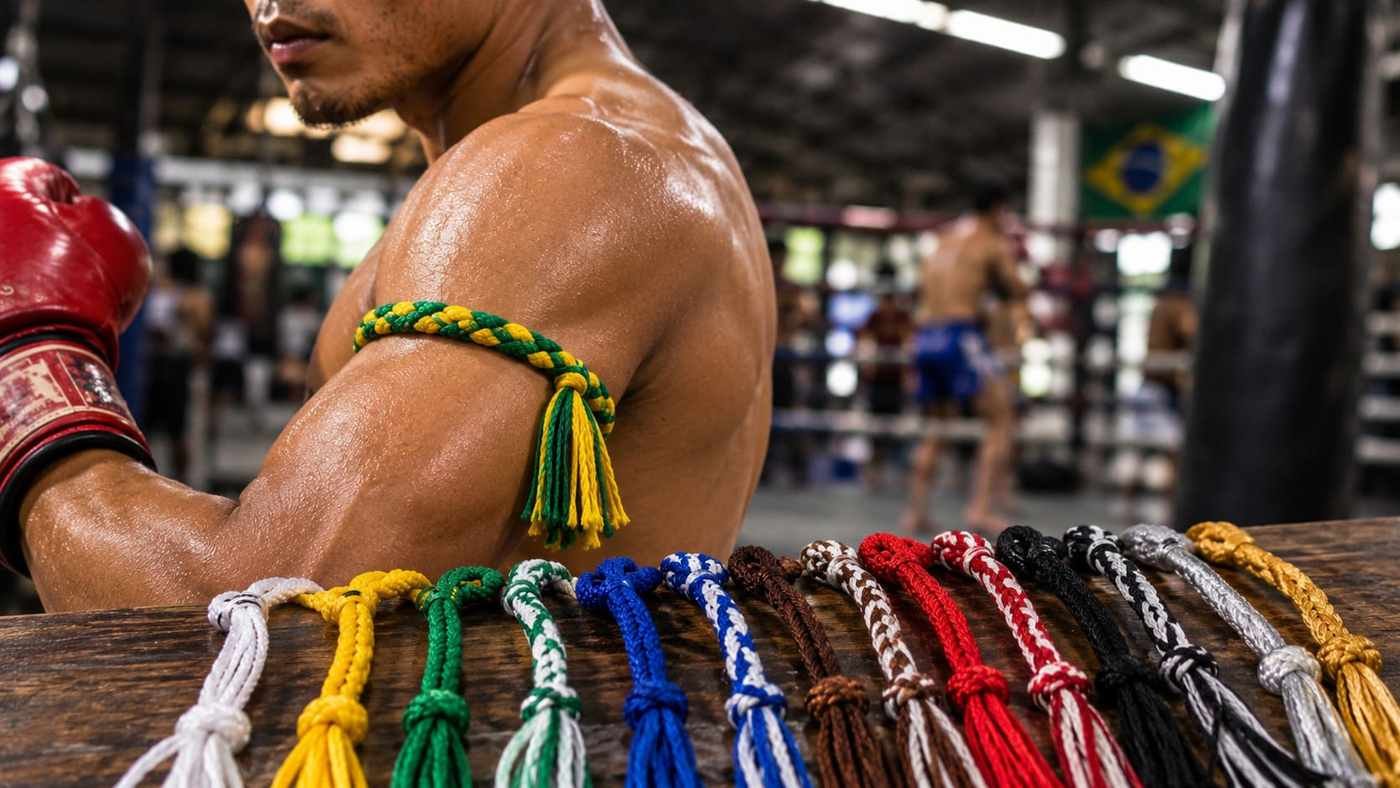
Walk into almost any Muay Thai gym in Brazil and look at the arms, not the feet. Somewhere above the elbow of most students you’ll find a braided cord in white, yellow, green, or blue, sometimes striped with a second color. That cord is the kruang, and it carries the whole Brazilian Muay Thai grading system on a few inches of rope. Nobody in Bangkok invented it. Brazil did, and the story of how a country of kickboxers ended up with sixteen colored ranks is one of the stranger and more charming chapters in the sport’s travels abroad.
I find it hard not to like the kruang. It is fussy, bureaucratic, and a little sentimental, which is exactly what happens to a fighting art when it moves to a new country and has to explain itself to parents, city councils, and school gyms.
A cord with two names
Brazilians use two words, often together. “Kruang” is the one on gym walls and exam certificates. “Prajied” (also spelled prajiad or pra jiad) is the Thai word for the cloth armband fighters wear. In Thailand a pra jiad is a blessed object, given by a teacher, sometimes holding a scrap of the fighter’s mother’s clothing or a Buddhist charm. Brazilian writers often explain the pairing this way: prajied is the cord itself, while kruang refers to the sacred, protective charge inside it. If you want the Thai side of that story in full, there’s a good explainer on mongkhon and pra jiad that covers what those objects mean in a Thai camp.
Brazil took that talisman and gave it a second job. It still sits on the upper arm (many gyms say the left, closer to the heart), but now it also tells you how long someone has trained and what they are allowed to teach.
Where the Muay Thai grading system came from
Muay Thai reached Brazil in 1979, through a teacher known as Nélio “Naja”. His first students came largely from taekwondo, and they were black belts. A roomful of people used to belts and ranks was never going to train for long without one. The first association followed in 1980, and a color sequence was worked out in those early years. Brazilian accounts say the grades were first shown on a belt around the waist before moving to the arm, where the Thai armband already lived.
Four decades on, the system has hardened into national institutions. There is more than one of them, which is very Brazilian and very martial arts. The Confederação Brasileira de Muay Thai (CBMT), the Confederação de Muay Thai do Brasil (CMTB), and a traditionalist body, the CBMTT, all grade students. Their color charts overlap heavily, and gyms usually tell you which confederation’s scale they follow.
Sixteen khans, from white to gold
Each rank is a khan, the Thai word for a step or level, and the numbers are counted in Thai: nueng, song, sam, and so on up to sib hok, sixteen. The sequence below follows the CBMT scale that most Brazilian academies publish.
| Khan | Thai count | Cord color | Level |
| 1 | Khan Nueng | White | Beginner |
| 2 | Khan Song | Yellow | Beginner |
| 3 | Khan Sam | Yellow and white | Beginner |
| 4 | Khan Sih | Green | Beginner |
| 5 | Khan Hah | Green and white | Intermediate |
| 6 | Khan Hok | Blue | Intermediate |
| 7 | Khan Jed | Blue and white | Intermediate |
| 8 | Khan Pad | Brown | Advanced |
| 9 | Khan Kaoh | Brown and white | Advanced |
| 10 | Khan Sib | Red | Advanced |
| 11 | Khan Sib Ed | Red and white | Instructor in training (Kru Fueng Sorn) |
| 12 | Khan Sib Song | Black | Assistant teacher (Kru Puh Chuay) |
| 13 | Khan Sib Sam | Black and white | Teacher (Kru) |
| 14 | Khan Sib Sih | Silver | Master (Arjarn) |
| 15 | Khan Sib Hah | Gold | Grandmaster (Arjarn Yai) |
| 16 | Khan Sib Hok | Gold and silver | Honorary grandmaster (Por Ra Ma Jarn) |
A few things jump out. The two-tone cords work like the stripes on a jiu-jitsu belt, a halfway point between solid colors. The student ranks stop at red, the tenth khan, and everything after that is a teaching credential. Black, which means “expert” in most martial arts, lands at the twelfth khan here and means you may assist in class. You need silver before anyone calls you a master.
Titles on the top rungs borrow Thai teaching words. Kru means teacher, and Arjarn (ajarn) is a senior, respected master. In Thailand those words are earned through reputation and years in a camp, a point that matters for the argument later. The layers of respect behind them, from the wai to who sits where at a gym, are laid out well in this piece on Thai gym hierarchy.
What a grading actually asks of you
The rules for moving up are modest and practical. At academies following the CBMT scale, a student needs at least 70% attendance over a three-month period before being put forward for the next cord. Three months is the usual cycle between beginner ranks, so a committed student could, on paper, go from white to green in under a year.
The CMTB adds a layer of paperwork that tells you a lot about how the system works socially:
- A fighter who wants to compete in CMTB events must be registered with the confederation and hold a current membership card.
- Registration usually runs through the coach, who affiliates the gym and then enrolls the students.
- Grades earned before a coach joined can be made official if the student is still training and renews the card.
- Ranks from another organization may be accepted, but only after the issuing body is checked. Certificates handed out by an individual, rather than an entity, are refused.
That last rule is the quiet heart of the thing. The kruang exists partly so that nobody can simply declare themselves a master. The confederation’s own site scolds, gently, the kind of teacher who thinks he knows everything and keeps his students outside the system. Grading, in the Brazilian view, is how a scattered sport stays organized.
Competition is the other reason. The CBMT uses graduation, alongside age and sex, to sort fighters into fair divisions. A yellow-cord teenager shouldn’t meet a brown-cord adult in an amateur bout, and the colored rope makes that easy to check at a weigh-in.
Brazil is not alone
Colored khans have spread well beyond Brazil. Portugal’s AITMA publishes its own graduações, and gyms in the UK, Europe, and North America run khan gradings, often through international associations. Thailand has its versions too. The Kru Muay Thai Association, for example, uses a khan sequence that starts the same way (white, yellow, yellow and white, green) but diverges at the top, with red and yellow for a full instructor and a fifteenth khan in gold. The colors are not universal, so a blue cord from one federation won’t necessarily mean the same thing at a gym across the border.
Why Thai traditionalists roll their eyes
Plenty of Thai trainers and Western purists find the whole arrangement odd, and their objection is easy to grasp. In a Thai camp nobody wears a rank. You are measured by your fights: how many, against whom, and at which stadium. A kid from Isan with 150 bouts and no certificate outranks a foreigner with a gold cord, and everyone in the room knows it.
The pra jiad, to them, is sacred and personal, never a scoreboard. Turning it into a color code tied to exam fees feels like selling a blessing by the yard. The titles grate too. A Thai kru becomes a kru because fighters keep coming to him and winning, and “Arjarn” is something other people start calling you. Granting those words at an exam flips the order.
There’s a gentler criticism as well, which is that grading can reward attendance over ability. Seventy percent of classes proves you showed up. It doesn’t prove your teep works under pressure. The broader guide to Muay Thai ranks and belts covers how the fight record still sits above any colored system for most Thai coaches.
Still, I’d defend the kruang a little. Most Brazilian students will never fight at Lumpinee. They are office workers, teenagers, and mothers training three nights a week, and a cord that turns green after a hard season gives them something to chase. Brazil has also turned out plenty of hard strikers, so the cord clearly hasn’t softened anyone.
FAQ
Is the kruang used in Thailand?
Mostly no. Thai camps rank fighters by their record, and armbands there are protective charms. Some Thai associations do run khan gradings, largely for instructors and foreign students.
How many kruang levels are there?
The CBMT scale has 16 khans: ten student ranks from white to red, then six teaching and master grades from red and white up to gold and silver.
How long does it take to change cord color?
At CBMT-aligned gyms the usual rule is a minimum of 70% attendance across three months before the next grading. Higher ranks take far longer and depend on the confederation.
Are prajied and kruang the same thing?
In Brazil people use the words together for the graded arm cord. In Thai usage, pra jiad is the armband itself and carries spiritual meaning rather than rank.
Will my Brazilian cord be recognized abroad?
Only sometimes. Color sequences differ between federations, and the CMTB itself accepts outside grades only after checking the issuing organization.