In Chaiya district, Surat Thani province, on the Gulf of Thailand, the old trail into town once passed a forest temple called Wat Thung Jab Chang, and it is there, according to nearly every account, that Muay Chaiya begins. What began there was a style of boxing built around one stubborn idea: you should not get hit.
That idea sounds obvious. In practice, plenty of Thai traditions prized the willingness to absorb a shin to the ribs and walk forward anyway. Chaiya went another way, and its keepers were proud of the difference.
A Monk Nobody Can Quite Name
The founder of Muay Chaiya has no confirmed name. Locals called him Por Than Ma, roughly “the venerable father who came,” and the records say little else. He arrived from Bangkok in the later years of King Rama III’s reign, which puts him in Chaiya somewhere around the 1840s or 1850s. Some tellings make him a former war commander who took robes and wandered south.
What people do agree on is that he taught. He trained the townspeople, became abbot of the temple, and left Chaiya known as a muang muay, a boxing town.
One story still told in Phum Riang has elephants trampling the temple gardens, then vanishing. The monk lifted a coconut shell to show the ground beneath it covered in their tracks, and the villagers swore never to let large animals onto the grounds again. I can’t tell you what was under that shell. The story does tell you how the region regarded the man. Fighters and students still travel to the stupa holding his ashes to kneel and perform the wai kru ram muay, the ritual dance of respect, before they pass.
The Governor Who Taught Boxing
A monk can start a tradition, but it takes patronage to spread one. Muay Chaiya got that from Kham Sriyaphai, a local official who rose through a series of royal titles and served as governor of Chaiya under King Chulalongkorn (Rama V). He ended his career as Phraya Wajisattayarak, and he did more than sponsor fights. He taught.
The big occasions came with the annual procession of the Buddha image in the eleventh lunar month, when crowds and officials gathered at a public rest house the governor had built in Phum Riang. Locals called it Sala Kao Hong, the nine-room pavilion. Travelers slept there. During the festival, men fought in front of it.
Those fights looked nothing like a modern stadium card.
| Element | Sala Kao Hong era (late 1800s) | Wat Phra Borommathat ring (from 1931) |
| Fighting area | Bare earth, four posts, thick hemp rope | Raised concrete-edged ring, earth fill covered with rice husk and hessian, later canvas |
| Hand protection | Raw cotton cord wound over cloth | Gloves |
| Matchmaking | No weigh-in, opponents paired by eye | Formal pairings |
| Rounds | Five rounds, fought in rotation between all pairs | Each pair fought its five rounds straight through |
| Timekeeping | A pierced coconut shell floating in water, a drum when it sank | A clock and a school bell |
| Music | Pi (oboe) and long drum | Pi and long drum |
| Admission | Free, prize money came from the governor | Paid entry, funds went to the temple |
The rotation worked like this. With five or six pairs on the day, each pair fought one round and retired to its shelter while the next pair went out, and the first pair returned for round two only after everyone had fought once. A pair that finished early, by knockout or surrender, dropped out of the cycle.
Cord, Cloth, and the Pra Jiad
Chaiya fighters wrapped their hands in the manner that historians now group under the name kard chuek, and if you want the wider background, there is a good account of fighting with rope-bound fists across old Siam. The Chaiya version had its own details, though.
Each fighter received a thick roll of raw cotton, which friends split and cut into lengths of roughly four to five meters. The first layer was smooth cloth. Over it went cotton twisted until it formed knots, then more cloth, then more knotted cotton, alternating for several layers. The wrap stopped at the wrist and reached only to the first knuckle of the fingers, so the hand could still close into a solid fist. A wrap pulled too tight kept the fist from clenching, and a loose fist broke fingers on impact.
That wrist-length wrap is the telling detail. Korat fighters from the northeast bound their arms nearly to the elbow, using the forearm as a shield. Lopburi and Bangkok-area boxers wrapped to mid-forearm. Chaiya kept the arm bare above the wrist, which says something about how its fighters expected to defend: with angles, footwork, and the structure of the guard rather than with padded forearms.
The headgear marked a Chaiya fighter too. Fighters from other regions wore the circular mongkol headpiece. The Chaiya pra jiad was flat, inscribed with protective incantations, and had a practical job as well: it kept hair out of the eyes. If it came loose mid-fight, a fighter could raise his hand and ask to put it back on.
What Makes Muay Chaiya Defensive
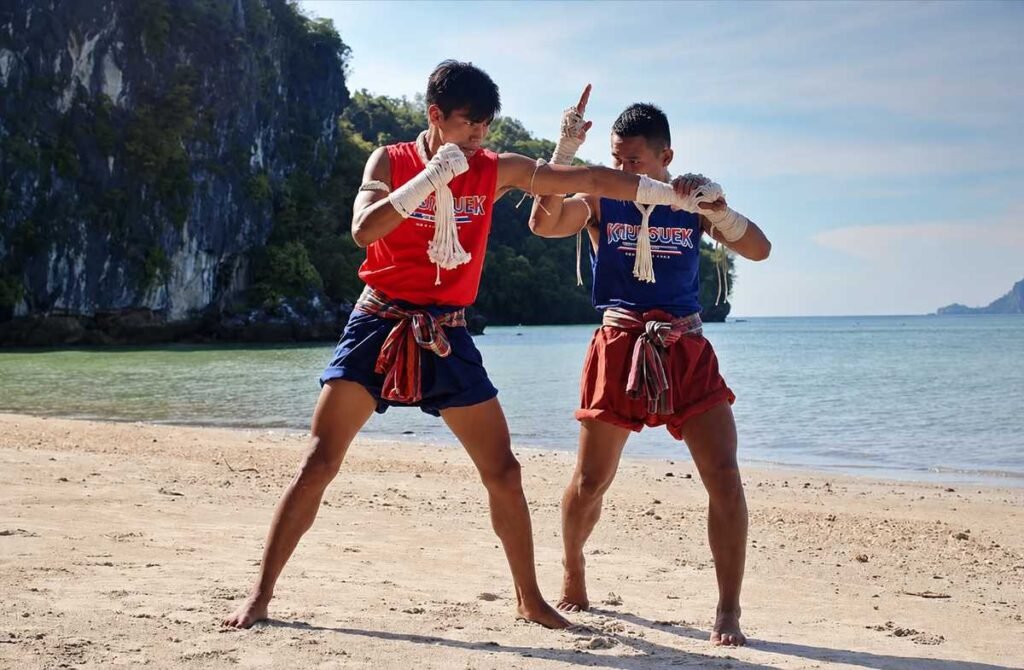
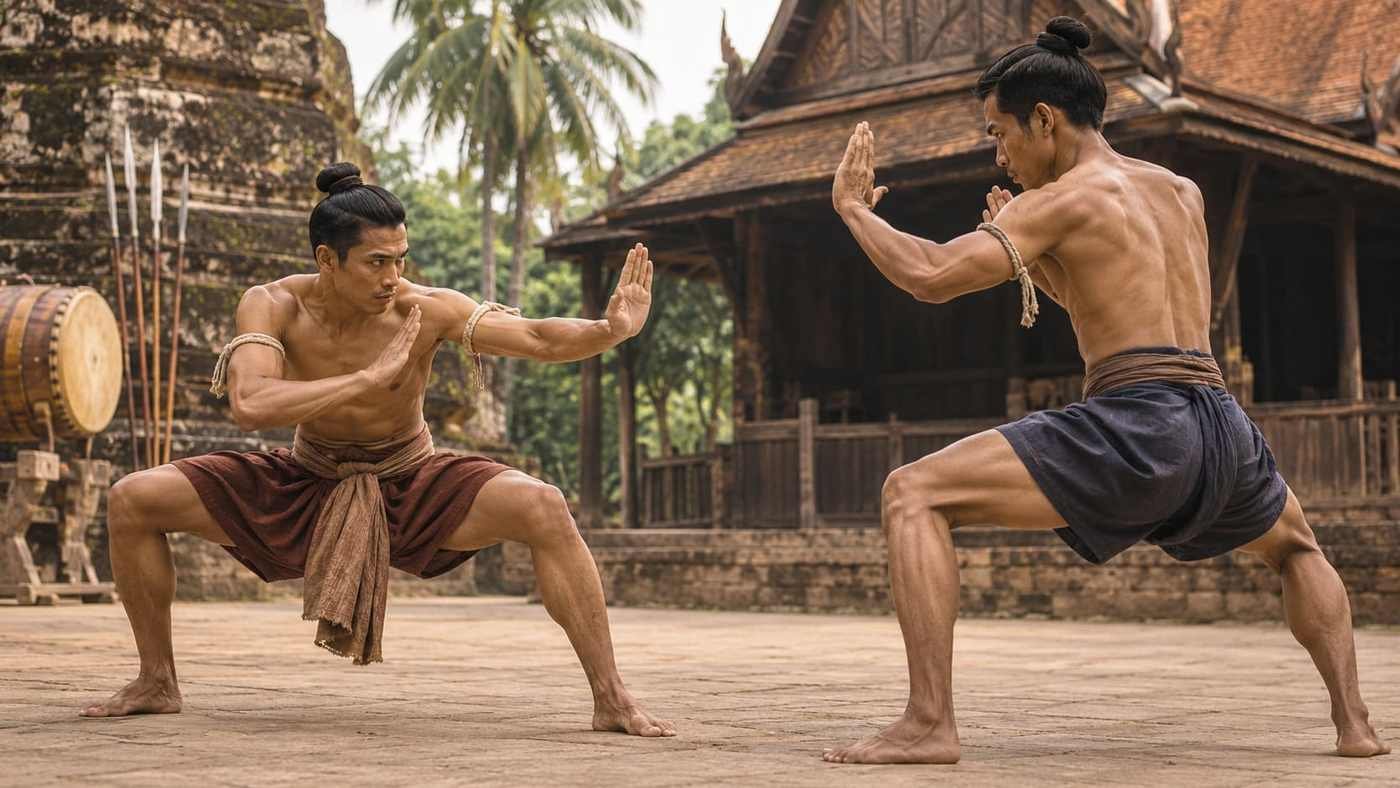
The Muay Chaiya stance sits low, and the arms form a tight triangle in front of the body. Anyone familiar with the classic Muay Thai guards will notice how much more closed it is than the tall, upright guard seen in stadiums today. Everything is tucked. The elbows cover the body, the forearms frame the head, and the fighter presents as small a target as possible.
Underneath that guard runs the footwork, yang sam khum, which translates roughly as “the three-point step.” Yang means to walk or step, sam is three, and khum refers to a point or position. The fighter moves between three foot positions to switch his lead and change angle, and the aim is speed and precision rather than distance. Khet Sriyaphai, the governor’s youngest son and later the most famous teacher of the style, wrote in his book on Muay Thai that the three-point step taught at Bangkok’s Suan Kularb school in the 1920s matched the tight, economical form taught by the old monk in Chaiya.
The full teacher’s stance carries a grander name, yang sam khum khlum daen yak, “the three-point step that covers the giant’s ground.” Khet also described ngai mat, a guard with the fists turned upward that he said set Chaiya apart from every other region. It has since disappeared from the modern ring.
Defense in the system comes down to evading, pushing away, and blocking. Students drill pong, pad, pid, and perd: protecting, deflecting, closing a line, and opening one. Readers who want the modern equivalents for each weapon can compare this with a breakdown of defending against all eight limbs. The principles overlap more than the terms suggest.
Throw, Pin, Grab, Break
A purely defensive art would lose most fights. Chaiya’s answer to an incoming attack was not just to survive it but to catch it. The Thai sources describe an advanced layer called tum tub jub huk: throw, pin, grab, break. It is taught only after a student has absorbed the conditioning, the teacher’s version of the three-point step, and the basic attacks and defenses, and then drilled them until the responses come without thought.
The named counters give a sense of the logic.
- Suea lak hang (“tiger drags its tail”): a lunging entry to seize the opponent and take him down.
- Thon yuang: a catch used against kicks, push kicks, and knees, which lets the defender throw the attacker, then press his head toward the ground and pin him with a knee or the hips.
- Khun yak pa nang and khun yak jab ling (“the giant carries off the lady,” “the giant catches the monkey”): answers to punching attacks.
- Phra Ram hak sorn (“Rama breaks the arrow”): the counter to an elbow.
The most celebrated use of this material came before King Chulalongkorn himself, at a royal exhibition held at Thung Phra Men in Bangkok. Governor Kham sent his best fighter, Plong Jamnongthong. Plong is said to have used the tiger-drags-its-tail entry to catch, throw, and pin a strong opponent from Korat. The king rewarded him with the title Muen Muay Mee Chue, roughly “the famed boxer.” Back home, 25 members of his boxing group were excused from the head tax, and Chaiya’s registered boxers skipped the unpaid labor levies everyone else owed. In return they had to train for real, and a man who dodged training was struck from the rolls.
The Long Decline, and Who Carried It North
Chaiya boxing moved to a new ring at Wat Phra Borommathat after the provincial seat shifted to Ban Don and the old pavilion fights ended. The temple ring, completed in 1931 for about 500 baht, hosted well-known names, Jamroen Songkitrat among them. It came down on 12 October 1981 to prepare the grounds for a royal visit. The Thai-language history is blunt about what followed: the scene weakened for lack of real sponsors, and gambling began deciding fights more than skill did.
The style survived largely because a few teachers carried it to Bangkok. Khet Sriyaphai taught it in the capital. Sunthorn Thaweesith, known as Ajarn Kimseng, taught boxing in government schools, and the forms of the phrom si na and yang suk kasem ritual movements spread through his many students, and fighters still perform them in the ring. Thonglor Yalae, called Khru Thong, trained under both men and from 1982 taught the old rope-bound approach to university clubs at Ramkhamhaeng and later Chulalongkorn. He died on 19 September 1996.
Today’s lineage runs through teachers such as Khru Praeng (Napaphop Pramuan), Khru Lek (Kridakorn Sodprasert), and Khru Lamp (Sakkapoom Chuthaphongtham). Some of their students have tested the style in amateur MMA events in Thailand, partly to answer the charge that Muay Chaiya is only for demonstration. The old men of Phum Riang would have told you to watch the feet and the elbows, and to notice who is still standing untouched in round five.
FAQ
What is Muay Chaiya?
Muay Chaiya is a traditional southern Thai boxing style from Chaiya district in Surat Thani province. It is known for a low stance, a tight triangular guard, the three-point step called yang sam khum, and counters that catch, throw, and pin an attacker.
Is Muay Chaiya purely defensive?
No. Its reputation rests on defense, but the system includes all the standard strikes plus an advanced layer of throws, pins, grabs, and joint breaks known as tum tub jub huk.
How did Chaiya fighters wrap their hands?
They wound raw cotton cord over layers of cloth, alternating smooth and knotted layers, and stopped at the wrist. Korat fighters wrapped nearly to the elbow, and central Thai boxers to mid-forearm.
Who made Muay Chaiya famous?
Governor Kham Sriyaphai promoted and taught it, and his fighter Plong Jamnongthong won the royal title Muen Muay Mee Chue before King Rama V. Later, Khet Sriyaphai, Ajarn Kimseng, and Khru Thong carried the style to Bangkok.