
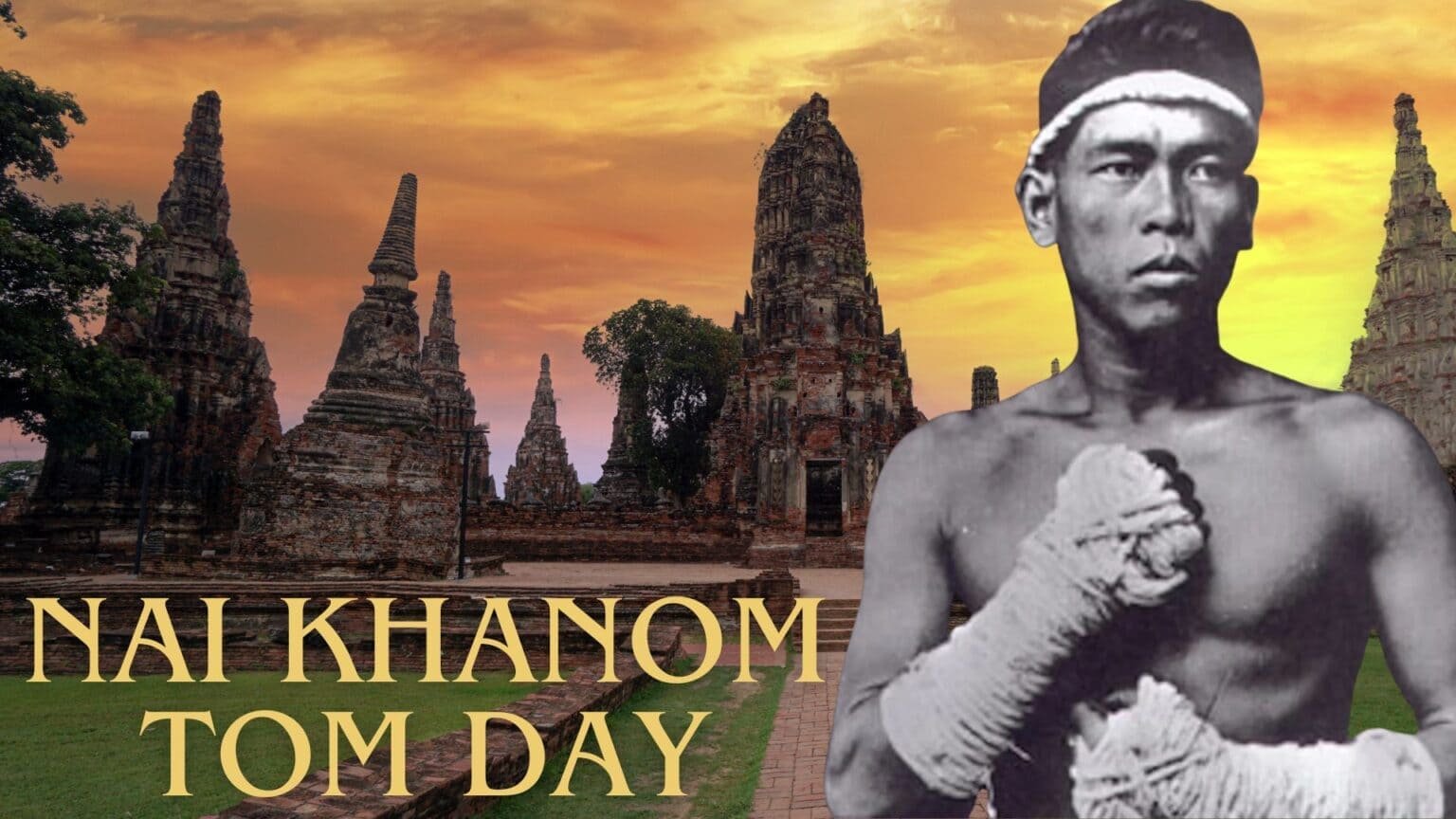
The gold umbrella went up on the morning of March 17, 1774. It had seven tiers, and the Burmese records claim it carried 15,038 gems. The king of Ava had ordered it raised onto the spire of the great pagoda in Rangoon, the one now called the Shwedagon, and he intended the celebration to be remembered. It was. Just not for the reason he expected. Thai tradition says that during those festivities a captive fighter named Nai Khanom Tom stood before the throne and beat ten Burmese and Mon boxers in a row with nothing but his hands, and that single afternoon is why Muay Thai people across the world now mark March 17 as their day.
What follows is the story as the Thai sources tell it, and then the harder question of how much of it actually happened.
A City Burned, a Boy Taken
Seven years earlier, in April 1767, Ayutthaya fell. The Siamese capital had stood for four centuries, and the Burmese armies that broke it did so thoroughly: temples burned, the royal line scattered, and tens of thousands of people marched north and west as prisoners. King Ekkathat, the last ruler of the city, died in the chaos of its fall.
Somewhere in those columns of captives, according to the legend, walked a young man already known as a good boxer “from the time of the old capital.” His name translates oddly into English. Khanom tom is a sweet, a small boiled dumpling of rice flour and coconut, and Nai is simply “Mister.” Mister Dumpling. It sounds like a joke until you remember that Thai nicknames are often given in childhood and stick for life, and that the man carrying this one was about to fight for the reputation of a country that, on paper, no longer existed.
The local government of Bang Ban district in Ayutthaya province gives him a full biography. He was born on a Tuesday in the second lunar month of 1750, in the village of Ban Kum. His father was Nai Koed, his mother Nang Ii, and he had one sister, Nang Ueay, killed by Burmese soldiers when she was small. By about the age of ten he had lost both parents the same way and was living at a temple, where he began training in boxing as a teenager. When the city fell, he was swept up with everyone else.
Hold on to that biography. It matters later.
March 17, 1774: The Fight Before the Throne
Here is the scene the Thai royal chronicle describes, in the manuscript known as the Phonnarat recension from Wat Phra Chetuphon (the temple most visitors know as Wat Pho).
The king of Ava is in Rangoon. The work on the great relic pagoda is finished, the umbrella has been raised, and a celebration is under way. Burmese nobles tell the king that Thai boxers are extraordinarily skilled. Intrigued, he orders one found and brought to him. They produce Nai Khanom Tom.
A Burmese boxer is matched against him, and the bout takes place in front of the royal seat. The chronicle is blunt about the result: the Burmese fighter loses before a single round is complete. The king sends in another. And another. Burmese and Mon fighters come forward, and the chronicle counts them loosely, as “nine or ten.” None of them can handle him.
Then comes the line every Thai schoolchild knows, here in paraphrase. The king, watching, raises his hand and strikes his own chest in admiration. The Thais, he says, have venom in every part of the body. Even bare-handed, with no weapon at all, one man can beat nine or ten. And he adds something far sharper: the Thais lost their city only because their rulers were poor ones. With good leaders, how could Ayutthaya ever have fallen? He then rewards Nai Khanom Tom “as was fitting.”
Notice what the chronicle does not say. There is no list of prizes, no freedom purchased with fists, no pair of wives. Those details belong to later retellings. The earliest written version ends with a reward of unspecified size and a king’s backhanded compliment that is really an insult aimed at the old Siamese court.
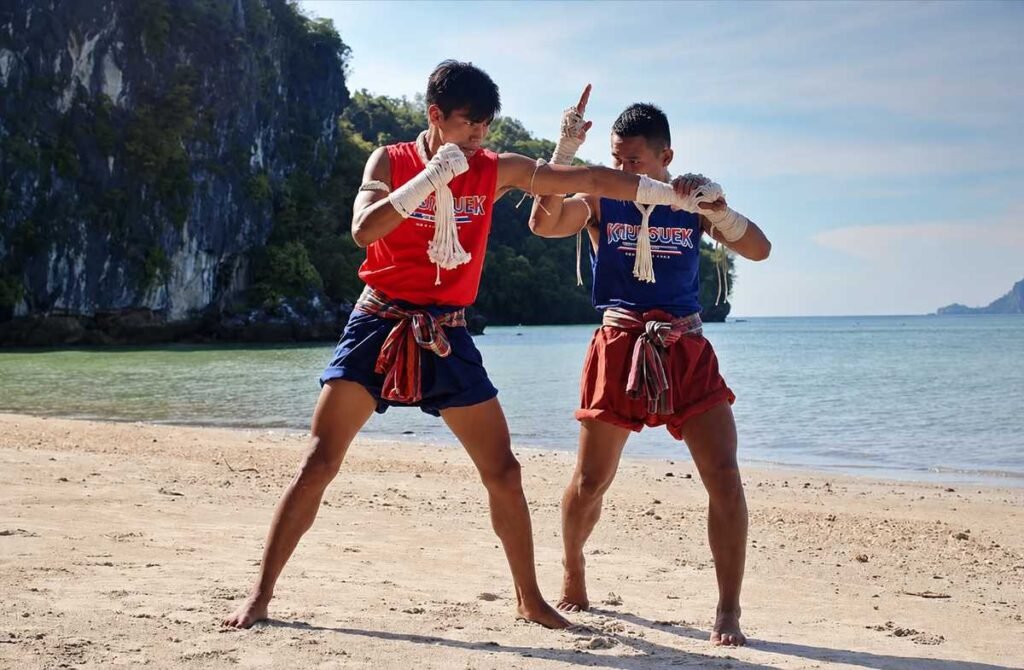
It helps to picture the fighting itself. Boxers of that era fought in the style called muay kaad chuek, with hemp rope wound around the hands and forearms instead of gloves. No ring ropes, no rounds timed the way modern bouts are, no weight classes. Popular versions add a scene in which Nai Khanom Tom performs a slow ritual dance before the first bout and the Burmese crowd mistakes it for sorcery. The chronicle mentions nothing of the kind, but the idea is plausible enough that it stuck, and the wai kru ritual still opens nearly every traditional bout.
What the Records Actually Show
Now the uncomfortable part. Nai Khanom Tom appears first, and essentially only, in that Thai chronicle manuscript. The famous printed edition that most Thais grew up with, the Royal Autograph recension, was revised later and copied the episode straight from the Phonnarat text. It is one source, repeated.
The Burmese side kept its own records of the same event, and they are detailed. They simply do not include him.
| Source | What it records about March 1774 | Does Nai Khanom Tom appear? |
| Thai royal chronicle, Phonnarat manuscript (Wat Phra Chetuphon) | Hti-raising festival in Rangoon, boxing before the king, one Thai beats nine or ten opponents | Yes, the earliest known account |
| Thai royal chronicle, Royal Autograph edition | Same episode, taken from the Phonnarat text | Yes, copied |
| Hmannan Yazawin (Burmese Glass Palace Chronicle) | King Hsinbyushin restores the Shwedagon, gilds it with gold equal to his body weight, raises a seven-tier gold umbrella set with 15,038 gems on the full-moon day of Tabaung, 1136 (March 17, 1774) | No |
| Testimony of the Ava people | The umbrella raising in 1774 and the execution of a Mon lord | No |
| Mon and Burmese chronicles | Largely the same events | No |
So the date is solid. The festival happened, the king was there, and the umbrella went up on the day the Thai tradition names. The Burmese scribes, who had every reason to record the triumphs of their king’s great ceremony, wrote about gold and gems and a Mon noble’s death. A foreign prisoner beating a string of local fighters is exactly the kind of embarrassing detail a court chronicle would leave out, which is one explanation. The other is that it never happened. Historians have not settled it, and the evidence available today does not let anyone settle it honestly.
The biography is shakier still. In 1986 the poet Khomthuan Khanthanu, a winner of the SEA Write Award, published a novel about Nai Khanom Tom. He placed the boy’s birth in Ban Kum, gave him parents named Nai Koed and Nang Ii and a sister named Ueay, and had him raised at a temple by an old monk before an unnamed stranger taught him to fight. Those are the same family details the Bang Ban municipality now presents as history. A novelist filled a gap in the record, and the gap closed around his invention.
None of that makes the legend worthless. It tells you what Thais needed a hero to be in the years after 1767: captive but unbowed, stripped of a country and still carrying its skill in his body.
How a Chronicle Episode Became a National Day
March 17 was long set aside in Thai boxing circles as “Boxers’ Day,” a date of honor for Muay Thai fighters, and the Bang Ban page says the same. The logic is simple: the day of Nai Khanom Tom’s victory became the day of every fighter’s pride.
Thailand also celebrates Muay Thai on February 6, a date tied to King Suriyenthrathibodi of Ayutthaya, the ruler remembered as the “Tiger King” who, legend says, fought incognito in village boxing matches. Gyms and promoters outside Thailand often blur the two, and many simply call both National Muay Thai Day. If you train abroad, you are most likely to hear about March 17, because the Nai Khanom Tom story is easier to tell in one breath.
For the broader arc, from battlefield skill to modern stadium sport, the full history of Muay Thai covers what came before and after this single afternoon in Rangoon.
Bronze, Television, and a Stadium Star in the Role
The people of Ayutthaya did what communities do with a hero: they cast him in bronze. One monument stands at the provincial central stadium in Ayutthaya. The residents of Ban Kum built their own, 2.4 meters tall, in front of the Wat Chulamani school in Bang Ban district, meant, in the words of the local notice, as a reminder and an example for Thai children.
Popular culture did the rest. After the 1986 novel came screen versions, and the casting of one of them says a lot about what the legend means inside the sport. In 1996 the Thai television drama Nai Khanom Tom put Somrluck Kamsing in the title role. Somrluck had become a national celebrity that same year by winning Olympic boxing gold in Atlanta, Thailand’s first Olympic gold medal. Choosing him made the connection explicit: the modern champion playing the ancestral one. He also came up through the stadium culture that peaked in the decades covered in a look at Muay Thai’s golden era, when the sport’s best fighters were household names across the country.
A feature film followed in 2003, and the story has been retold in comics, school textbooks, and gym murals ever since.
Marking March 17 If You Train
In Ayutthaya, the day usually brings ceremonies at the monuments, group wai kru performances, and exhibition bouts. Abroad, the day is quieter. If your gym does nothing for it, a few ideas carry the spirit without turning it into a costume party:
- Open the session with a wai kru. Even a short, simple version connects the day to the ritual it grew up beside.
- Try a round with wrapped hands and no gloves, on pads only. You will feel quickly why rope-bound fighters valued elbows, clinch, and short, accurate strikes over wild swings.
- Tell the story honestly. The legend, the Burmese silence, the 1986 novel. Students tend to find the uncertainty more interesting than a tidy myth.
- Fight the ninth round. The romance of the tale is the ninth and tenth opponent, when a tired man keeps going. Finish class with one extra round after everyone thinks it is over.
The chronicle gave Nai Khanom Tom one afternoon, a handful of sentences, and a king’s grudging praise. Every March 17 since, fighters have given him the rest.