
Most people who train for a year and still freeze in sparring have not been lazy. They have been busy. They hit the bag, they ran the combinations the coach called, they sweated through the shirt, and none of it asked them a question. A fight is nothing but questions, fired at you faster than you can think. Good Muay Thai drills are the only honest rehearsal for that, because each one forces a decision under a little pressure and then makes you repeat it until the decision stops being a decision.
What follows is not a list of combinations. Combinations are sentences you memorize. Drills teach you to hear the other man speak and answer him. There are twelve here, grouped by the problem they solve: reaction, defense, clinch, and feet. Some need a partner. Some need only a wall and a stubborn mind.
The Twelve Muay Thai Drills at a Glance
| # | Drill | Solo or partner | What it builds | Suggested dose |
| 1 | Coach’s call pads | Partner | Reaction to a visual cue | 3 x 3 min |
| 2 | Tap-and-counter | Partner | Counter timing | 3 x 2 min |
| 3 | Mirror teep | Partner | Distance reading | 2 x 3 min |
| 4 | Eyes-open slip line | Solo | Head movement, composure | 3 x 2 min |
| 5 | Kick-check-return | Partner | Leg defense, instant reply | 4 x 2 min |
| 6 | Catch and sweep | Partner | Punishing the body kick | 3 x 2 min |
| 7 | Wall guard | Solo | Tight elbows, frame | 3 x 1 min |
| 8 | Neck-fight rounds | Partner | Grip fighting in the clinch | 4 x 2 min |
| 9 | Knee ladder | Partner | Knees off a controlled head | 3 x 1 min |
| 10 | Line walk and pivot | Solo | Stance under movement | 3 x 3 min |
| 11 | Corner escape | Partner | Getting off the ropes | 3 x 2 min |
| 12 | Play sparring | Partner | Everything, live and light | 3 to 5 x 3 min |
The doses are starting points for a beginner or early intermediate. Double them when the movement gets boring, which is the signal that it has finally become yours.
Reaction Drills: Teaching the Body to Answer First
1. Coach’s call pads
A pad holder who calls “jab, cross, kick” out loud is feeding you a recipe. Take the words away. The holder simply shows a target, and you strike what appears: a pad at the face means a punch, a pad on the thigh means a kick, a pad pulled to the chest means a knee. Then the holder starts swinging back, a slow round kick or a jab, and you must defend before you are allowed to hit again.
The same logic runs underneath a real Thai trainer’s session, and anyone curious how that feels over a full stretch should read about five rounds with a Thai trainer. The pads are a conversation, not a menu.
2. Tap-and-counter
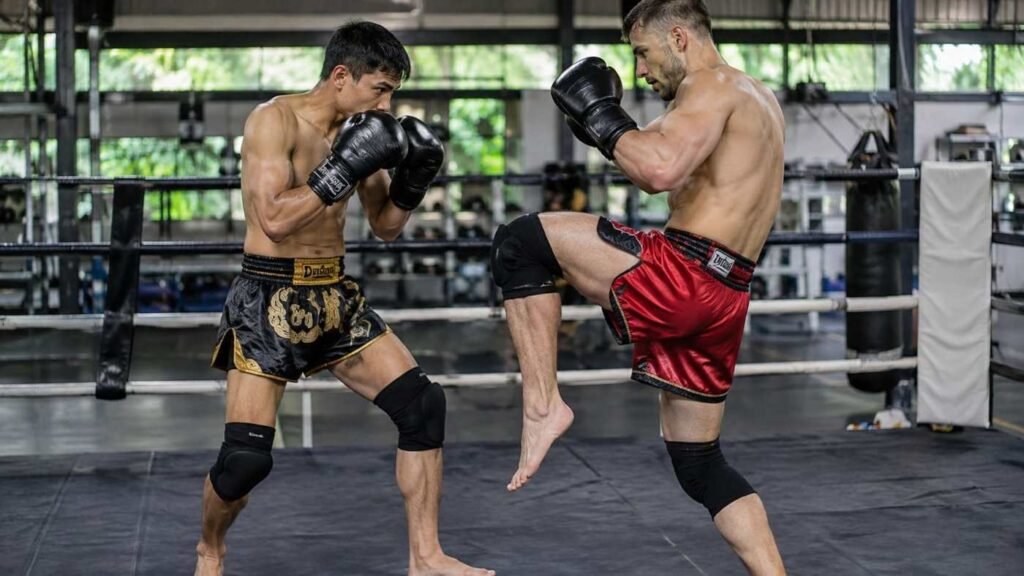
Both fighters in gloves, standing in range. One throws a light jab. The other parries or slips it and fires back a single counter, cross or low kick, then resets. Swap roles every thirty seconds. The rule that matters is that the counter must land within a heartbeat of the defense. Late counters are just second attacks, and a sharp opponent sees them coming across the room.
3. Mirror teep
One partner moves, forward, back, circling, and the other must hold the exact distance where a teep would land on the belly. When the leader steps in carelessly, the follower teeps, lightly. It sounds tame. Two minutes of it will tell you more about your sense of range than a month of heavy bag work, because the bag never walks into you.
Defense Drills: The Part Everybody Skips
4. Eyes-open slip line
Tie a rope or a resistance band across the room at shoulder height. Walk its length in stance, dipping under it and rolling from side to side, and throw a punch each time you come up. Keep the eyes on the far wall the whole time. The real enemy here is blinking and looking at the floor, two habits that sparring will punish without mercy.
5. Kick-check-return
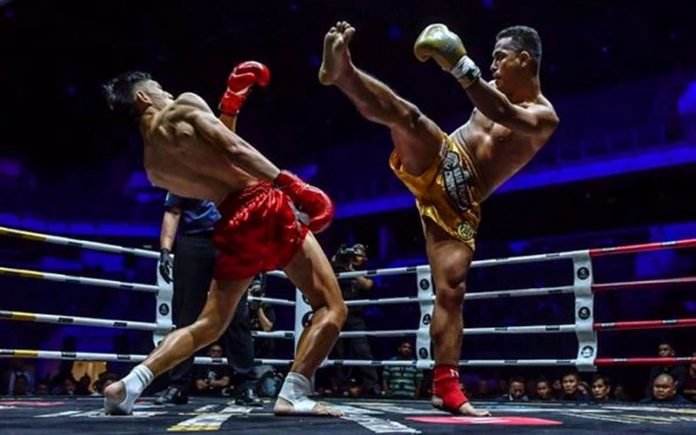
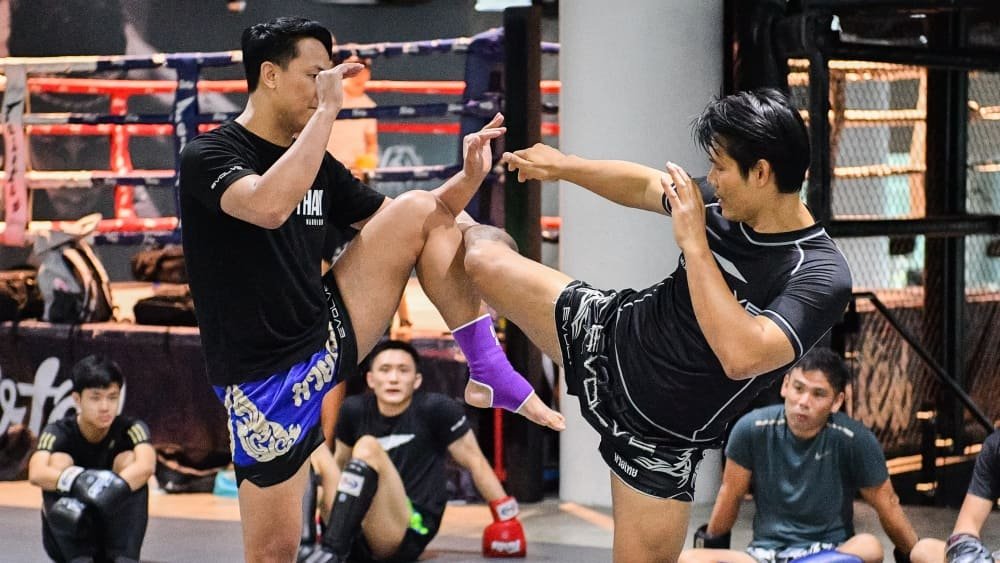
Your partner throws a medium-power round kick at the leg or body. You lift the shin to meet it, knee turned out slightly, then plant and return a kick of your own off the same side before the partner has recovered. The check is only half the skill; the return is what makes a kicker think twice. Before you start this one, get the mechanics straight with a guide on checking a kick properly, because a lazy check with the foot flexed wrong hurts more than eating the kick.
6. Catch and sweep
Here the partner kicks to the body at half speed and you trap the leg, forearm under the calf, the other hand on the shoulder or the ankle. From the catch you have options: a sweep of the standing leg, a straight punch while he hops, or a push that sends him stumbling. Thai fighters score heavily on this in real bouts, since a kick caught and a man dumped on the canvas is the sort of thing judges remember. Go slowly. Nobody should hit the mat hard in practice.
7. Wall guard
Stand side-on with your back half an inch from a wall and throw punches without the elbows touching it. This is solo work and it is dull, and it fixes the flared elbow that opens the ribs to every knee in the gym. One minute a round is plenty. The burn in the shoulders arrives sooner than you expect.
Clinch Drills: Where Fights Are Actually Won in Thailand
The clinch deserves more of your week than most Western gyms give it. Thai camps spend long blocks every afternoon locked up, and fighters there treat it as the true measure of a man’s strength and cunning. The grip you are fighting for is the double collar tie, often called the plum: both hands stacked behind the opponent’s head, elbows squeezed into his collarbones. From it, the straight knee (khao trong) goes up the middle.
8. Neck-fight rounds
No knees at first. Two partners lock up and do nothing but fight for position: swim an arm inside, break the posture, turn the partner, win the inside lane. When one fighter gets a clean double tie, he holds it for a two-count, then both reset. Neck-fight rounds tell you whether your neck and your patience are ready. Most beginners discover that neither is.
9. Knee ladder
One partner holds a tight plum on the other, who wears a belly pad or holds a kick shield against his stomach. The knee fighter throws ten straight knees, left and right, pulling the head down into each one, then eight, then six, down to two. No rest between rungs. The ladder teaches you to keep your posture tall and your hips driving forward when your lungs are asking you to stop. The man being kneed learns to keep his frame, which is its own quiet education.
Footwork Drills: The Stance Has to Travel
10. Line walk and pivot
Put a strip of tape on the floor. Stand with your lead foot on one side and your rear foot on the other, the width of your shoulders apart. Step forward, back, and pivot off the lead foot at the end of every length, throwing a round kick as you finish each turn. If your feet cross the tape, you were off balance and you know it. Two rounds of this before class sharpen the stance more than any warmup jog.
11. Corner escape
One partner walks the other backward into a corner or against the wall of the gym, throwing light punches. The fighter on the ropes has to get out without running: angle off with a pivot, slip and step to the open side, or frame and teep his way back into the middle. Count how many times you get out cleanly in two minutes. The number will be embarrassing at first. Good.
Drill 12: Play Sparring, the Reward at the End
The Thai word for sparring starts with len, which means “to play,” and that tells you how it is done in the camps. Fighters who compete often spar light, frequently, and with a grin, because they are saving the damage for fight night when they are paid for it. The contact is just enough to show your partner where his guard has opened.
Every drill above gets tested here. Three minutes of light, honest exchanges, no ego, 50% power at most. If you catch yourself loading up on a big right hand, you have stopped playing. Back off, laugh it away, and let the other fellow find his rhythm too. The point of play sparring is volume of decisions, and you only get volume if neither of you is hurt.
A Few Hard Rules for Getting Anything Out of This
- Drill slower than feels heroic. Speed without the right shape only builds a fast mistake.
- Switch roles every round. The man holding, feeding, or leading learns nearly as much as the man working.
- Let the feeder be honest. If your partner never throws back, the drill is a pad session with a nicer name.
- Keep a short log. Write down which drill fell apart and why. Next week, start there.
The feeder’s job is badly underrated, and it is where most partner drills die. Someone who holds pads flat, drops them early, or swings back wildly turns a sharp drill into chaos. If you are new to that side of the work, spend ten minutes on holding Thai pads well before you volunteer; your partner will thank you, and so will his shoulders.
How to Fit the Twelve Into a Normal Week
Nobody needs all twelve in one session. Three training days is enough to rotate through them and see real change in a couple of months. Here is one way to build it:
| Day | Warmup (solo) | Main block (partner) | Finisher |
| Monday | Line walk and pivot, wall guard | Coach’s call pads, tap-and-counter | Play sparring, 3 rounds |
| Wednesday | Eyes-open slip line | Kick-check-return, catch and sweep, mirror teep | Knee ladder |
| Friday | Line walk and pivot | Neck-fight rounds, corner escape | Play sparring, 3 to 5 rounds |
Keep the rest between rounds to about a minute, which is a little less than the two minutes a fighter gets between rounds in a professional bout. Shorter rests make the drills harder, and harder is the idea. After six weeks, take a fresh look at your log, drop the drill you have mastered, and double the one that still makes you look foolish. That one is where your fighting is hiding.