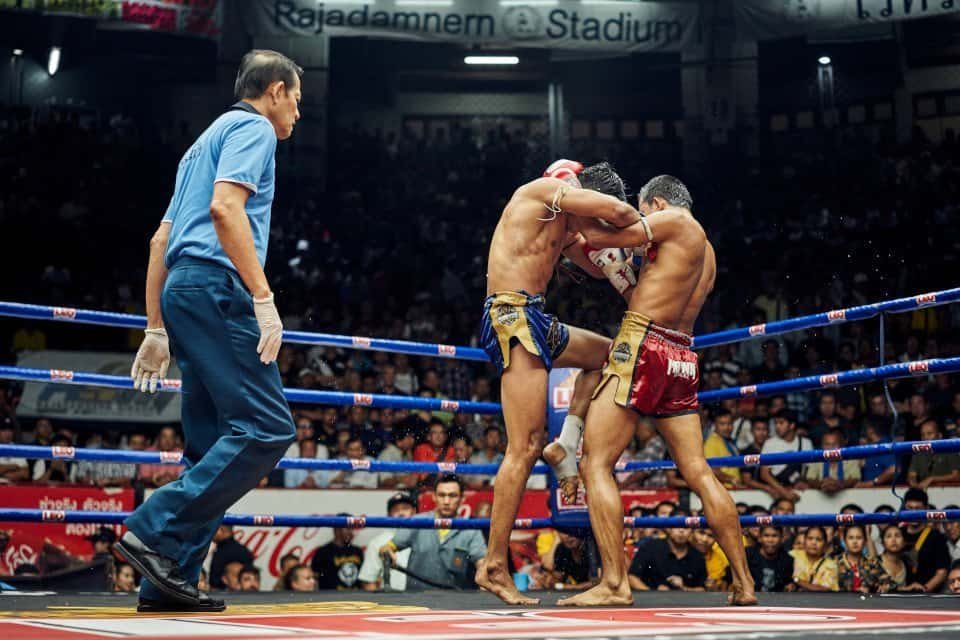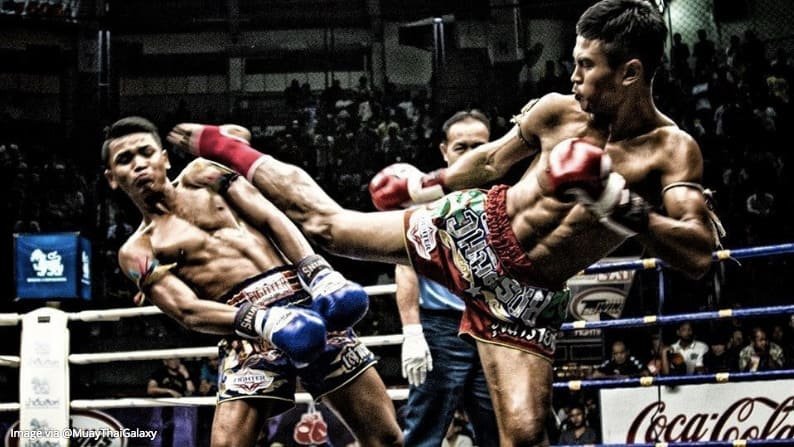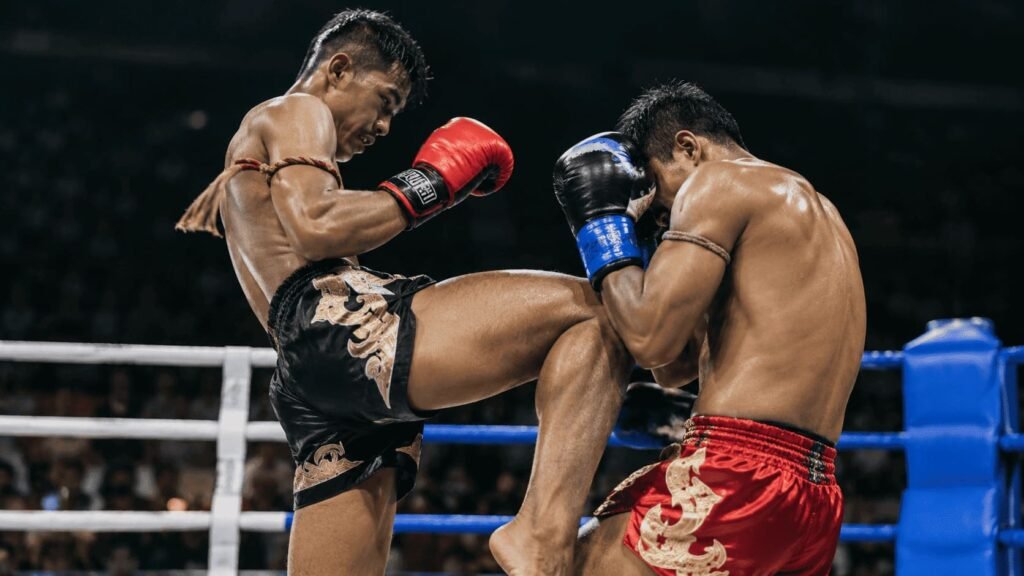


He taps the two pads together and points at your lead leg. That is the whole instruction for the next three minutes. Nothing gets called out, nothing gets counted in English, and there is no chain of eight strikes to memorize. You throw a left kick, he shifts the pad about an inch, you throw it again, and somewhere around the fortieth one he makes a short noise that means the shin finally landed where he wanted it.
Anyone whose idea of muay thai pad work comes from short videos finds this baffling. The clips that travel are the ones where a holder feeds a fourteen-strike sequence with a spinning elbow buried in the middle of it and the fighter hits every pad clean at full speed. Those clips are choreography, and choreography has real uses: it trains rhythm, memory, and the confidence to keep punching when you are tired. What a Thai trainer does with you at four in the afternoon looks nothing like it, and understanding the gap is probably the single most useful thing a trainee in their first year can pick up.
Where the pads sit in the day
A Thai gym runs two sessions. Morning starts with a run somewhere between 6 and 7, then rope for fifteen or twenty minutes, then shadow. The afternoon session usually kicks off around 3:30 or 4 and follows the same shape. Rope, shadow, and then the bag, and you stay on the bag until a trainer looks up and waves you into the ring. That wait might be four minutes. It might be twenty-five. Nobody books a slot, and asking for one marks you as new.
Once you climb through the ropes you get four or five rounds. Most gyms run three minutes with a minute of rest, though plenty of trainers run five-minute rounds and cut the break short when they feel like it. The clock is a suggestion. He decides when the round ends, when the session ends, and whether you get an extra round because your right kick was falling apart. Clinch and conditioning come afterward, which is deliberate: pads happen while you still have something in the tank.
Round one: he is reading you, not training you
Single strikes only. Jab, cross, teep, one kick per side, nothing stacked together. It feels like a waste of a round if you came in wanting to work.
He is doing an assessment. Which side you favor. Whether your right kick lands with the shin or with the top of the foot. Whether your left hand drops six inches every time you throw that right kick. How long your balance takes to come back after you miss. By the end of three minutes he has decided what the session is about, and if the kick is genuinely bad he may spend the entire round on that one kick and nothing else. Boring is the point. A hundred left kicks with a small correction on rep forty is worth more than a hundred and twenty strikes spread across nine techniques.
Here is where a lot of guides oversell the Thai session. A trainer who is bored, underpaid, or holding for his fifth tourist of the afternoon will stand there with the pads at chest height and let you flail for fifteen minutes. That happens, it happens at famous gyms, and a good coach in Ohio who actually watches you is better than a disengaged legend in Bangkok.
Round two: two strikes, and what the pad angle is telling you
Now things get combined, but barely. Kick-cross, jab-kick, teep-cross, cross-hook. Two beats, occasionally three.
The instruction stops being verbal and becomes the pad. Held flat and turned slightly toward you at rib height, it wants a round kick that travels through the target. Lifted and angled down, it wants the head kick. Dropped low with the flat face toward the floor, it wants a knee going up rather than a knee driving forward. Your job is to read the pad and answer it. Trainees who watch the trainer’s face instead of his hands end up throwing the strike they planned rather than the strike being asked for, which is the same bad habit that gets you countered in sparring.
You will hear counting in Thai, so learn the first five: neung, song, sam, see, ha. When a kick lands properly you may get “suay,” which means beautiful and is about as much praise as the format allows. Chase it.
Round three: the round where he starts hitting back
Everyone remembers this round. After your cross, a pad swings at your head, so your hand comes back or you wear it. He teeps you in the stomach mid-combination. He shoves your shoulder after a kick to see whether you land balanced or hop sideways like a flamingo.
The pressure is the whole point. Pad work that never punishes you teaches you to drop your guard at speed, because there is no cost. Three or four returns a round changes how you finish every combination, permanently. You will get caught, it stings a bit, and the correct response is to keep going rather than to stop and laugh, which is the reflex most Western students have to unlearn.
Round four: knees, and the belly pad
He straps on the belly pad or hugs a kick shield to his midsection and the session changes character. Long knees walking forward across the ring. Then he catches your neck, pulls your head down, and you knee off the clinch position with your posture already compromised, which is where knees from the clinch actually get thrown in a fight.
Twenty or thirty knees in a set is normal. This round exposes conditioning faster than anything else in the gym, and there is no technique to hide behind: either your hips come through and your standing leg holds, or you are just walking into a pad with your knee up. Dieselnoi Chor Thanasukarn built an entire Lumpinee career on this one weapon and eventually ran out of people willing to fight him. Nobody is expecting that from you in round four. He is checking whether your knees still travel upward once your legs are gone.
Round five: empty the tank
The last round is conditioning wearing a technical costume. Ten kicks per leg without putting the foot down. Fifty knees. Thirty seconds of continuous one-two while he walks you backward into the ropes. Then the buzzer goes and he keeps holding, because the last thirty seconds after you thought you were finished is the part he cares about.
Technique falls apart here and that is diagnostic rather than a failure. Whatever your body does when your brain has stopped supervising is the technique you actually own. If your kick turns into a slap at ninety seconds, that slap is what shows up in round three of a fight.
| Round | Focus | Typical output | What the trainer is judging |
| 1 | Single strikes, loosening up | 60-100 strikes, mostly one at a time | Dominant side, shin vs foot contact, dropped hands, balance recovery |
| 2 | Two-strike combinations, reading pad angles | 100-150 strikes | Whether you answer the pad or throw what you planned |
| 3 | Combinations under return fire | 80-120 strikes plus defense | Guard discipline, whether you finish balanced, reaction to being hit |
| 4 | Knees, belly pad, clinch position | 60-120 knees | Hip drive, standing leg, posture under a neck pull |
| 5 | Burnout sets to the buzzer and past it | Whatever is left | What your technique degrades into when you are exhausted |
Between rounds, he is not resting either
The minute of rest is short and mostly silent, and he spends it watching you breathe. Whether you are recovering in forty seconds or still gasping at the buzzer tells him more about your fight readiness than any round did.
He is also tracking one specific thing: whether a correction stuck. Thai coaching rarely explains. He shows the fix once, physically, maybe moves your elbow with his hand, and then waits to see if it appears on its own in the next round. Needing to be told a third time is how you end up spending your whole camp on the same kick. Sound matters too. A round kick that lands with the shin bone flat across the pad makes a hard crack that carries across the gym, and a kick that lands with the foot or arrives at an angle makes a duller slap. Half the time he judges the kick without watching it.
How to be a decent student on the pads
Watch the pads and his chest, not his eyes. Don’t talk during the round, and save questions for the break, one at a time. Don’t apologize for a bad rep, since the apology costs three seconds you could have spent throwing the next one. Hit the pad rather than pushing it, because a strike that lands and stays is a strike that would have been leaned on in a fight instead of landing.
One thing you can do at your next class without asking anyone’s permission: pick a single combination and throw only that one for a full round, watching where the pad ends up after each rep. If your holder wants to feed you a nine-strike chain, take one round of it and negotiate for the other. Filming a round from the side rather than the front is the other cheap upgrade, since the front angle hides everything that matters about hip rotation.
Cardio with mitts is a different product, and that is fine
A Tuesday night class in Toronto has twenty-two people in it and one coach. Nobody is getting five focused rounds. The long called-out combination exists because it keeps a big room busy, gets heart rates into the right zone, and gives people the feeling of having trained hard, which is what most of them paid for and there is nothing wrong with that. Plenty of good coaches will defend the long chains on their own terms, and they have a case for beginners who need to learn to keep moving.
Just don’t confuse the two things. If you want the round-by-round version, buy a private. In Thailand that usually runs somewhere around 500 to 1,000 baht; in the US and Canada expect roughly 60 to 120 dollars an hour. Either way, book it with a coach who will hold from the holder’s side properly, and ask him to work the one strike you are worst at rather than the one that feels good. Three minutes of a shin landing wrong and being corrected on the spot beats a month of comfortable reps on the heavy bag.