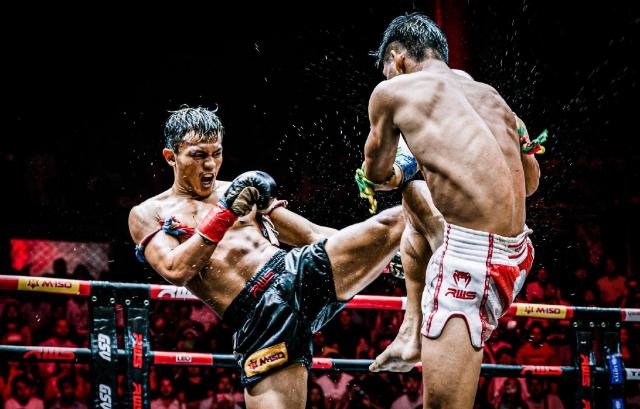
The block that goes nowhere
Stand at the back of a beginner sparring round and count how often somebody blocks a kick cleanly and then does absolutely nothing with it. Shin comes up, the kick thuds into the guard, both hands stay welded to the head, everyone resets. Six seconds later it happens again on the other side. That block bought a free half second of a man balanced on one leg, and it got handed straight back.
The habit comes from the order most Western gyms teach in: block, check, parry, cover, and offense once your defense is solid. Sensible for keeping new people intact. It also builds a fighter whose defense and offense are two separate jobs, and stadium judges punish that for five rounds straight.
A man who eats a body kick and answers it has won that exchange, even though he took the harder shot. Thai judges score a fight as one story told across five three-minute rounds, with rounds three and four carrying most of the verdict, and what they are reading is who dictates and who reacts. Block, block, block, reset reads as reacting. Block and return reads as control. The counter is not an advanced topic you reach in year three. It is what makes the block worth throwing.
Your weight decides the counter, not your reflexes
Here is the part that gets skipped. The window for a counter opens before their strike arrives, and it opens because of where your weight already is.
Sit around 60 percent on the rear leg with a soft front knee and your lead leg is free: teep, check, or lead kick with no preparatory shuffle to warn anyone. Plant flat and even on both feet, which is what people do the instant they get nervous, and you own nothing but your hands and some optimism. Nearly every “I froze” story from a beginner’s first six months is really a weight story: the read was fine, but the foot that needed to move was carrying half a body.
The other version is backing straight up. To retreat out of punching range you have to travel through kicking range, so a straight-line retreat parks you exactly where his round kick was already aimed. Step off at an angle or step in. Straight back is the one direction that pays your opponent.
If this comes at you, throw this
Against the teep
Three answers, and the choice depends on how much warning you got.
Parry across your body with the rear hand and their hips turn with the foot, which opens the whole flank for a lead hook. Lazier and faster: drop the point of your rear elbow onto the incoming foot. It stings, it costs nothing, and the hook comes off the same motion. Third option is the hip check, where you hollow the midsection out, take all weight off the front leg, and let the foot slide across before returning your own teep to their hip.
Delayed version: absorb it and attack the plant. A teep leaves someone on one leg and then reloading, and the beat right after their foot touches down is the cleanest low kick you will get all round.
The trap is stance. Square up slightly, stand a touch flat, and a teep-heavy opponent will aim at your stomach almost on schedule. Once you know it is coming, you are not countering anymore. You are collecting.
Against the body kick
Check high, forearm and shin forming one wall on the same side, then fire the same-side kick back before their leg has finished landing. The same-side return is the single most Thai answer in the sport and almost nobody drills it enough.
The delayed option is better against heavy kickers. Take it on the arm, absorb, then step in behind a cross as their kicking leg comes down. A round kick returning to the floor is the least mobile second in Muay Thai. Their hips are turned away, the lead hand is nowhere, and a straight punch lands on a head that cannot go anywhere.
To invite the kick: let your lead hand drift a few inches low and leave it there. Kickers read an open flank the way a puncher reads a dropped chin.
When the head kick comes
Wall it off with bicep and glove pressed together, never with a single floating arm. Then punch. A missed or blocked head kick spins somebody most of the way past you, and the rear cross into the side of a turning head is the reason head kickers hesitate. If they overspin, take the back hip instead and knee.
The low kick
Check it, obviously. Most guides stop there, which is where they oversell the check as a complete skill. A check that ends in stillness just tells your opponent the leg is safe and the head is free.
The immediate return is a rear low kick to the leg they just planted on. They are loaded on that side, cannot lift it in time, and it lands. The delayed return is the hook: as their right kick arrives, their head travels toward your left hand, so the left hook meets it coming in.
Now the honest part: plenty of good coaches tell beginners not to punch off a low kick for the first year, and their reasoning is solid. To land that hook you have to accept the kick, and beginners accept it on a straight, unloaded leg. That is how you end up with a dead thigh for ten days, or worse. Check reliably first, add the return kick second, and leave the hook counter until your leg comes up without you asking it to.
The trap here is range theater. Drift in and out at the edge of their kicking distance with a shallow lead-hand feint until they start reaching for the leg. A reached low kick is a slow low kick.
The long knee up the middle
Frame on the hip or the top of the thigh with your lead forearm and turn them off line, or teep the hip while the knee is still loading, which is far easier than teeping the knee itself. Do not grab for the head with both hands. A knee fighter, a muay khao, wants exactly that and will out-clinch you the second you offer it.
Delayed: the retraction. A long knee lands them on one leg with square hips, and a shove or a sweep in the direction they are already falling finishes it without any strength.
Knee fighters come forward when you retreat in a straight line. Give them two steps of backward movement, then cut off at an angle on the third and meet them coming in. They are committed to a direction. You are not.
Behind the jab-cross
Long guard the jab and teep the cross. A straight teep into a man walking forward is the highest-percentage counter in Muay Thai, because you are adding his momentum to yours and he cannot check what he cannot see coming through his own arms.
The delayed answer is to slip outside the cross, land the hook, and kick the same side immediately. Punches pull the hands up to the head. The kick arrives underneath them.
If someone only punches, it is usually because your kicks stopped. Throw a kick you have no intention of landing and watch the hands come back down.
Intercept, meet, or take it and return?
Every counter above sits in one of three timings, and choosing the wrong one for your build is why a technique that works for your training partner does nothing for you.
Intercepting means firing while they load, before the strike exists. It reads the shoulder and the hip, never the fist, and it belongs to long, rangy fighters with a good teep. Samart Payakaroon built a career on it.
Meeting means you both arrive together and someone gets the better of the trade. Shorter, denser builds do well here because they can afford the exchange. Beginners should stay out of it.
Taking and returning means you accept the strike on your guard and answer in the recovery beat. Least glamorous, safest, and what most Thai fighters do most of the time. Under two years of training, live here. The other two are what you graduate into.
Catching, sweeping, and where the sport stops
Catching a kick is legal and so is sweeping off it, as long as the sweep uses your own leg or a push while their balance is already gone. Judo throws, hip throws, and suplexes are not, and the referee will break a catch quickly if you stand there holding a leg. The Western gym problem is timing rather than legality: the catch is over-taught, the follow-up under-drilled, and the man standing upright with a leg in his arms and no plan gets kneed in the face. Catch and move in one motion or do not catch. Saenchai made this look like theft, but he was already sweeping before the kick finished landing. The full picture of what is allowed sits in the clinch and sweeps guide.
What a counter costs you
A counter is a bet, and it is worth being clear about the stake. You are choosing to stay in range when you could have left. You are committing to a read, and reads are wrong often enough to matter. Worst of all, a fighter who trains only counters slowly turns into a fighter who waits, and waiting loses rounds to anyone willing to throw first. Against a pressure fighter in the Rodtang mold there is frequently no counter window at all, because there is no gap between his strikes to counter into.
One thing to do this week. In your next three pad rounds, make a single rule: nothing gets defended without a return. Every check ends in a kick, every parry ends in a hand, every catch ends in a sweep attempt. Then take the rule into light sparring and lead with nothing for a full round. You will get hit more for the first week. Getting hit more is the price of the information, and by about week three the returns start firing before you decide to throw them.
Questions people actually ask
Why do I freeze right after I block something?
Because your weight is stuck on both feet and there is nothing free to throw. The freeze feels mental but it is almost always postural. Keep the lead leg light and the block turns into a launch instead of a full stop.
Should I be catching kicks in sparring, or is that a bad habit?
Catch them, but only if the catch immediately turns into a sweep, a knee, or a step off to the side. Catching and standing still is a worse habit than not catching at all, and it teaches your partner that your hands are busy. If you keep getting swept when your own kick is caught, turn your hip over and pull the foot out toward their body rather than yanking it back.
What is the easiest counter to learn first?
The rear teep against a forward-moving opponent. It needs no timing genius, it works against punchers and knee fighters alike, and it scores as an act of control rather than a defensive move. After that, the same-side kick return off a check.
How do I counter someone who just walks me down and never stops punching?
Stop retreating in a straight line, because that is what makes their volume work. Take two steps back, angle off on the third, and meet them with a teep as they turn to find you. Pressure fighters commit to a direction, and changing it costs them far more than it costs you.