
Two neighboring countries share a border of roughly 800 kilometers, a common Hindu and Buddhist inheritance, a nearly identical ritual dance before a fight, and a combat sport that an outsider would struggle to tell apart from its twin. They cannot agree on what to call it. In Thailand the art of eight limbs is Muay Thai. In Cambodia it is Kun Khmer, also known as Pradal Serey, and Cambodians will tell you, with some heat, that it was theirs first.
The argument deserves better than the shouting it usually gets online. Both sides have a case. Neither side has the whole of it. And the few things that genuinely separate the two styles are more interesting than the flags being waved over them.
What the Words Actually Mean
Start with the vocabulary, since the dispute is, at bottom, a dispute about vocabulary.
Muay Thai means, plainly, Thai boxing. Kun Khmer translates as Khmer martial art. Pradal Serey, the older and still common Cambodian term, means “free boxing,” a name that dates from the early twentieth century, when the French colonial administration codified local fighting traditions into something with rules, rings, and rounds. Cambodia’s formal designation is longer still, but Kun Khmer is the name the country now pushes abroad, and the name it put on the program when it hosted the Southeast Asian Games in 2023.
Notice what each name claims. “Thai boxing” asserts a nationality. “Khmer martial art” asserts a nationality too, only an older one. Nobody in this quarrel is innocent of flag-planting, which is worth remembering whenever someone insists that only the other side is being political.
The Case for Kun Khmer
The Cambodian argument rests on antiquity. The Khmer Empire, founded in 802 AD, dominated mainland Southeast Asia for centuries, and its temples carry carvings of fighters locked in what look very much like clinches, knees, and elbows. Cambodian historians trace a line from Bokator, the close-range battlefield art of the empire, through to modern Kun Khmer. On this reading, the Siamese kingdoms that rose later absorbed Khmer court culture wholesale (dance, script, royal ceremony), and a fighting art came along with the rest.
There is a darker chapter that Thai critics tend to forget. Under the Khmer Rouge, between 1975 and 1979, martial arts were banned and boxers were executed, worked to death, or driven into exile. The art very nearly vanished, and martial arts stayed restricted in Cambodia until 1987. When Cambodia rebuilt its boxing, it did so in the shadow of a neighbor that had spent those same decades turning Muay Thai into a global export. You can understand why a Cambodian fighter might resent being told his national sport is a regional variant of someone else’s.
The Case for Muay Thai
The Thai reply is less about who threw the first elbow and more about who built the modern sport. Bangkok introduced gloves, timed rounds, and weight classes in the 1920s and 1930s. Thai stadiums created the professional circuit, the gambling economy (for better and worse), the gym system, and the training camps that foreigners have been flying into for forty years. The International Federation of Muaythai Associations, based in Thailand, won full IOC recognition in 2021.
Thais also point out that the old Siamese fighting arts have their own long lineage, which is a fair point and a large subject. For the pre-sport roots on the Thai side, the story of Muay Boran and its regional styles shows how much variety existed before Bangkok standardized anything.
The strongest Thai argument, though, is a practical one. A name that the whole world already recognizes is not something a country gives up lightly, and the IFMA secretary general’s line on the matter was blunt: Kun Khmer is not Muay Thai, in the way judo is not karate. That formulation cuts both ways, of course. If they are different sports, Cambodia is entitled to its own name. If they are the same sport, the question of whose name it should carry becomes much harder to settle by appeal to marketing.
Kun Khmer vs Muay Thai in the Ring: What Is Actually Different
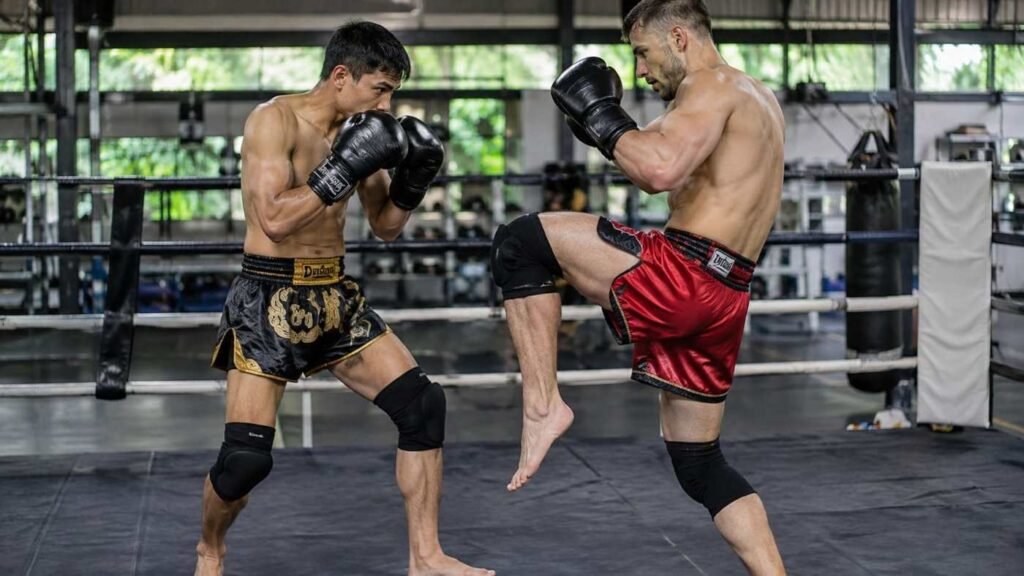
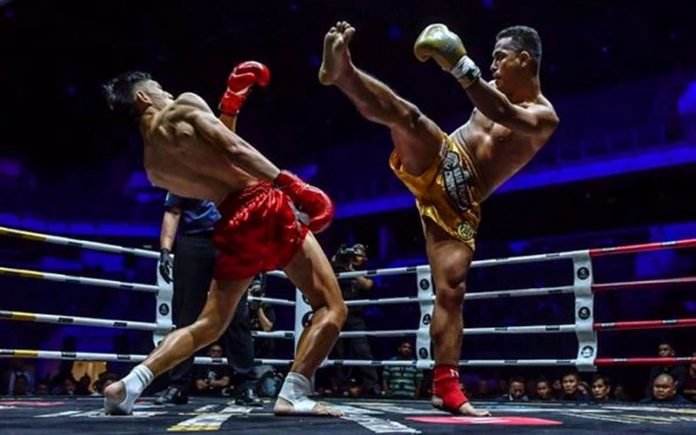
Here the partisans on both sides will be disappointed. Modern Kun Khmer and modern Muay Thai are extremely close. Both are fought over five three-minute rounds with gloves, both allow punches, kicks, knees, and elbows, and both permit clinching. A Thai fighter could step into a Phnom Penh ring tomorrow and understand everything happening around him.
The differences are real but come down to emphasis, culture, and scoring habits rather than rulebooks.
| Aspect | Muay Thai | Kun Khmer (Pradal Serey) |
| Meaning of the name | Thai boxing | Khmer martial art (Pradal Serey: “free boxing”) |
| Pre-fight ritual | Wai kru ram muay, with posture sets that vary by gym and region | Kun kru, commonly described as 17 postures, many drawn from the Reamker (the Khmer Ramayana) |
| Fight music | Pi Java (oboe), two drums, small cymbals | Sralai (oboe), sampho drums, chhing cymbals |
| Favored weapons | Kicks, teeps, and knees score heavily | Elbows used more often and more aggressively |
| Clinch | Long clinch exchanges to land knees and off-balance | Shorter clinch, used as a launch point for elbows and knees |
| Pace | Slow first round, scoring built across the fight | Tends toward forward pressure from the opening bell |
| Governing structure | IFMA (amateur), Thai stadiums and promotions (pro) | Kun Khmer Federation, Cambodian TV promotions |
| Modern codification | Gloves and rounds from the 1920s to 1930s | Codified as Pradal Serey under French rule |
Take the elbow point seriously but not too seriously. Cambodian fighters do throw more of them, and a Kun Khmer card often feels less patient, with less of the careful probing that Thai stadium fighters use in round one while the gamblers study them. That is a difference of style, the kind you also find between a Lumpinee veteran and a fighter from the Isaan provinces.
The music and the ritual are the most striking difference to watch, precisely because they are so alike. Both orchestras use a reed oboe, drums, and cymbals, and to an untrained ear the sound is nearly identical. The ritual dances share a skeleton and diverge in detail. This is exactly what you would expect from two traditions that share an ancestor, and exactly why arguing over which one is “original” produces so much heat and so little light.
One further shared inheritance is the rope. Before leather gloves arrived, fighters on both sides of the border bound their hands in hemp cord, and the Cambodian tradition is still revived for occasional exhibition bouts. The Thai version of that era is its own brutal chapter, covered in the history of rope-bound Kard Chuek fighting.
How a Kickboxing Event Became a Diplomatic Incident
The quarrel had simmered for years. In late 2022, UNESCO inscribed Kun Lbokator, Cambodia’s traditional martial art, on its Representative List of intangible cultural heritage, and Thai social media erupted with accusations that the file borrowed Muay Thai elements, including the wai kru and its footwork. Cambodia’s answer was that the listing said “in Cambodia,” not “of Cambodia,” and that inscription is not a property deed. The distinction was careful, lawyerly, and satisfied almost nobody.
Then came the 32nd SEA Games, hosted in Phnom Penh in May 2023. Muay had appeared on the program of earlier editions. Cambodia, as host, listed the sport as Kun Khmer instead. Prime Minister Hun Sen offered what sounded like a compromise: call it Kun Khmer in Cambodia, Muay Thai in Thailand, Muay Lao in Laos. Bangkok did not accept it.
IFMA announced it would not send athletes, and warned member federations that anyone sending fighters to the event risked a two-year ban from IFMA competition. Thailand stayed home. Six nations took part, Cambodia, Vietnam, Laos, Myanmar, the Philippines, and Malaysia, in bouts held from May 6 to 11 at the Morodok Techo National Stadium complex. Cambodia topped the medal table in its own sport, which surprised no one, and Kun Khmer was written into the Southeast Asian Games Federation’s charter the same year.
The 2025 Rematch That Never Happened
Two and a half years later the Games moved to Thailand, December 9 to 20, 2025, and the roles reversed. On November 24, 2025, the Kun Khmer Federation announced it would boycott, citing the 2023 Thai boycott and, more urgently, the safety of its boxers amid border tensions. Its president said the decision was about athlete safety, not politics. The Cambodian billiards federation pulled out too.
Events then overtook sport entirely. Fighting flared again along the border, and on December 10, one day after attending the opening ceremony in Bangkok, Cambodia withdrew its entire delegation, citing security concerns and the fears of athletes’ families. A regional games meant to celebrate neighborliness finished with ten nations instead of eleven.
The Kun Khmer row did not cause that conflict, and it would be silly to pretend otherwise. Still, the sequence illustrates something uncomfortable. Once a sport’s name becomes a proxy for national honor, each boycott justifies the next one, and the fighters, who mostly respect each other, pay for it with lost medals and lost chances.
The Olympic Question Hanging Over All of This
The practical stakes are larger than any single SEA Games. IFMA has spent years lobbying for a place on the Olympic program, a campaign traced in detail through Muay Thai’s Olympic ambitions, and Olympic sports need one name, one federation, and one rulebook. Cambodia will not want its fighters competing under a Thai label on the largest stage in sport. Thailand will not hand over a brand it spent a century building.
There are workable precedents. Olympic taekwondo and Japanese karate coexist as separate sports despite a shared family tree. Two parallel federations for Muay Thai and Kun Khmer could do the same, as IFMA’s own judo-and-karate comparison implies. The less workable option is the current one, in which each country treats the other’s name as an insult and each regional tournament becomes a referendum on history.
What This Means If You Train
For a practitioner in Toronto or Texas, almost nothing changes. The techniques you drill on the pads are the same in both systems. If you ever train in Cambodia, you will find the gyms cheaper, the elbows sharper, and the pride just as fierce as in Bangkok. Use the local name in the local gym. Call it Kun Khmer in Phnom Penh and Muay Thai in Chiang Mai, and watch how quickly people warm to you.
One small habit helps if a Cambodian and a Thai teammate share your gym: learn both names for the ritual (wai kru and kun kru) and both orchestras’ instruments. Coaches notice that kind of respect, and it tends to earn you better holding on the pads.