
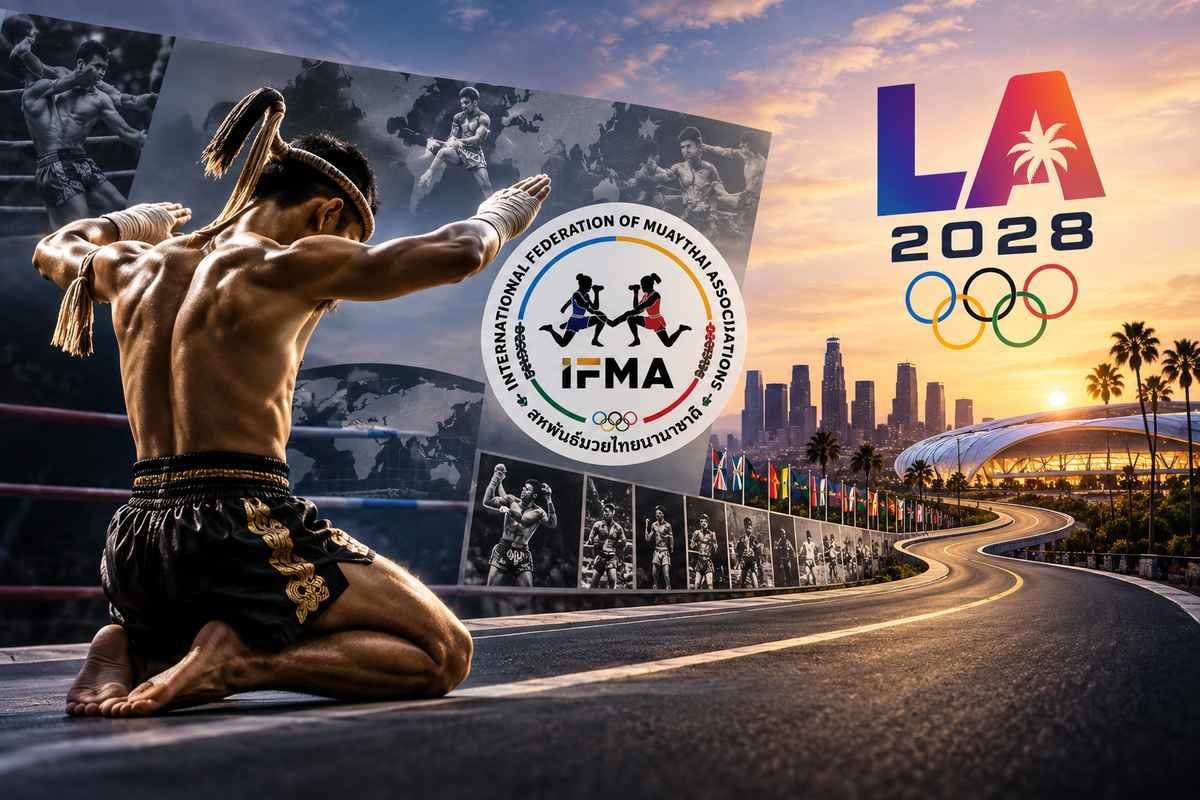
Muay Thai is not an Olympic sport. It holds a real, documented form of Olympic recognition through its international federation, but recognition is not the same as a spot on the program, and the two get confused constantly.
The Short Answer: Recognized, Not Included
No medal event, no Olympic rings next to the name, not yet. What Muay Thai does have is International Olympic Committee recognition of its governing body, the International Federation of Muaythai Associations, known as IFMA. That status puts the sport in a waiting room shared by dozens of recognized-but-not-included disciplines, from squash to bowling. Recognition means the IOC accepts IFMA as the legitimate global authority over the sport and allows it to compete for a place on future programs. It does not guarantee anything.
For a sport with a fight card in nearly every province of Thailand and gyms now running in well over 100 countries, that gap between recognized and included is the entire story.
The Recognition Timeline
IFMA has pushed for Olympic standing for decades, and the paperwork side of that push made its biggest leap in the mid-2010s, when the IOC extended full recognition to the federation. That step is generally treated as the sport’s largest institutional milestone: the moment Muay Thai stopped being an outsider in Olympic terms and became a federation with standing, meeting access, and a seat at IOC-level conversations.
Recognition opened doors that have nothing to do with a torch relay. Muay Thai has since appeared on the program of multi-sport events that sit just below the Olympics in prestige, including the World Games, where it has run as a medal sport in recent editions. It has also shown up at the World Combat Games, an event built specifically to showcase Olympic-recognized combat disciplines that haven’t made the main program yet.
None of that is the Olympics. It is, however, the track record IFMA points to whenever it argues the sport is ready.
IFMA Amateur Rules vs Pro Muay Thai
A lot of confusion starts right here. The Muay Thai fans watch on pay-per-view from stadiums like Lumpinee is not the version competing for a World Games medal, and it was never built to be.
IFMA-sanctioned amateur competition runs on a rulebook designed for safety and judged clarity, not spectacle. Headgear is mandatory. Fighters wear shin guards, groin protection, and in several divisions a padded vest that cushions the torso against kicks and knees. Contact is real, but the padding changes what a fight looks like and how it tends to end. Knockouts happen far less often than on the professional circuit.
Scoring is the bigger split. Professional Muay Thai in Thailand judges a bout cumulatively across rounds, rewarding effective aggression and weighting the middle and later rounds more heavily than a fast start. Amateur IFMA bouts lean toward a technical, point-based model closer to Olympic boxing or taekwondo scoring, where clean strikes and ring control earn points round by round in the moment rather than reconstructed at the final bell. Readers curious about the domestic scoring approach can check the breakdown of the 10-point must system used in professional bouts, which shares some structure with amateur judging but rewards different things.
Two versions of the same sport, sharing techniques but very little of how a winner actually gets decided.
Why LA 2028 Said No
Los Angeles organizers got to propose a slate of additional sports for the 2028 Games on top of the fixed Olympic core, and Muay Thai never made that shortlist. The sports the LA 2028 committee pushed forward, and that the IOC later approved, were chosen for reasons that had little to do with combat-sport merit: existing American audience size, venue and broadcast economics, and in some cases a straightforward returning-sport logic tied to past Olympic appearances.
Muay Thai runs into an obstacle that a sport like squash doesn’t face. Boxing already holds a combat-sport slot, and adding a second striking discipline with overlapping technique and audience is a harder sell inside an already crowded program. There’s a trust problem too. Judging consistency has dogged Muay Thai at the international level for years, with scoring disputes at major amateur tournaments drawing complaints from national federations themselves. The sport also carries a cultural association, fair or not, with the gambling culture built up over a century of stadium betting in Thailand, and IOC program reviews have historically treated that kind of baggage as a red flag for other sports as well.
None of that means the case is weak. It means the case wasn’t strong enough, yet, for one host city with one specific set of priorities.
The Case for Brisbane 2032
Ask people inside IFMA where the real opening sits, and most point past LA to Brisbane. Australia has an active competitive Muay Thai scene, IFMA still has years to build a cleaner judging track record before program decisions lock in, and host-city proposals for additional sports tend to favor federations that show up with tidy data and fewer disputes on file.
The argument for eventual inclusion is fairly simple. Muay Thai already draws global participation numbers that rival sports already on the program, and it brings real athleticism and a broadcast-friendly intensity that networks tend to like. The argument against it hasn’t disappeared: fix the judging complaints, keep the gambling association at arm’s length from the amateur side, and make the case that a second striking sport adds something boxing doesn’t already cover.
Brisbane 2032’s additional-sports list is not finalized, and nobody outside the IOC and the host organizing committee can say with certainty what will make the final cut. IFMA has treated the cycle as its clearest near-term target. That is a different thing from a promise.
What Recognition Already Changed
Recognition rewired the sport’s institutional plumbing well before any Games slot got attached to it. National governing bodies affiliated with IFMA now exist across dozens of countries, giving amateur fighters a formal competitive pathway that barely existed a generation ago. The United States has its own national federation structure feeding into that IFMA pathway, steering athletes toward sanctioned amateur competition instead of leaving the entire scene to gym-level organizing. In a handful of countries, national Olympic committees route sport-development support through recognized federations, turning what used to come out of fighters’ own pockets into an actual budget line for coaching and travel.
The next real test isn’t a distant IOC vote nobody can predict. It’s whether IFMA can walk into the Brisbane cycle with a judging record clean enough to make the case on merit alone. Olympic program decisions shift from cycle to cycle, and host cities keep changing what they’re willing to propose, so anyone tracking this closely should check current IOC and IFMA sources directly rather than treat any single article as the final word.