


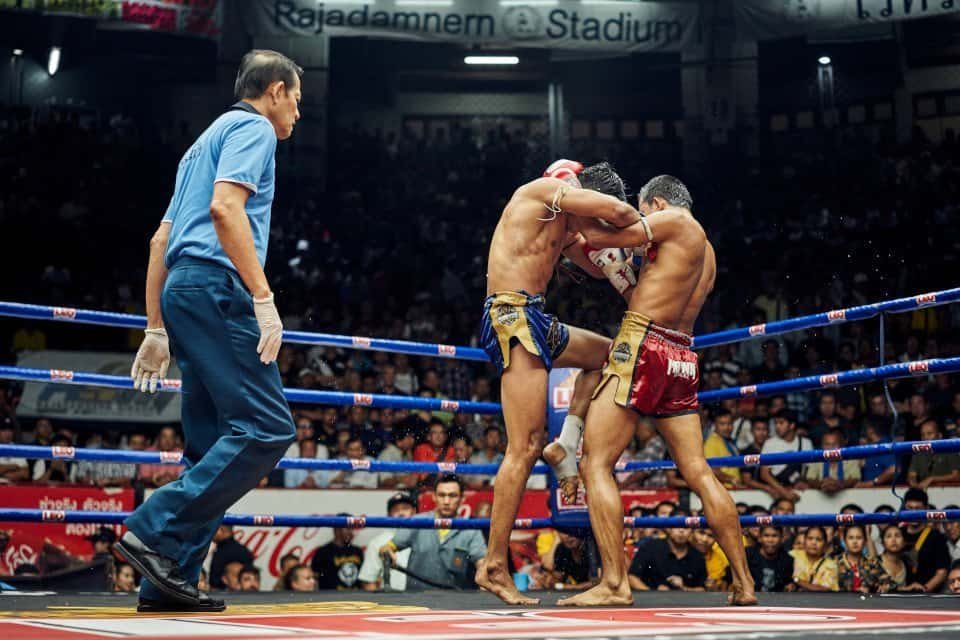
Somewhere above the ring at a Bangkok stadium, a hand shoots up. Fingers splay, then fold, then splay again. Ten rows away, a stranger catches the signal and answers with a gesture of his own. Neither man has spoken a word. Money has just changed hands, or at least a promise of it has, and the fight has not even reached the second round.
Watch the crowd instead of the ring for a few minutes at a place like Lumpinee or Rajadamnern and a different sport comes into focus. It runs on odds that shift fighter by fighter, round by round, sometimes strike by strike. It has its own language, its own traders, and its own rhythm. For a very long time, it has also been the financial engine that keeps stadium Muay Thai running at all.
The Second-Class Section: A Trading Floor
Thai stadiums are commonly split into three seating tiers, and the cheapest of them, often called the second-class section, is where the betting culture lives. Ringside seats hold tourists, officials, and the occasional camera crew. The second-class section holds the men who actually move the money.
Describing it as a trading floor is not much of a stretch. Groups cluster by fight, by fighter, by faction. Voices rise and fall with the action. Bets are placed continuously through a fight, not just before it starts, which is the detail most visitors miss. A fighter can open as the favorite and close as the underdog inside a single five-round bout, all based on what the crowd sees happening in front of them.
This constant repricing is the whole point. It rewards spectators who read a fight well, and it punishes anyone who bets on reputation alone. A famous name losing the first two rounds gets no sympathy from the odds.
Hand Signals and Odds
The signaling system itself has been reported on for decades and it works without a single word spoken aloud. Bettors use combinations of raised fingers, palm orientation, and small gestures to communicate which fighter they favor, at what odds, and for how much. A bettor looking for action on the red corner might hold up a hand in one position; someone willing to take that bet on the blue corner answers back.
It looks chaotic from outside. It isn’t. Regular bettors read it as easily as most people read a scoreboard. The signals shift constantly through a bout because the odds themselves shift constantly, tracking momentum almost live. A fighter landing clean knees in round three will see the numbers move against him within seconds, long before the judges’ scorecards reflect anything.
This is peer-to-peer wagering, not a bookmaker’s operation. No single house sets a line and takes a cut. Individuals bet against individuals, adjusting terms as they go, which is part of why the system has stayed informal for so long.
Why Gambling Funds the Sport
Here is the part that matters most for understanding Muay Thai as an industry: gate receipts at most stadium shows have never been the main source of money in the room. Ticket prices, especially for the cheap seats where the real betting happens, are modest. The volume of money actually wagered on a single card can dwarf what the venue collects at the door.
That has real consequences for fighters and promoters alike. Purses, prize structures, and even which bouts get booked have long been described as shaped, at least in part, by what will draw strong betting interest rather than by what makes the best technical matchup on paper. A fight between two evenly matched, well-known fighters generates action. A mismatch does not, no matter how skilled the favorite is.
Camps and promoters have long had reason to build fighters known for exciting, unpredictable action, because that reputation drives betting volume, and betting volume pays the bills backstage. Ticket sales matter. They have never carried the sport alone.
How Betting Shapes Fights and Judging
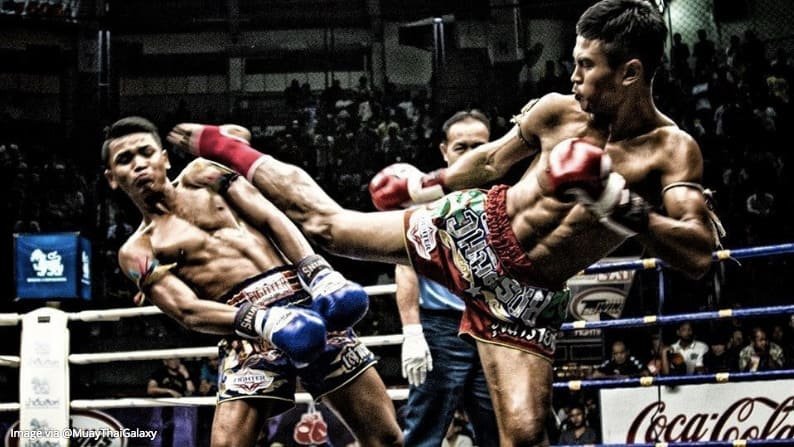
Anyone who has watched a handful of traditional stadium bouts has noticed the pattern: a slow, almost exploratory first two rounds, followed by a sharp, urgent push in rounds four and five. Commentators and longtime fans commonly describe this as the classic “slow start, urgent finish” shape of a Muay Thai fight, and betting culture is widely cited as one of the reasons it exists.
It is worth being careful here. This pacing pattern does not mean fights are staged or that outcomes are predetermined. It means the traditional scoring system weights the middle and late rounds more heavily than the openers, and bettors know it. Fighters and corners know it too. Early rounds become a feeling-out process partly because that is sound strategy anyway, and betting money simply amplifies an incentive that was already built into the scoring rules.
The influence runs both directions, honestly. Judging under the traditional point system has long been described as reading fights the way an engaged, betting-literate crowd reads them: who controlled the center, who looked more composed, who won the moments that mattered. A crowd with money on the line is not a passive audience. It is arguably the most attentive judge in the building, and the formal scorecards have historically tracked closer to crowd sentiment than international audiences sometimes expect.
None of this proves any specific bout was fixed. It shows a sport where pacing, scoring, and betting conventions grew up together, each reinforcing the others over a long stretch of time.
The Fixing Scandals
No honest account of this subject can skip the uncomfortable part. Match-fixing allegations have been a real, recurring feature of Thai stadium boxing’s history, and periodic scandals involving suspiciously one-sided betting patterns or bouts that ended in ways that raised eyebrows have been documented by Thai media and sporting authorities over the years.
The general shape of these controversies tends to repeat. A fight draws unusual betting volume or an unusual shift in odds shortly before it starts. The bout itself looks off to experienced observers, sometimes because a heavily favored fighter loses in a manner that does not match his record or visible ability. Officials investigate, sometimes suspensions or fines follow, and the sport moves on until the next incident surfaces.
It would be dishonest to call this a solved problem. It would be equally dishonest to treat every close or unusual result as proof of fixing. Fights get upset for ordinary reasons: injuries, bad weight cuts, a flawed game plan, an opponent who simply had the better night. But the betting economy gives fixing a financial motive that most combat sports never carry, which is exactly why oversight bodies keep watching for it.
Reforms and Cleanup Efforts
Thai boxing authorities and the major stadiums have responded to these problems over time, not with a single fix but with an ongoing series of reforms. Stricter licensing for promoters and matchmakers, tighter pre-fight medical and eligibility checks, and closer monitoring of unusual betting activity around specific cards have all been part of efforts commonly described as attempts to clean up the sport’s reputation.
Some oversight comes from the stadiums themselves, which have a direct interest in protecting their own legitimacy. Some comes from sporting federations and government bodies that regulate combat sports in Thailand more broadly. Enforcement has been described by observers as inconsistent across eras and venues, which is fair for any informal economy trying to formalize itself piece by piece.
The reform effort is real. It is also incomplete. That is a more honest summary than claiming either that nothing has changed or that the problem has been solved.
A Legal Note for Tourists
This is the section to read carefully if a stadium trip is on the itinerary. Gambling in Thailand is heavily restricted under national law, with only a narrow set of exceptions such as the government lottery and a couple of licensed horse racing venues. Casual spectator betting inside a stadium exists in a legal gray zone: it happens openly, it is tolerated in practice at many venues, and it is not the same thing as being legal in the formal sense.
Tourists sometimes assume that because locals are betting in plain view, joining in carries no risk. That is not a safe assumption, and enforcement attitudes can vary by venue, by city, and by the mood of the moment. A visitor who gets pulled into a dispute over an unpaid bet has essentially no legal standing to resolve it, because the wager itself was never a recognized legal contract to begin with.
Online betting from outside Thailand is an entirely separate legal question, governed by the laws of whatever country the bettor is actually in, and it has nothing to do with what happens inside a stadium’s second-class section. This article is not encouraging participation in either. It is explaining, as plainly as possible, how a real and long-standing part of Muay Thai’s culture and economics actually works. Anyone planning a first stadium visit should treat the legal gray zone as background knowledge, not an invitation, and the travel handbook covers the practical side of a first trip in more depth.
For anyone deciding what to wear to a stadium event, the same instinct applies: watch first, understand the room, and decide from there how close to the action you actually want to be.
FAQ
Is stadium betting on Muay Thai legal in Thailand? It sits in a gray area. Thai gambling law is strict and only allows a small number of exceptions, and informal spectator betting at stadiums is tolerated in practice rather than formally legalized, which means it carries real legal uncertainty for anyone who takes part.
Does betting mean Muay Thai fights are fixed? No, not as a general rule. Betting culture shapes pacing, purses, and matchmaking incentives in documented ways, and match-fixing scandals have genuinely occurred and been investigated over the years, but the presence of heavy betting around a fight is not proof that any specific result was arranged.

One Comment