

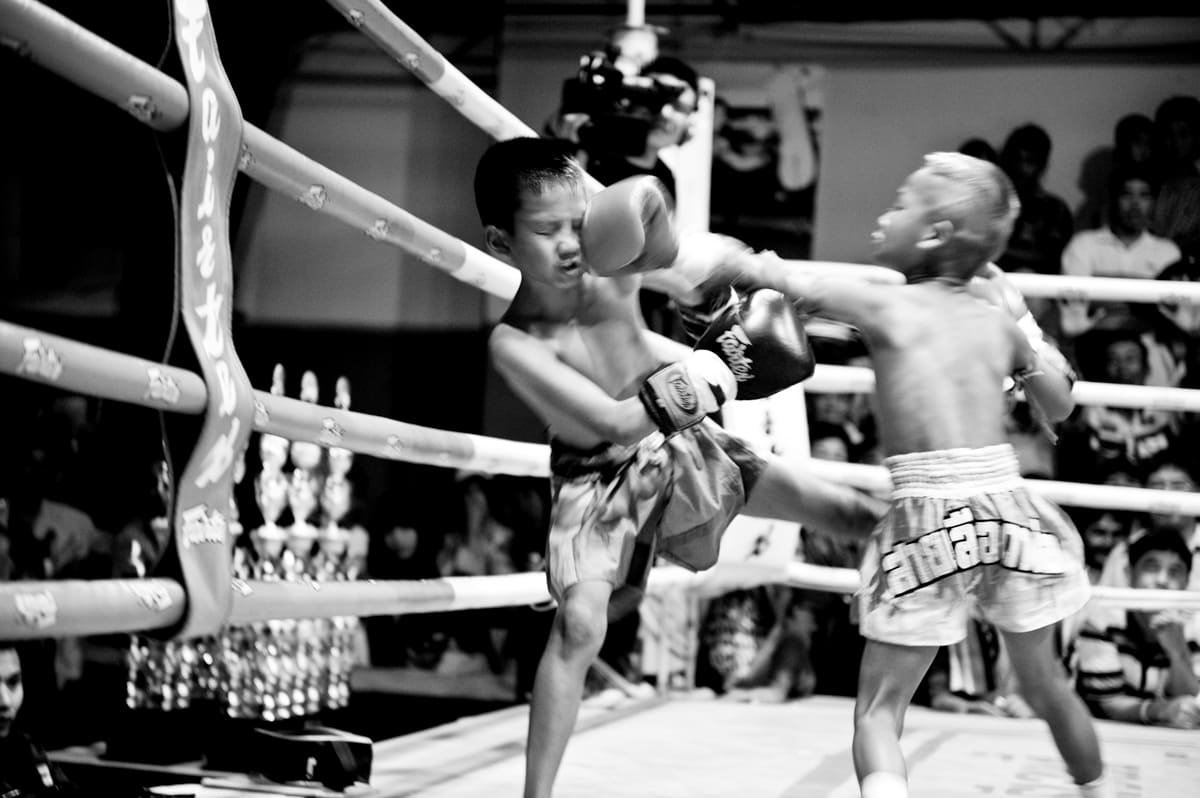
A weekend card in the northeast looks nothing like a stadium show. The ring goes up in a temple field or inside a square walled off with corrugated sheeting, and the front row stands close enough to put a hand on the apron. Two boys climb through the ropes at maybe 25 kilos each. In most cases nobody has weighed them, the doctor on duty looks them over for open cuts, and that is the medical portion of the evening. Then the men on opposite sides of the ring start throwing hand signals at each other, and the money starts moving.
The fight is the smaller transaction. Everything else in this argument follows from that one fact, and skipping it is why so much Western commentary on the subject lands badly.
Follow the money before anything else
The purse a child takes home is close to nothing. A ten-year-old fighting on provincial cards might get 300 baht whether he wins or loses, roughly nine dollars. Reporting on junior fights in Surin province a decade ago put the figure as low as 500 baht. Even the best-known child fighters in the country pull something in the range of 3,000 to 10,000 baht for a big match, while adult champions on the same circuit are paid ten or twenty times that.
The side bet is where the actual money sits. Thai gamblers call the headline wager on a match the dumpan, and on a well-matched pair of young fighters it can run into hundreds of thousands of baht. A children’s bout at Rajadamnern in January 2020 carried a reported dumpan of 300,000 baht, for two boys at 35 kilos. Around the edges of that, individual bettors trade odds by hand signal, sums from 100 baht up to 50,000 and beyond, adjusting between rounds as the fight turns. If you want the mechanics of how that system shapes matchmaking, ringside betting works the same way at the top of the sport as it does in a rice-field ring.
Camp owners are not usually skimming the boy’s purse. The common arrangement is that the camp feeds, houses and trains him, and the owner bets on his own fighter, which is a decent reason to keep that fighter healthy and a terrible reason to pull him out of a fight he might lose narrowly. Families in the poorest provinces may be earning a couple of hundred dollars a month from farm work. A son who wins regularly can bring in comparable money, plus school fees, plus a route into a life that is not rice.
Thai law has never treated any of this as employment. Prize money is legally an award, not a wage, so the child labor provisions that would otherwise apply simply do not reach it. That single classification is doing more work than any age limit ever has.
What the brain scans actually found, and what they can’t tell us
The research everyone cites comes out of Ramathibodi Hospital in Bangkok, where the neuroradiologist Jiraporn Laothamatas and her team spent years imaging young fighters. Their child muaythai work compared groups of boxers with under two years, two to five years, and more than five years of ring experience against 200 age-matched controls from the same socioeconomic background. They ran MRI, functional MRI and diffusion tensor imaging alongside neuropsychological testing. The imaging showed reduced fractional anisotropy, which points to white matter damage, raised MD values consistent with loosening of brain tissue, and MRI signal indicating old blood products sitting in the brain. Memory-task activation was lower in the fighters. Average IQ was lower too, and it dropped further the longer a child had been fighting. Public presentations of the wider dataset put the gap at roughly ten points.
That is a serious body of evidence and it deserves to be taken seriously. It also has limits that get flattened whenever a headline quotes the ten-point figure.
The design is cross-sectional, which means it photographs two groups at one moment and cannot by itself establish that boxing caused the difference. IQ testing is sensitive to schooling, and a boy who fights forty times a year is a boy missing a great deal of school. Matching for socioeconomic status helps with that objection but does not dissolve it. Much of the imaging work reached the public through conference presentations and press briefings rather than a large peer-reviewed clinical paper, which is a normal way for research to travel in Thailand and still a reason to hold the numbers loosely. What the scans show is much harder to argue with than what the IQ scores are supposed to prove. Repeated head impacts leave marks on a developing brain. That part is not really contested by anyone qualified, including the doctors who oppose a ban.
November 2018
Anucha Tasako fought on a charity card in Samut Prakan, on the edge of Bangkok, on November 10, 2018. He was thirteen, fighting under 41 kilos, in a bout worth around 2,000 baht. He was knocked down in the third round, and he died two days later of a brain hemorrhage. Neither boy was wearing headgear, which was ordinary rather than exceptional.
He had started at eight. Depending on which outlet you read, he had between 150 and 174 recorded fights behind him, and his ring name is given differently across the coverage, which tells you something about how little of this circuit is properly documented. His parents had separated and he lived with his uncle, who was also his trainer. The money he earned went to his schooling and the household.
Two responses from that week are worth holding side by side. His uncle told Thai PBS that he blamed nobody and that his nephew died like a warrior, then said he wanted a law requiring under-15s to wear protective gear. A lawyer representing several camps called the death unprecedented and blamed the referee for being slow and the venue for having no doctor on standby. Both of those men watched the same boy die. Neither concluded that children should stop fighting.
There is a detail that rarely survives the retelling: days earlier, a 49-year-old Italian fighter named Christian Daghio had been knocked out in the twelfth round of a title fight in Rangsit and died as well. Thailand was having an argument about child safety in a month when the sport had killed an adult too.
Where the law actually stands
The 1999 Boxing Act sets 15 as the minimum age for registered professional competition and asks for parental consent below that. In practice it is close to a dead letter. Between 2010 and 2017 only 10,373 child fighters were formally registered, while officials in the sport estimate somewhere near 200,000 children under 15 compete regularly. Medical campaigners have put the total as high as 300,000, with some starting at four.
After Anucha’s death, an amendment drafted in the National Legislative Assembly proposed barring under-12s from competition and tightening consent and registration. Deputy Prime Minister Prawit Wongsuwan ordered a review. Samart Payakaroon, the former WBC world champion and probably the most respected living name in the sport, led a delegation of fighters to the Sports Authority with a letter and a banner reading “stop the law to eradicate Muay Thai.” The bill went back to the Cabinet. It never became law, and neither did the attempt before it.
The argument reopened in 2026 on different ground. A draft Child Protection Act prepared by the Ministry of Social Development and Human Security, backed by the National Human Rights Commission, would prohibit arranging bouts involving anyone under 15 outright, and permit 15 to 18 only under specific rules and safety equipment. That draft went to the Council of State and into public consultation, with the Sports Authority’s own boxing commission inviting the Muay Thai community to file comments. Muay Thai organizations petitioned the ministry against it on June 19, arguing they had not been consulted and that a ban could damage the campaign for UNESCO recognition. An MP, Kittiphan Saokaew, called publicly for the boxing community to unite against it.
Meanwhile the Sports Authority ran its own pilot, and this is the part I find genuinely interesting. At an event in Ang Thong on July 3, 2026, young fighters competed in headgear and elbow guards under a proposed age-tiered format: nobody under seven in competition at all, 1.5-minute rounds for ages seven to ten, three-minute rounds above that, with gear distributed through regional offices. Deputy governor Prodpran Samanmitr’s position was that the Boxing Act already requires protective equipment for under-15s and that the sport should be arguing from medical and sports science data rather than sentiment.
So the state is currently running two incompatible plans at once. One ministry wants children out of the ring; the sports body wants them in it wearing more foam. Whichever wins, the provincial cards where most children actually fight have ignored every previous version of the law, and there is no obvious reason to expect this round to be different.
The case the coaches make, stated fairly
Take it seriously, because it is not stupid.
The first argument is developmental. Thai coaches talk about “boxing bones,” the idea that ring timing, composure and the ability to read an opponent are built by fighting young and cannot be installed later in a gym. Every great Thai fighter of the golden era came up this way, hundreds of fights deep before turning twenty. Samart’s point that Thai fighters already struggle against foreign competition is not a rhetorical flourish; the domestic pipeline has thinned as the economy has improved and more kids go to university instead.
The second is economic and it is the harder one. Reformers propose removing an income stream from families who have few alternatives, and the reform proposals are conspicuously light on what replaces it. One Bangkok fight doctor put it bluntly: these kids stay out of trouble, they are healthy, and if the government takes fighting away, what is it offering instead? That question has not been answered in eight years of drafting.
Where the coaches lose me is the claim that a complete ban is the only thing on the table. It is not, and it never was. Adisak Plitponkarnpim, who runs the child injury research center at Ramathibodi and is the most quoted reformer in the country, has argued for non-contact competition under ten and no head contact from ten to fifteen. Jiraporn has said the same thing: teach them, gear them up, keep them out of full bouts until they are older. That is a rule change, not an extinction event. Framing it as the end of Muay Thai has worked politically for nearly a decade, which is precisely why it keeps getting said.
Why kids’ bouts in the West look nothing like this
If you have watched a junior division at an American or European amateur show, the contrast is immediate. Head contact for young competitors is off the table, headgear and shin pads are mandatory, elbows are gone entirely, and rounds are short. IFMA, the international federation, prohibits strikes to the head outright in its 10-11 junior division. Several Western amateur bodies bar head shots up to and including age 14, require body shields for juniors, and forbid elbow strikes to the head under 18. Some US promotions run explicit no-head-contact divisions for first-time youth competitors.
| Ruleset | Head strikes, under-15s | Required gear | Rounds |
| Thai provincial child circuit | Permitted | Gloves only in practice | 3 or 5 x 2 min |
| Thai SAT 2026 pilot framework | Permitted | Headgear, elbow guards | 1.5 min (7-10), 3 min (11+) |
| IFMA junior 10-11 | Prohibited | Headgear, body protector, shin pads | Short, tournament format |
| Typical Western youth amateur | Prohibited to 14 | Headgear, shin pads, body shield | 2 x 1.5 to 3 x 2 min |
Worth saying plainly: the Western model is not morally superior by design. It exists because insurers, athletic commissions and parents in litigious countries demanded it, and because no American ten-year-old is feeding a household with his fight purse. Remove the economic pressure and the safety rules become easy. That is the whole trick, and it is not a trick Thailand can perform on command. If you are weighing this for your own kid, the same logic applies at home: when kids should start is a different question from when they should be hit in the head.
What is settled and what isn’t
Settled: repeated blows to the head damage developing brains, and Thai child fighters absorb a great many of them. Settled: the 1999 Act is not enforced at the level where most children fight. Settled: the purses are trivial and the betting is not, which means adults are the primary financial beneficiaries of children taking head trauma.
Not settled: whether a ten-point IQ gap can be attributed to punches rather than missed schooling, whether a national ban would protect children or simply push the same cards further underground, and whether age-tiered contact rules can be enforced in a temple field on a Saturday night when nobody enforces the weigh-in either.
The uncomfortable part for foreign fans is that the tourist circuit and the streaming subscriptions sit downstream of this pipeline. The fighters people fly across the world to watch were, without exception, once eight-year-olds on a card like the one described at the top of this article. Nobody has yet proposed a version of Muay Thai that keeps the first thing and gets rid of the second.



One Comment