
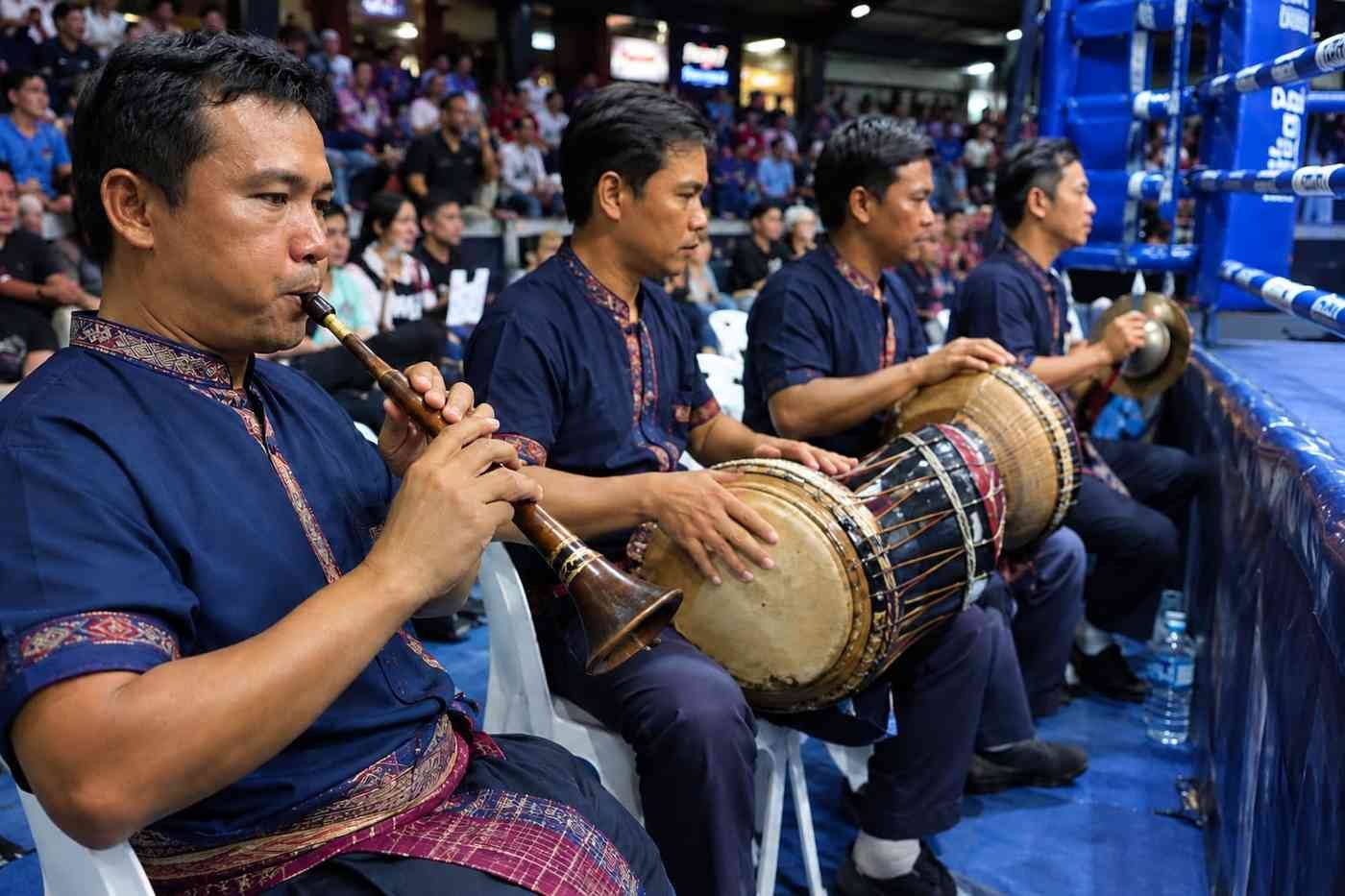
Four musicians sit on plastic chairs a few feet from the ring apron at Rajadamnern, and most of the tourist seats never look at them once all evening. They are the reason round four sounds nothing like round one. Once you know what they are doing up there, you stop hearing wallpaper and start hearing a live tempo track that is reacting to the fight in real time, which changes how you watch the whole sport.
The four men on the plastic chairs
The group is deliberately small: one reed player, two drummers, one on cymbals. Thai sources call the band a pi muay, and musicologists writing about the broader tradition file it under wong pi chawa klong khaek, the oboe-and-drum ensemble that also plays at ordinations, at funerals, and at the Royal Barge Procession. Same four instruments, completely different job depending on the night.
That nasal, wailing lead is a pi chawa (ปี่ชวา), a quadruple-reed shawm. Not a flute, whatever the YouTube comments say. Four reeds instead of the two on a Western oboe is part of why the tone cuts through a room full of shouting gamblers with no amplification at all. The Thai name means Javanese pi, though the instrument probably came out of the Indian subcontinent and reached Thailand via trade routes through Java, and it is a close relative of the shehnai. The pi player leads. Everyone else follows him.
Underneath sit the klong khaek (กลองแขก), a pair of double-headed barrel drums played with bare hands. The two are not identical and are not supposed to be. The higher-pitched one is the tua phu, the male drum; the lower is the tua mia, the female. Two players interlock their parts in hocket, so the rolling rhythm you think you are hearing is actually two lines stitched together, neither of which sounds finished on its own. The rhythmic patterns have their own name, nathap, and a drummer moving to a different nathap is doing something closer to a gear change than a fill.
Last, the small brass cupped cymbals: ching (ฉิ่ง). The full name is ching chap, which is also the sound. A damped, unaccented ching, then an open ringing chap, four beats, accents alternating, all night. Least glamorous seat in the band, and the one holding the rest together, because when the ensemble decides to accelerate, the cymbals are what the other three lock onto.
Sarama or phleng muay? They are not the same thing
English-language articles use sarama for the whole evening’s music. Strictly speaking, sarama (สะระหม่า) is the piece played for the pre-fight ritual, and once the bell goes the music becomes phleng muay, boxing music, working on entirely different rules. Nobody at a stadium is going to correct you, and Thai fans use the word loosely too. The distinction is worth keeping straight for one reason: the ritual music is a known piece, and the fight music is invented on the spot.
The ritual half is the only part that’s written down
For the pre-fight dance, the band plays slow, formal, and unhurried. The drums stay quiet under the reed rather than driving anything. That tempo is there to serve the fighter’s movements, not the other way around, and the ram muay has its own logic that the music is simply dressing. Nowhere else in the night is the band following a script.
After the bell, nobody is reading a score
There is no sheet music. The pi player improvises a melody over whatever nathap the drummers have set, the others react to him, and the performance is rebuilt from nothing at every single fight. Musicians train for it by apprenticeship, usually starting on ching or drums for years before anyone hands them the reed, because leading requires both the breath control and the judgment to steer a group through a fight that has never happened before. The comparison people reach for is jazz. A blues band reading a room is closer.
What they are reading is the action. A fighter steps forward, starts landing, and the tempo lifts. Both men reset and circle, and it settles again. The band watches the crowd as much as the ring, and in a Thai stadium the crowd means the gamblers, whose noise rises and falls with the odds. This is where a lot of write-ups oversell it. The musicians do not drag a slow fight into being fast. They confirm what the room already felt, about half a second later, and that half second is exactly what makes it useful to you as a viewer.
Reading a fight by ear
A stadium bout gives you five three-minute rounds and a two-minute gap after each. Here is roughly what the tempo is telling you at each stage.
| What you hear | What is usually happening |
| Slow, stately, drums barely present | The ram muay, before the fight starts. Not a read on anything yet. |
| Complete silence | Between rounds. The band stops at the bell and does not restart until the next round is underway. |
| Steady, unhurried pulse through rounds one and two | Feeling-out phase. Under Thai stadium scoring these rounds carry the least weight, and everyone in the building knows it. |
| A clear lift early in round three | The fight has started for real. Bets are placed, and both corners are now working. |
| Sharp acceleration in round four | Someone has committed to winning it. Round four decides most stadium fights. |
| Drums crowding the reed, near-frantic, final ninety seconds | Close fight, no clear leader, and the crowd is at full volume. |
| Tempo easing off in the fifth while both men still move | The result is already settled and both fighters are running out the clock. |
The round-four acceleration is the one to train your ear on first, because it is the least ambiguous. If you have read anything about how Thai judges score, you know rounds three and four carry the fight. The band knows it too. When the pi suddenly climbs and the klong khaek start doubling up eighty seconds into the fourth, a fighter has decided the fight is available and is going after it, and you will see the evidence in the ring a beat later.
Why is it live in Bangkok and canned everywhere else?
Rajadamnern and Lumpinee both keep live musicians, and it is part of what you are paying for. Outside Thailand, almost nothing is live. Promotions run a recording, and for years a very specific one: a 1999 sarama album put out by V. Music became the default track at Western shows and has stayed there, which is why the music at your local amateur card sounds identical from event to event and why it never once responds to the fight in front of it. A recording cannot accelerate when a fighter finds his range. Most of the function is gone, and what is left is atmosphere.
Plenty of people never make peace with the sound either way. The reed sits outside Western tuning, and an ear raised on equal temperament tends to hear it as out of tune rather than as a different system entirely. Fight fans say out loud that the music is the reason they never got into the sport, and that is a real response, not a failure of taste. It grows on most people who stick around. It does not grow on everyone.
Try this on your next card
Pull up a full stadium fight on YouTube, skip to round three, and mute the English commentary. Watch two rounds that way, listening only to the band, and try to call the moment the tempo lifts before it does. Then run it again with the sound normal. Two or three fights of this and you will start catching the acceleration a half beat early, which means you are reading the same signals the band is reading. It costs you twenty minutes and it permanently changes what a card sounds like.
The building versus the stream
On a stream, the music is buried. Commentators talk over it, the broadcast mix pushes it behind the crowd, and the reed comes through your laptop speakers as a thin whine somewhere in the background. In the building, the pi chawa is not behind you in a speaker array, it is ten feet away and unamplified, and the drums arrive in your chest before your ears sort out what they are. The gamblers’ shouting rides on top of the same tempo. Everything in the room is locked to one pulse and the pulse is a live one.
Go once, sit close, and the recording at your local amateur show will never sound the same again. You will hear it for what it is: a photograph of a band.