At the edge of many Thai training camps, tucked between the heavy bags and the dirt road, there is often a small house on a post. It is rarely more than a foot tall, painted in fading gold and red, with a tiny roof shaped like a temple and a miniature figure standing inside. Fresh flowers sit on its ledge some mornings. Other days there is a glass of red soda, a bit of rice, or a stick of incense burning down to ash in the heat. Fighters walk past it every day on their way to skip rope or wrap their hands, and most of them do not think twice about it. It has simply always been there, the way a shrine on a family porch has always been there.
That small structure is called a san phra phum, a spirit house, and it points to something much larger than the boxing ring itself: a belief system woven through everyday Thai life, one that Muay Thai’s rituals borrow from rather than invent.
Spirits in Thai Culture 101
Thailand’s dominant religion is Theravada Buddhism, but it exists alongside an older layer of folk belief in spirits, generally called phi. These spirits are thought to inhabit trees, rivers, houses, and particular plots of land. Some are protective. Some are simply present, neither good nor bad, and need to be acknowledged rather than feared. This isn’t a fringe belief held by a superstitious few. It shows up in how homes are built, how land is used, and how people greet the unseen parts of their environment.
A phra phum, specifically, is a guardian spirit associated with a piece of land. Before construction begins on a house, a shop, or a gym, it’s common practice to set aside a small space for that spirit, so the household living there and the spirit already there can coexist peacefully. Many cultures leave a corner for something they can’t fully explain and don’t feel the need to. Thailand simply names it.
The Camp Spirit House
Training camps, being built on land like anything else, often include their own san phra phum somewhere on the property. Fighters and trainers may leave small offerings there: flowers, food, incense, sometimes a bottle of the local red soft drink that shows up as an offering across Thailand for reasons nobody can fully trace anymore. Before a bout, some fighters will stop by the spirit house on their way out, bow their head, and ask for protection or a clear mind in the ring.
None of this is mandatory, and no two camps handle it quite the same way. Some gyms treat the spirit house as a quiet daily habit, barely commented on. Others build it into pre-fight routine more visibly, with a trainer or camp elder leading a short moment at the shrine before the fighter leaves for the stadium. What stays consistent is the underlying idea: the land holds something, and it’s worth a moment of acknowledgment before stepping into a fight.
Entering the Ring Over the Ropes (and Why)
Watch enough traditional Muay Thai broadcasts and a small detail becomes obvious. Fighters rarely climb between the ropes to enter the ring. Instead, they step up onto the middle rope and swing a leg over the top one, ducking their head as they go, so the whole body passes over rather than through.
This connects to a belief held widely in Thai culture: the head is the most sacred part of the body, and the feet are the least. It’s considered disrespectful to let anything, especially another person’s feet, pass over your head, or to let your own head pass beneath something in a way that seems to lower or diminish it. Passing between the ropes would mean the ropes, and anyone standing near them, effectively pass over the fighter’s head. Going over the top rope keeps the head above everything else in the ring, physically and symbolically.
Some fighters extend the ritual further, circling the ring’s perimeter on the outside before entering, often moving counter-clockwise, as part of a broader pre-fight sequence that also includes bowing to each corner. The exact steps vary by camp and by fighter. What doesn’t vary is the underlying logic: the ring is treated, for those few minutes, as more than a padded square with ropes around it.
Amulets and Charms
Many Thai people, fighters included, carry or wear small protective items as part of daily life; a pendant, a piece of cloth, a small object blessed by a monk. These are generally referred to as amulets, and belief in their protective power sits somewhere between religious devotion and personal comfort, depending on who you ask. A fighter might wear one under their gloves or keep one in a training bag, not necessarily expecting it to stop a punch, but valuing what it represents: a connection to a teacher, a temple, or a moment in their life that mattered.
It would be easy to reduce this to a checklist of specific objects and specific powers, but that flattens something that varies enormously from person to person and region to region. What matters is the pattern, not the particulars: physical objects carrying meaning beyond their material value, kept close during moments of risk. That’s a familiar impulse well beyond Thailand. Muay Thai just makes the moment of risk unusually public.
Lucky Days and Colors
Thai folk astrology assigns significance to the day of the week a person was born on, and by extension to certain colors and activities associated with that day. This shows up outside the ring too, in choices about what to wear on a given day or when to schedule an important event. Some fighters carry a version of this into fight preparation, favoring a particular color of shorts or a particular day for a bout when they have any say in the matter.
Calling this a fixed, universal system that every fighter follows to the letter would overstate it. Think of it as a shared cultural framework, one that individual people apply with different levels of seriousness, the same way someone elsewhere might feel a preference for a particular date without treating it as an unbreakable rule. A fighter who dislikes a certain color for a fight isn’t being irrational by the standards of the belief system they grew up inside.
What Survives in Modern Arenas
Step into a glossy, internationally broadcast ONE Championship card and the picture shifts. The lighting rig, the sponsor branding, the countdown clocks all pull the event toward a global combat-sports product built for television. Fighters from dozens of countries compete on the same bill, many with no connection to Thai folk belief at all, and the promotion’s presentation reflects that broader audience.
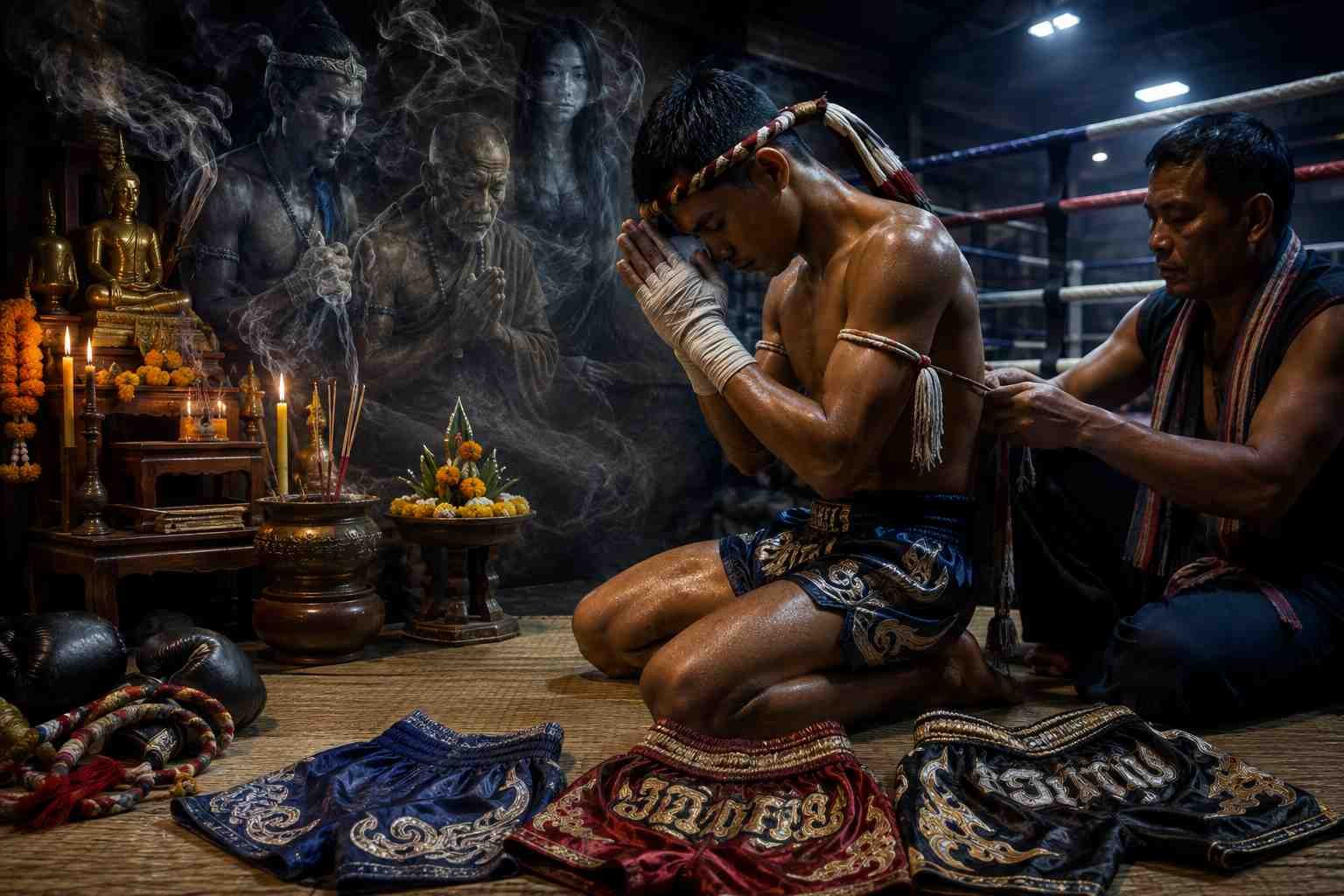
Even there, though, older habits persist in patches. Ring-entry customs tied to respect for the ropes still appear, sometimes performed out of genuine belief, sometimes carried forward as tradition and showmanship both. The pre-fight Wai Khru dance, closely linked to these same spiritual roots, still opens most cards regardless of the fighter’s nationality or the size of the production budget. What’s largely absent from a made-for-broadcast arena is the quieter, unfilmed version: the stop at the camp’s spirit house before the drive to the venue, the specific color chosen for a specific reason nobody in the broadcast booth will mention.
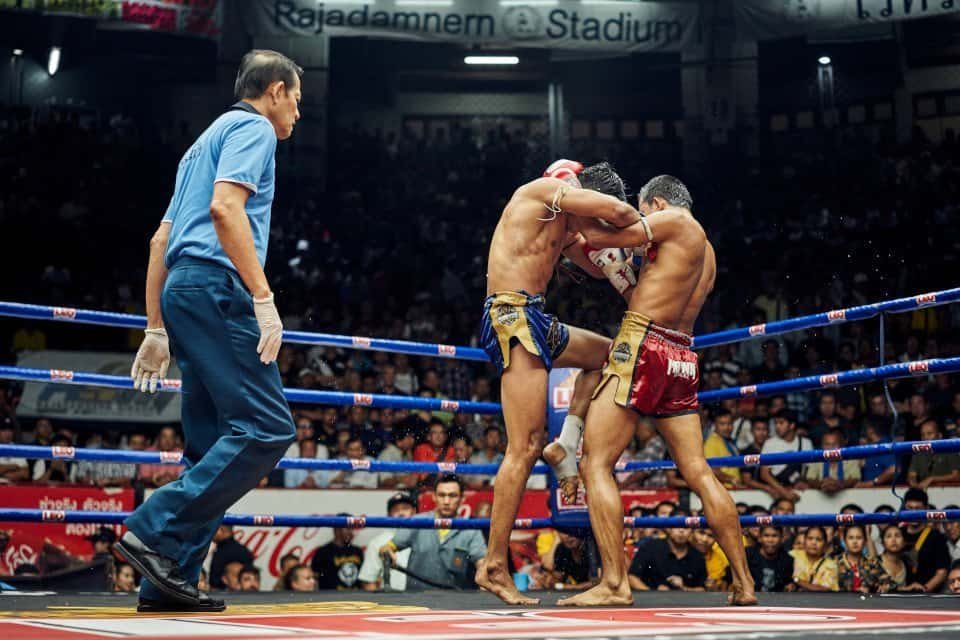
Traditional stadiums in Bangkok, by contrast, still carry the fuller, less curated version of these customs, simply because the audience and the atmosphere expect it. Modern Muay Thai hasn’t abandoned its spiritual roots, and it hasn’t preserved them fully intact either. Which parts survive tends to depend on who’s watching and what the event is built to be.
A Note on Respect
None of this is decoration. For the fighters who practice it, walking around a ring counter-clockwise or bowing at a small spirit house belongs to a belief system that shapes how they understand their own bodies, their land, and the moments that matter most in their lives. A foreign visitor watching a fight for the first time might notice the ring-entry ritual and find it striking, even beautiful, but the deeper value in it has little to do with how it looks from the outside. It comes from what it means to the person doing it, in a country where the line between the sacred and the everyday was never drawn as sharply as it is elsewhere.