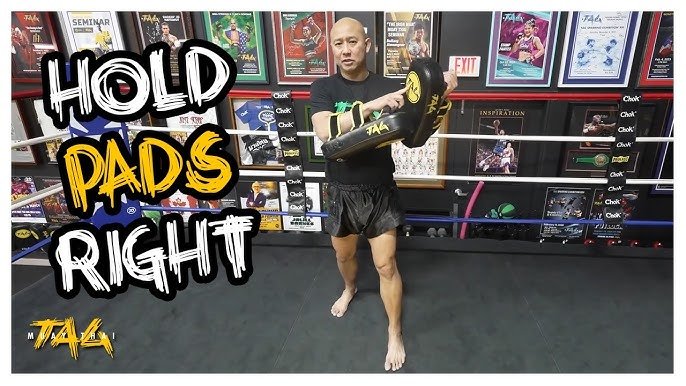
Nobody teaches you how to hold pads. You show up to class, your coach pairs you with a partner, hands you a set of Thai pads, and says “go.” Meanwhile the person striking has had weeks of instruction on stance, hip rotation, and follow-through. You get nothing. That’s backwards, because a bad holder can undo months of a striker’s progress in a single round, and a good one can teach almost as much as the coach standing across the gym.
Holding pads well is a skill on its own. It has its own footwork, its own timing, and its own list of ways to get hurt if you do it wrong. Most gyms just assume you’ll figure it out by watching other people hold. Some people never do.
The Basics: Position and Meeting Force
The single biggest mistake new holders make is treating the pads like a target that just sits there. A pad is not a punching bag bolted to the ceiling. When your partner throws a strike, you meet it with a small amount of counter-pressure, pushing back into the pad at the moment of contact rather than letting your arm go soft and absorb it passively.
This does two things. It gives the striker something solid to hit, which is what makes power training actually build power. And it protects your own joints, since a loose, floppy pad transfers more shock into your wrist and elbow than one you’re actively bracing.
Keep the pads tight against your forearms. Not gripped at arm’s length out in front of your chest, tight against the forearm itself, so the strike’s force runs through the pad and into your forearm bone rather than bending your wrist backward.
Your stance matters as much as your arms. Stand with knees slightly bent, weight balanced, feet roughly shoulder width apart. You need to be able to step, pivot, and absorb without stumbling. A holder standing flat-footed with locked knees gets pushed around by every solid strike that lands.
Thumbs stay tucked in, never poking out past the edge of the pad. Elbows stay close to your ribs between strikes, not flared out. A tucked elbow protects your own body if a strike lands somewhere other than the pad, and it keeps your arms fresh through a longer round.
Angles for Every Strike
Every strike wants a slightly different presentation. Give the wrong angle and you either short-change the strike’s power or you set your partner up to hurt their wrist or shin on your terms, not theirs.
The Jab
Hold the pad flat, facing straight at your partner, roughly at shoulder height. A jab is quick and comes straight through the center line, so the pad needs to meet it head-on. Angle it even slightly and you’ll catch the punch off-center, which twists the striker’s wrist on contact.
The Hook
Turn the pad to a 90-degree angle, facing to the side rather than straight ahead. A hook travels in an arc, not a straight line, and a flat pad forces an awkward, glancing hit. Rotate the pad so its face lines up with the curve of the punch and the hook lands clean, the way it’s supposed to.
The Kick
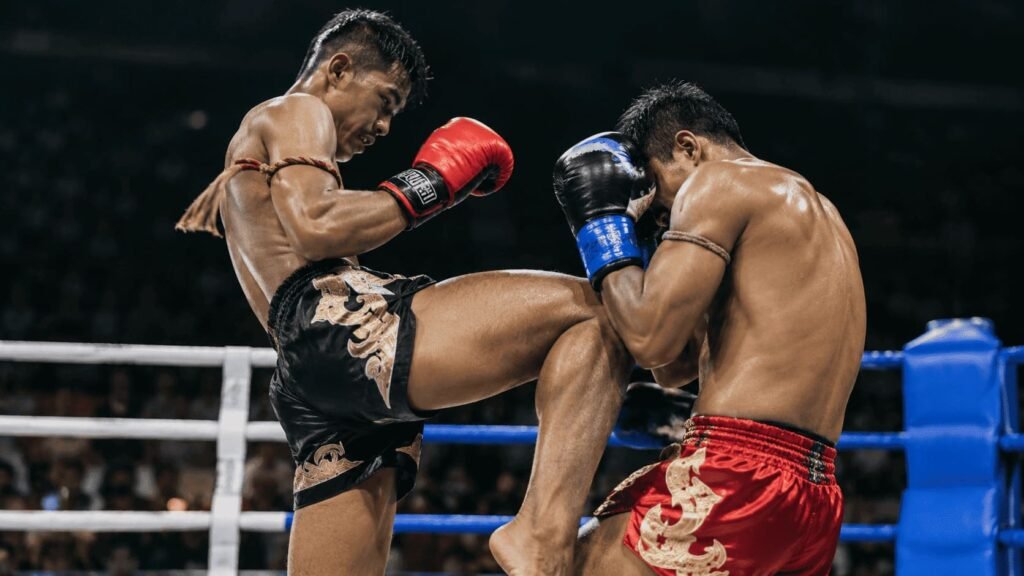
Bring both pads together in front of your body and angle them to the side, away from your centerline. This is where holding actually gets physical. A kick carries far more force than any punch, and the pads need to be stacked so the impact spreads across both forearms instead of buckling one arm alone.
The Teep
Use a belly pad if you have one, or angle a single Thai pad flat against your stomach and hips. A teep, sometimes called a push kick, is about pushing an opponent away rather than snapping through them, so you want a surface that lets you actually feel and absorb that shove.
Holding for Kicks Without Getting Hurt
Kicks are where new holders get injured, mostly from standing in the wrong spot. Never stand directly in the line a kick travels. If your partner throws a right roundhouse, that kick has a flight path, and your body has no business being anywhere along it except the small window where the pads intercept it.
Angle your body slightly off that line before you call the kick. Brace through your legs, not just your arms, since a full-power roundhouse will move your whole upper body if your base isn’t solid. Beginners often try to catch kicks the same way they catch punches, arms only, and end up getting knocked sideways.
Keep your elbows tucked here too. A kick that slips past the pad edge and catches your forearm bare is painful but survivable. One that catches your unprotected ribs because your elbow was flared out is a different story.
3 Starter Combos to Call
New holders freeze up on what to actually call out loud. Start with these three and build from there once they feel automatic.
- Jab, cross, hook. The classic three-punch combo. Flat pad, flat pad, then rotate to 90 degrees for the hook.
- Jab, cross, low kick. Teaches the transition from hands to a kick without a pause in between. Flat, flat, then bring both pads together and angle away from center.
- Cross, teep, cross. Works the push kick into a punch combo, which is common in actual sparring exchanges. Flat pad for the cross, belly pad or angled pad for the teep, back to flat.
Pacing Your Partner
A good holder reads the room before calling anything. If your partner is breathing hard thirty seconds into a round, that’s not the moment to demand five-strike combos thrown at full speed. Slow the pace, call simpler two-strike combos, let them recover a little while still working.
The reverse matters too. If someone’s fresh and clearly wants to push harder, holding them to a slow, easy rhythm the whole round wastes their training time. Watch their footwork and their breathing, not just their hands, and adjust what you’re calling in real time.
Timing your calls matters as much as the combo itself. Call the next strike just as the current one lands, not a full second later. A delayed call breaks the striker’s rhythm and turns a flowing round into a stop-start mess.
If your gym runs structured rounds, the same rhythm principles that guide a beginner’s speed training exercises apply to how you call combos as a holder, matching tempo to what the striker can actually sustain.
Common Holder Mistakes
Holding the pads too far from your body is the mistake that causes the most damage, and it’s rarely on purpose. New holders extend their arms out to get a “better look” at the strike coming in, but that extended position gives the striker’s hand or shin nowhere to transfer force except straight back into their own shoulder. Keep the pads close, near your chest and forearms, and let your arms absorb the impact instead of your partner’s joints doing the work.
Standing too stiff is another one. Locked knees and a flat stance mean every kick rocks you back on your heels, which then throws off the angle for the next strike.
Calling combos your partner hasn’t learned yet is a subtler mistake. If class covered jab-cross-hook that day, don’t suddenly call a spinning back kick because you saw it online. Stick to what’s already been taught, the kind of foundation covered in most beginner training guides, until your partner tells you they want to freestyle.
As you get more comfortable, start moving away from called combos altogether. Free-form holding, where you react to whatever your partner throws and call the next strike based on their positioning, is the real test of whether you’ve actually learned the skill or just memorized three combos. It takes months to get comfortable there. Most people who hold pads for years are still improving at it.
FAQ
Do I need special pads to start holding? No. Any set of Thai pads works for beginners. What matters more is your stance and angle, not the equipment itself.
How do I know if I’m holding pads correctly? Ask your partner. If a strike feels wrong, painful in the wrist, or off-balance, on their end, the angle or your positioning is usually the cause.
Can holding pads actually improve my own skills? Yes. Reading a partner’s rhythm, timing your calls, and understanding strike mechanics from the receiving end all carry over directly to your own striking.

One Comment