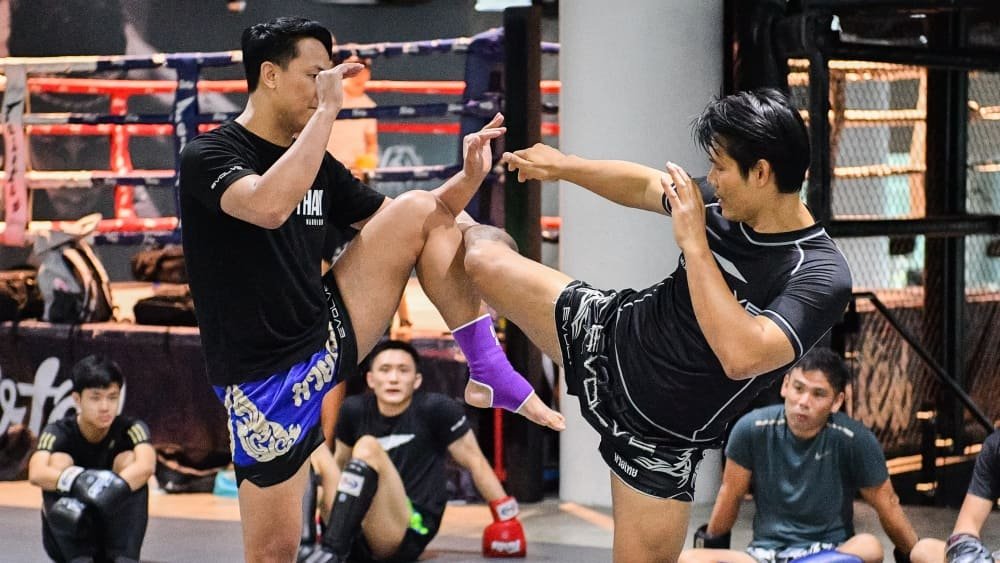
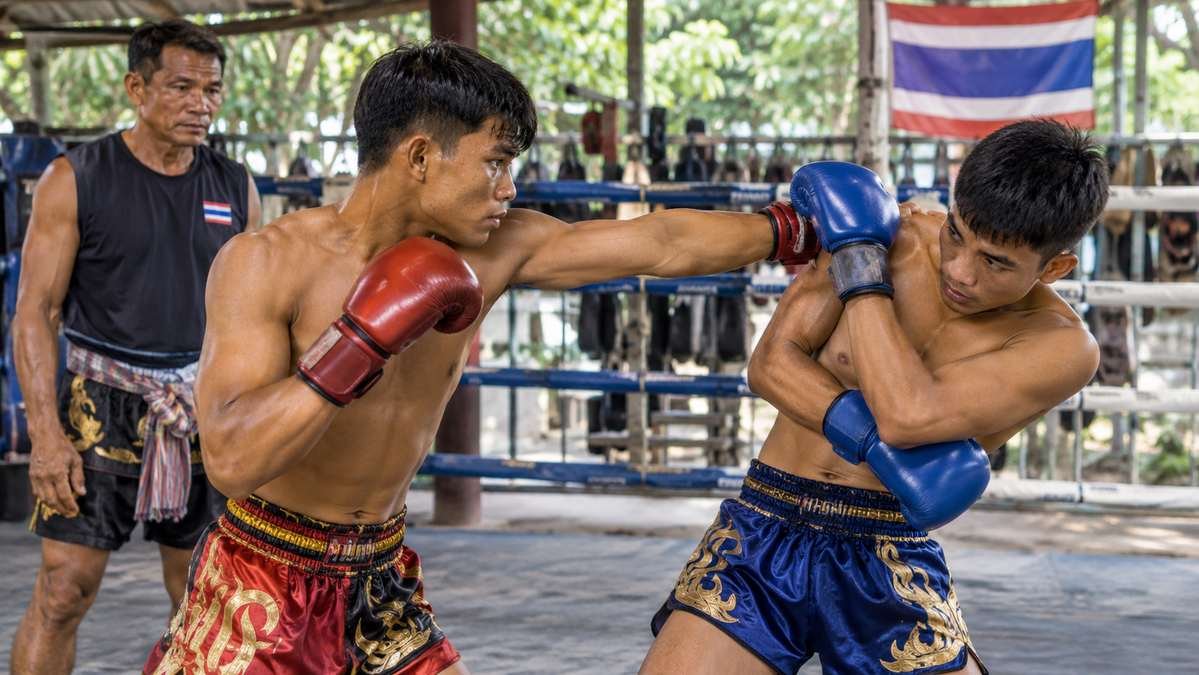
Two students stand an arm’s length apart on a worn canvas. The older one steps in behind a left jab thrown at half speed. The younger one moves his right foot a half step aside, tilts away, and lets the fist pass his ear. His right hand settles on the attacker’s upper arm, his left closes on the wrist, and for a moment they hold the pose like figures on a temple mural. The teacher at the ropes says nothing, which in a Thai gym usually means it was acceptable.
They are rehearsing the first entry in the Mae Mai Muay Thai, the fifteen master techniques Thai teachers have treated for generations as the grammar of the art. Few people who train abroad learn them by name. They repay the effort, for what they teach about distance and angles and for the small story each name carries.
What does “Mae Mai” mean?
Thai teachers sort the techniques of their art into tiers. Mae mai translates roughly as “mother moves,” the parent techniques from which everything else is born. Below them sit the luk mai, the “child moves,” finer variations, and beyond those the kon muay, tricks and counters that individual teachers invented and named for their own students.
A Thai youth encyclopedia calls the mae mai the techniques a student must perform before moving on to the luk mai. Every entry is a dialogue. One person, the fai ruk (attacking side), throws something. The other, the fai rab (receiving side), answers it. If you have already worked through the basic moves beginners learn, the mae mai are the next layer: the same punches, kicks, knees, and elbows, now arranged as answers to a specific question.
Most of those questions are a straight punch. A few are a roundhouse kick.
The fifteen Mae Mai Muay Thai techniques at a glance
The list below follows the order used by a long-established gym in Rangsit, north of Bangkok. Sources agree on the names, though the last two sometimes swap places and the side of a given step varies by teacher.
| # | Thai name | Rough English meaning | Incoming attack | The answer |
| 1 | Salab Fan Pla | Alternating fish teeth | Jab | Slip outside, trap arm and wrist |
| 2 | Paksa Waeg Rang | Bird parting the nest | Jab | Step inside, both forearms up |
| 3 | Chawa Sad Hok | The Javanese hurls a spear | Straight punch | Slip, elbow to the ribs |
| 4 | Inao Tang Kris | Inao stabs with his kris | Right straight | Parry, horizontal elbow to ribs |
| 5 | Yok Khao Phra Sumen | Raising Mount Meru | Jab | Drop low, rise with uppercut |
| 6 | Ta Then Kam Fak | The old monk props the pod | Jab | Deflect upward, uppercut |
| 7 | Mon Yan Lak | The Mon braces the pillar | Jab | Lean back, push kick to chest |
| 8 | Pak Luk Toy | Driving in the peg | Roundhouse to ribs | Elbow point into the shin |
| 9 | Chorakhe Fad Hang | Crocodile whips its tail | Missed jab | Spinning back heel kick |
| 10 | Hak Nguang Aiyara | Breaking the elephant’s trunk | Roundhouse | Catch leg, elbow the thigh |
| 11 | Naka Bid Hang | The naga twists its tail | Roundhouse | Catch and twist foot, knee the leg |
| 12 | Wirunhok Klap | Virudhaka turns back | Mid kick | Heel push into the hip, spin him |
| 13 | Dap Chawala | Snuffing the lamp | Jab | Press the arm down, counter punch |
| 14 | Hak Kor Erawan | Breaking Erawan’s neck | Jab | Clinch the neck, knee to face |
| 15 | Khun Yak Jab Ling | The giant catches the monkey | Punch, kick, elbow | Three-part defense |
Seven ways to meet a straight punch
The first seven all begin with a straight punch at the face. They differ in where the defender goes.
Outside and inside: Salab Fan Pla and Paksa Waeg Rang
Salab Fan Pla is the scene from the gym. The defender steps right, leans away (the Rangsit instructions say near 60 degrees), and ends up outside the punching arm, hands on the upper arm and wrist in a grip that resembles the start of an arm break. Teachers treat it as the first lesson in getting off the line.
Paksa Waeg Rang goes the other way. The defender steps forward, inside the jab, and raises both forearms against the attacker’s arm, fists together in a shape the text compares to a wai, the Thai greeting with pressed palms. The eyes watch the rear hand, because it is coming next. Nothing hits anyone here. The move exists to get you inside safely.
Two elbows with foreign names: Chawa Sad Hok and Inao Tang Kris
Both names point toward Java. Chawa is the Thai word for Javanese, and Inao is the prince-hero of a Thai court epic adapted from the Javanese Panji tales, armed here with the wavy-bladed kris. In Chawa Sad Hok the defender slips the punch, leans about 30 degrees, and drives the left elbow into the ribs under the attacker’s arm. In Inao Tang Kris the left hand parries a right straight, the right foot steps in, and the right elbow travels parallel to the floor into the ribs. The spear and the dagger are both elbows.
Down and up: Yok Khao Phra Sumen and Ta Then Kam Fak
Phra Sumen is Mount Meru, the mountain at the center of the Buddhist and Hindu cosmos, and its technique is an uppercut thrown while rising from a crouch. The defender sinks forward about 45 degrees, lets the jab pass overhead, then straightens the right leg and drives the right fist under the chin.
Ta Then Kam Fak reaches the same target differently. The defender steps inside, knocks the punch upward with a bent arm, and uppercuts with the other hand. One ducks under, the other lifts the problem away.
The pillar: Mon Yan Lak
The seventh technique answers a punch with a foot. The defender rocks back and away, raises both arms, and plants the sole of the foot in the attacker’s chest or stomach hard enough to send him backward. The Mon are among the oldest peoples of the region, and the image is a man bracing a post. Anyone who has studied how the teep works will recognize it at once.
When the attack is a kick
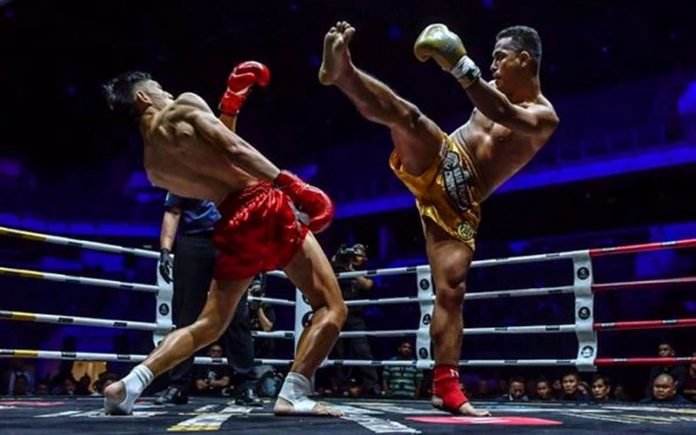
Techniques 8, 10, 11, and 12 change the question to a roundhouse kick aimed at the ribs, and most of the answers accept the kick rather than run from it.
In Pak Luk Toy the defender turns toward the leg and meets the shin with the point of the elbow, the other arm held higher in case the kick rides up. A luk toy is a peg driven into a surface, which is a fair description of an elbow point meeting a shin.
Hak Nguang Aiyara, breaking the elephant’s trunk, has the defender step chest to chest with the kicker, catch the leg, lift it high, and drive the right elbow into the upper thigh. Naka Bid Hang, named for the serpent spirits of temple art, catches the kick at heel and toes, twists the foot outward, and knees the calf or knee joint.
Wirunhok Klap takes its name from Virudhaka, one of the four guardian kings of Buddhist cosmology. Nothing is caught. The defender fires his heel into the upper thigh of the kicking leg, fast and hard enough, the instructions insist, to spin the attacker around.
Spinning, snuffing, breaking
Chorakhe Fad Hang is the showpiece. The attacker misses a jab and stumbles forward, and the defender hops aside, pivots on the left foot, and whips the right heel into the stomach or neck: a spinning back kick, long before kickboxing gyms made it fashionable.
Dap Chawala, snuffing the lamp, is modest by comparison. The defender steps outside the jab, presses the arm down, punches the face, and springs away at an angle. Hak Kor Erawan is the least subtle entry. Erawan is the three-headed elephant ridden by the god Indra, and here the defender brushes the jab aside, leaps in, pulls the head down, and knees the face.
The giant and the monkey
The final mother move is taught in three parts, because it answers a sequence rather than a single strike. The Rangsit instructions call it a very important technique for handling an opponent who punches, kicks, and elbows in a continuous chain.
- The attacker jabs. The defender steps in and uses the right arm to sweep the punching arm off the body.
- The attacker follows with a right roundhouse to the ribs. The defender shifts back and to the side, sinks, and drives the right elbow into the kicking thigh.
- The attacker bends his right arm and comes down with an elbow at the head. The defender raises a bent arm to meet it under the elbow, then rocks away and steps back about half a pace.
Teachers tend to save it for last.
Why several of them rarely appear on fight night
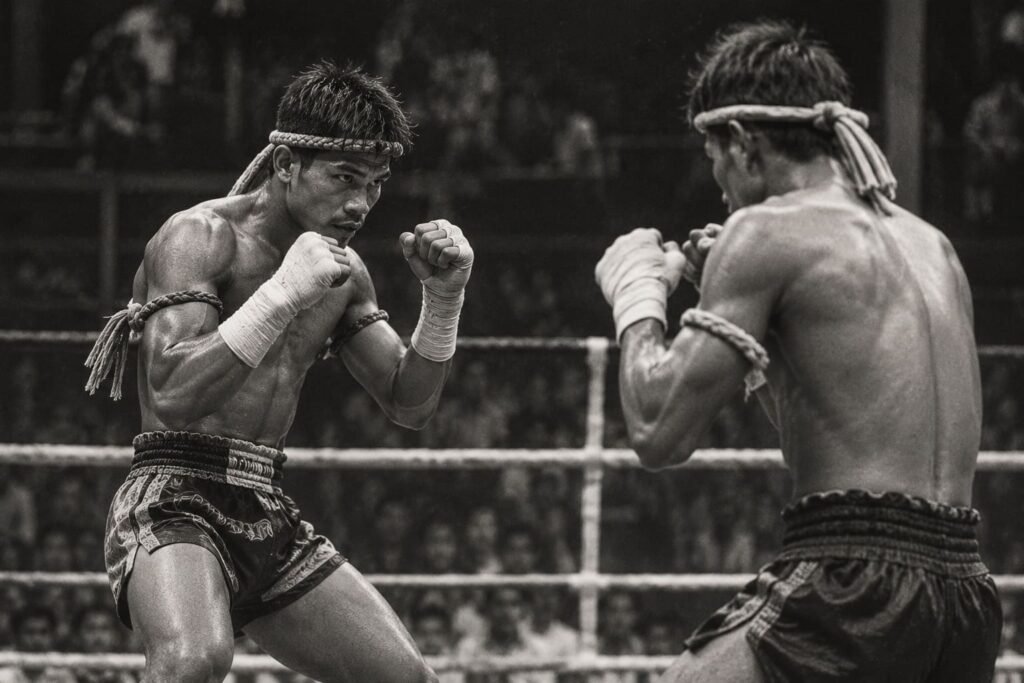
The Rangsit gym’s explanation is plain. Fighters once fought bare-handed or with hands wrapped in raw cloth, free to grab, throw, and twist. Gloves and modern rules turned some old moves into fouls, made others awkward through padding, and let several fade away. The grips in Salab Fan Pla, the foot twist of Naka Bid Hang, and the elbow driven into a caught leg belong more comfortably to the older fighting culture that people now call Muay Boran and its roots than to a stadium bout under current rules.
The principles survive, though. Stepping off the centerline, entering behind raised forearms, meeting a kick with a bony point: those ideas are everywhere in modern Muay Thai, even when nobody in the corner calls them by their old names.
How the mother moves are drilled
The Thai sources insist that a student be fluent with each weapon alone before combining them in the mae mai. In practice that means slow partner work, with the attacker throwing a real jab on a real line, not a lazy arm that flatters the defense.
Drill each technique from both sides, since teachers disagree about which foot steps where. Hold the finishing position for a count to check the lean and the hands. Save the grabs, twists, and elbows to the leg for controlled contact with a partner you trust. After those feel natural, start on the luk mai, which is exactly the order the old teachers intended.
FAQ
How many Mae Mai Muay Thai techniques are there?
Fifteen, although the order of the last two (Hak Kor Erawan and Khun Yak Jab Ling) varies between sources.
What is the difference between mae mai and luk mai?
Mae mai are the “mother” techniques, mastered first. Luk mai are the “child” variations built on them and taught afterward.
Are the Mae Mai legal in modern Muay Thai fights?
Their principles are. Some actions, such as twisting a caught limb, clash with modern rules or are impractical in gloves.
Can a beginner learn the Mae Mai?
Yes, once the basic strikes feel comfortable. Go slowly with a cooperative partner and learn both sides.