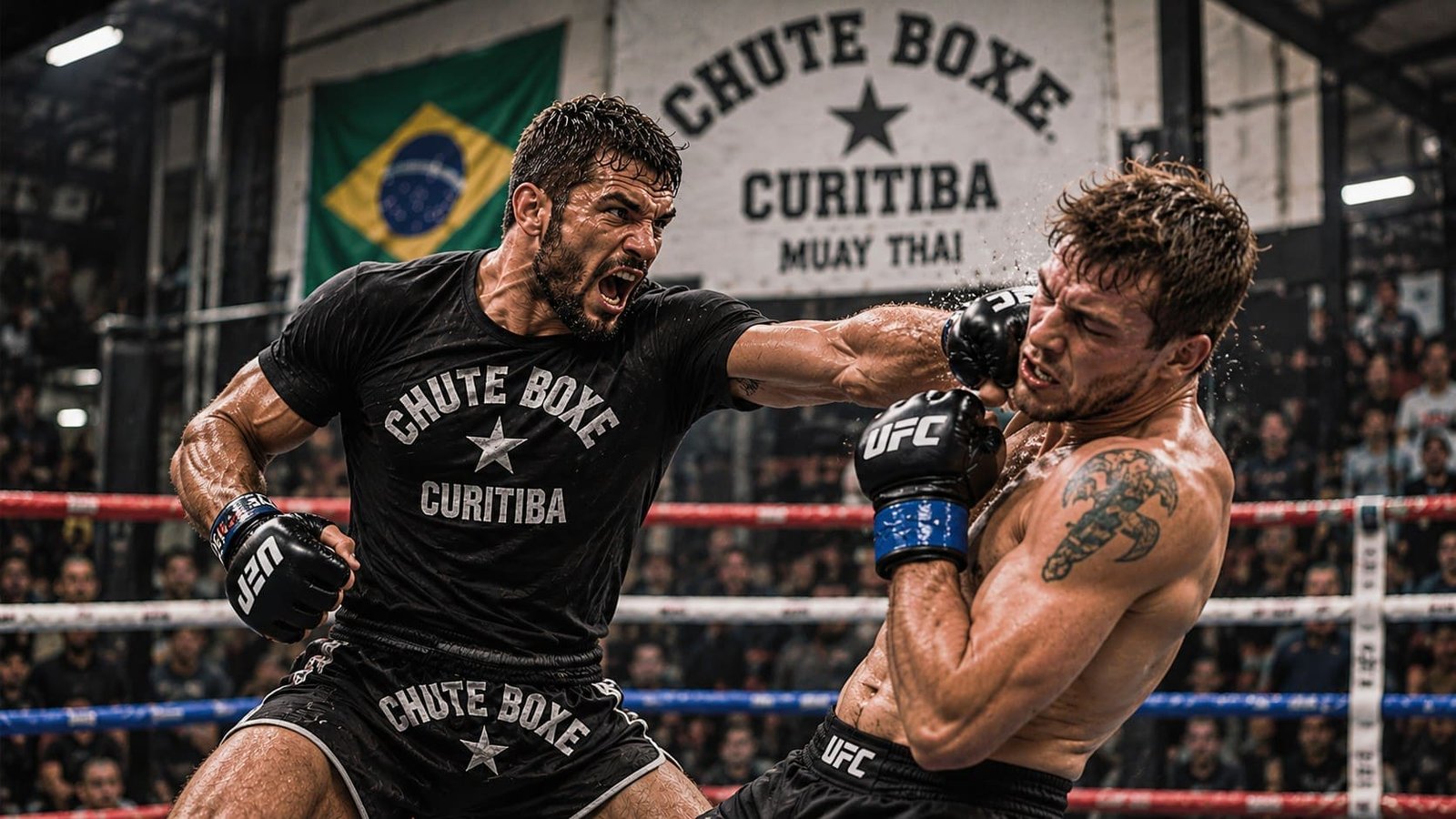
Every sport keeps a few addresses that people speak of the way old baseball writers spoke of certain ballparks, with a lowered voice and a small smile. In mixed martial arts, one of those addresses sits in Curitiba, a cool, rainy city in the south of Brazil that nobody would have picked as a factory for violence. Chute Boxe began there in 1978 as a plain Muay Thai school. Within twenty-odd years its fighters were walking into Japanese arenas with shaved heads and bad intentions, and the rest of the sport had to learn a new word for trouble.
The name itself is a small joke on the outsider. “Chute” is Portuguese for kick, so the gym is, more or less, Kick Boxing. What came out of it was something wilder than the name suggests.
A Square Before a Gym
The family tree starts with Nélio “Naja” Borges de Souza, a taekwondo black belt who went looking in the 1970s for a striking art with fuller contact, found Muay Thai, and carried it home to Brazil. He settled in Curitiba. One of his students was Rudimar Fedrigo, the son of immigrants, and in 1978 Fedrigo started a team of his own.
He did not have a room to put it in. The first classes were held outdoors, in Praça Oswaldo Cruz, a public square in the middle of the city, where passersby could watch young men throw kicks at each other between the benches and the trees. There is something lovely in that picture, and something prophetic, too. Chute Boxe never did learn to train politely.
A real home came later, when an abandoned warehouse was converted into the Thai Gym, described in Brazilian retellings as the only Thai-style training hall in the country at the time. The engine of the place was internal competition. Every weekend, students fought one another, and the results sorted the ordinary from the dangerous. Anderson Silva, José “Pelé” Landi-Jons, and Rafael Cordeiro all came through that weekend sieve.
What the Chute Boxe Style Looked Like
Brazilian Muay Thai in those years had a slightly different accent from the Thai original. Many of the first Brazilian nak muay (the Thai term for a Muay Thai fighter) arrived from taekwondo and Kyokushin karate, so the early game leaned heavily on varied kicks. That kind of crossover is common, and some backgrounds carry over better than others, as anyone comparing which combat sports adapt fastest will notice. In Curitiba, though, the kicking soon became secondary to a temperament.
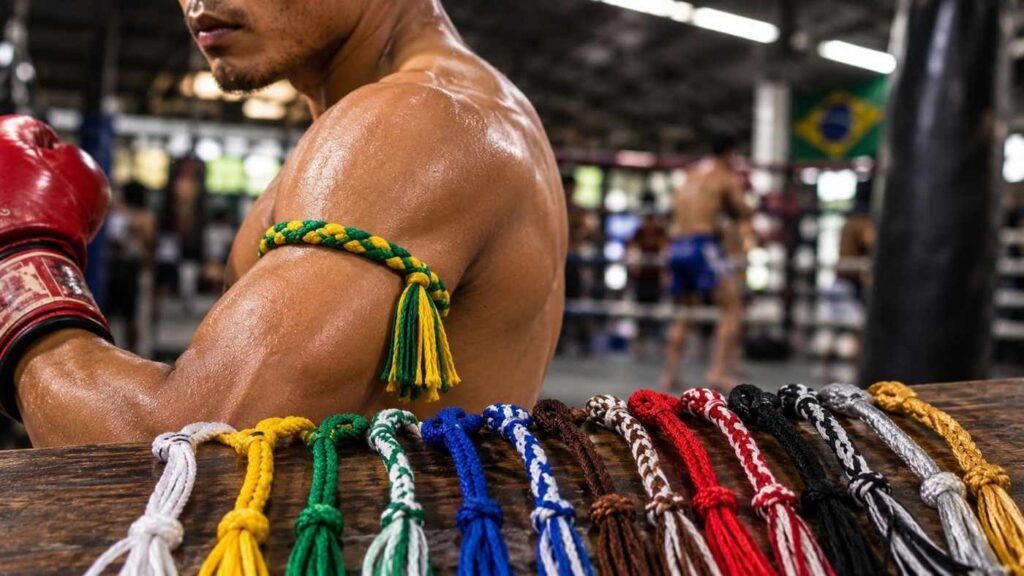
The Chute Boxe style, as Brazilians came to describe it, was ferociously aggressive: wild combinations, heavy low kicks, a notable shortage of defense, and one governing idea, which was to finish the other man as fast as possible. Fedrigo’s gym also introduced colored prajied (the cloth armbands Thai fighters wear) as a ranking system, a belt-style ladder borrowed from other martial arts that Thailand itself has never used.
Here is how the school’s habits compared with the textbook version most Western beginners meet:
| Element | Traditional Thai approach | Chute Boxe approach |
| Pace | Patient early rounds, reading the opponent | Pressure from the opening bell |
| Defense | Checks, guard, and balance valued highly | Often sacrificed for volume |
| Kicks | Round kick to the body as a scoring weapon | Heavy low kicks to break the legs |
| Clinch | Knees and off-balancing to score | Plum clinch as a launch pad for knees to the face |
| Ranking | No colored grading in Thai camps | Colored prajied as a belt ladder |
| Goal | Win the fight on the judges’ eyes | End it early |
Friburgo, 1989: Five Shaved Heads
Every dynasty has a founding legend, and this one has a bus ride. In 1989, Fedrigo took five fighters to the Brazilian national Muay Thai championship in Friburgo, in the state of Rio de Janeiro. Among them was a young Wanderlei Silva. The trip took about twelve hours. The five, with their heads shaved, went through the field in a manner that left the rest of the country’s Muay Thai people blinking, and Curitiba’s claim as the capital of the sport in Brazil dates from that weekend.
One would like to have been in the stands. The picture of five skinheads climbing off a long bus and dismantling the national elite has the shape of a movie, and the facts, as far as they go, support it.
The Turn Toward Vale Tudo
The pivot came in 1991. Brazil had just watched a notorious televised challenge between jiu-jitsu and luta livre (a Brazilian submission-grappling rival to the Gracies), and Fedrigo saw in that brawl where fighting was heading. He widened the Chute Boxe program to include wrestling and Brazilian jiu-jitsu. By 1995 the team was regarded as a prime training camp for vale tudo, the “anything goes” no-holds-barred bouts that preceded modern MMA.
The distinction between the two sports still matters to anyone starting out, and the question of whether to train MMA first has a Chute Boxe answer built into it: the striking base came first, and everything else was bolted on around it.
Rivalries followed, the most famous of them between Pelé Landi and Jorge “Macaco” Patino, a grudge that had Brazilian fans choosing sides. Then came the International Vale Tudo Championship, the IVC, the country’s premier no-rules promotion of the late 1990s. Chute Boxe fighters took three of its titles: Wanderlei Silva, Pelé Landi, and Rafael Cordeiro each wore a belt. The IVC became the gym’s doorway to Japan.
The PRIDE Years
What Chute Boxe did in PRIDE Fighting Championships is the reason its name travels. The rules in Japan allowed knees to the head of a downed opponent, stomps, and soccer kicks, and Curitiba had been training for exactly that sort of evening for years.
Wanderlei Silva was the centerpiece. He won the inaugural PRIDE middleweight title (the 205-pound class, which PRIDE called middleweight) on November 3, 2001, by beating Kazushi Sakuraba for the second time, and he held it until Dan Henderson knocked him out at PRIDE 33 on February 24, 2007. Along the way he beat Sakuraba three times and Quinton “Rampage” Jackson twice, and he walked to the ring with a stare that made grown men check their exits. His clinch knees were the purest expression of the Chute Boxe idea anybody has put on film.
The Rua brothers came next. Murilo “Ninja” Rua was the elder and the steadier. His younger brother, Mauricio “Shogun” Rua, became the most successful fighter the gym ever produced. On August 28, 2005, in the PRIDE middleweight Grand Prix, the Brazilian Top Team’s Ricardo Arona beat Wanderlei in the semifinal and seemed, for a few hours, to have broken the spell. Later that night Shogun knocked Arona out in the first round of the final, on the mat, which was supposed to be Arona’s territory. A rivalry between the two Brazilian camps that had been simmering for years boiled over that evening.
Shogun later won the UFC light heavyweight title by knocking out Lyoto Machida in 2010 and lost it in his first defense to Jon Jones at UFC 128. The broader story of Muay Thai fighters in the UFC has few chapters as loud as his.
Cris Cyborg belongs in this company as well. She built her toughness sparring with men at the gym, and after losing her professional debut in 2005 she went unbeaten for roughly thirteen years, a run that shaped women’s MMA as surely as Wanderlei shaped the men’s middleweights.
Anderson Silva, meanwhile, fought in PRIDE while still with Chute Boxe, then left after disputes with the gym’s management and went off to train with the Nogueira brothers of the rival camp. Fedrigo never quite forgave him. Silva, for his part, credited those new friendships with saving his career, and what he built afterward in the UFC is well known.
When the Family Scattered
PRIDE folded in 2007, and the Chute Boxe roster seemed to fold with it. Wanderlei left around the same time. The Rua brothers and André “Dida” Amade departed to open their own gyms, and Rafael Cordeiro went to California to found Kings MMA, where in 2020 he spent five months preparing Mike Tyson for his exhibition with Roy Jones Jr.
Fedrigo, speaking in 2014, said the organization had 22 gyms across Brazil and that the Curitiba headquarters alone counted around 5,000 students. He also admitted that producing another dominant generation had grown much harder in a sport where every camp now trained everything.
The lineage kept going anyway. In São Paulo, coach Diego Lima built a branch known as Chute Boxe Diego Lima, and it became one of the strongest modern gyms carrying the name. Charles Oliveira joined it in 2018, looking for sharper striking to go with his jiu-jitsu, and in May 2021 he stopped Michael Chandler to win the UFC lightweight title. In 2023 Fedrigo awarded him a black prajied in Muay Thai, which is the kind of gesture that tells you where a family thinks its roots are.
The Chute Boxe Tree at a Glance
| Name | Chute Boxe role | Where the road led |
| Rudimar Fedrigo | Founder, 1978 | Still the patriarch of the Curitiba school |
| Wanderlei Silva | 1989 Friburgo team, IVC champion | PRIDE middleweight champion, 2001 to 2007 |
| Mauricio “Shogun” Rua | PRIDE fighter | 2005 PRIDE Grand Prix winner, UFC champion |
| Cris Cyborg | Trained with the men | Long unbeaten run in women’s MMA |
| Rafael Cordeiro | Weekend-fight product, IVC champion | Founded Kings MMA in California |
| André “Dida” Amade | Coach and fighter | Opened his own gym, Brazilian TKO |
| Cristiano Marcello | Grappling coach | Founded CM System |
| Diego Lima | Branch leader | Chute Boxe Diego Lima in São Paulo |
What a Muay Thai Student Can Borrow From Curitiba
Nobody sensible should copy the defensive habits. The old Chute Boxe fighters paid for their abandon with a great many hard nights, and a beginner who drops the guard to throw a fourth hook will learn the same lesson more cheaply in sparring.
The rest is worth stealing. Build the striking base first and let the other skills attach to it. Keep the low kick heavy and honest. Treat the clinch as a place where fights get finished rather than stalled. And if your gym runs a friendly internal fight day, go, because the weekend sieve in a warehouse in Curitiba made more champions than any fancy facility ever has.