Background matters in Muay Thai. It just matters a lot less than most people walking into their first class assume. A former wrestler and a former soccer player will both be better off than a total beginner in month one, but by month six the gap between them and the person who showed up with zero athletic history has mostly closed. What separates fighters at that point isn’t what sport they used to play. It’s who kept showing up.
Still, the question is worth answering honestly, because it comes up constantly. Reddit threads on r/MuayThai fill up every few weeks with some version of “I did wrestling for eight years, will that help?” or “I’ve never played a sport in my life, am I doomed?” Below is a real ranking, sport by sport, with the actual mechanism behind each transfer explained rather than just asserted.
What Actually Transfers Between Sports
Athletic transfer works through three channels: movement patterns your body already owns, conditioning your lungs and legs already have, and habits your nervous system has to unlearn. The first two help. The third can actively slow a new fighter down, which is why some backgrounds that sound perfect on paper don’t play out that way in the gym.
A wrestler’s hips already know how to fight for position at close range. A distance runner’s aerobic base means five-round sparring doesn’t wreck them the way it wrecks a sedentary beginner. But a boxer’s guard, built around slipping punches with a squared-up stance, can fight against the wider, more loaded stance Muay Thai needs for checking kicks. Transfer isn’t a single dial that goes from zero to maximum. It’s a mix of gifts and debts, and the ranking below sorts backgrounds by the net of the two.
The Ranking
Wrestling and Judo: The Clinch Is Already Half-Built
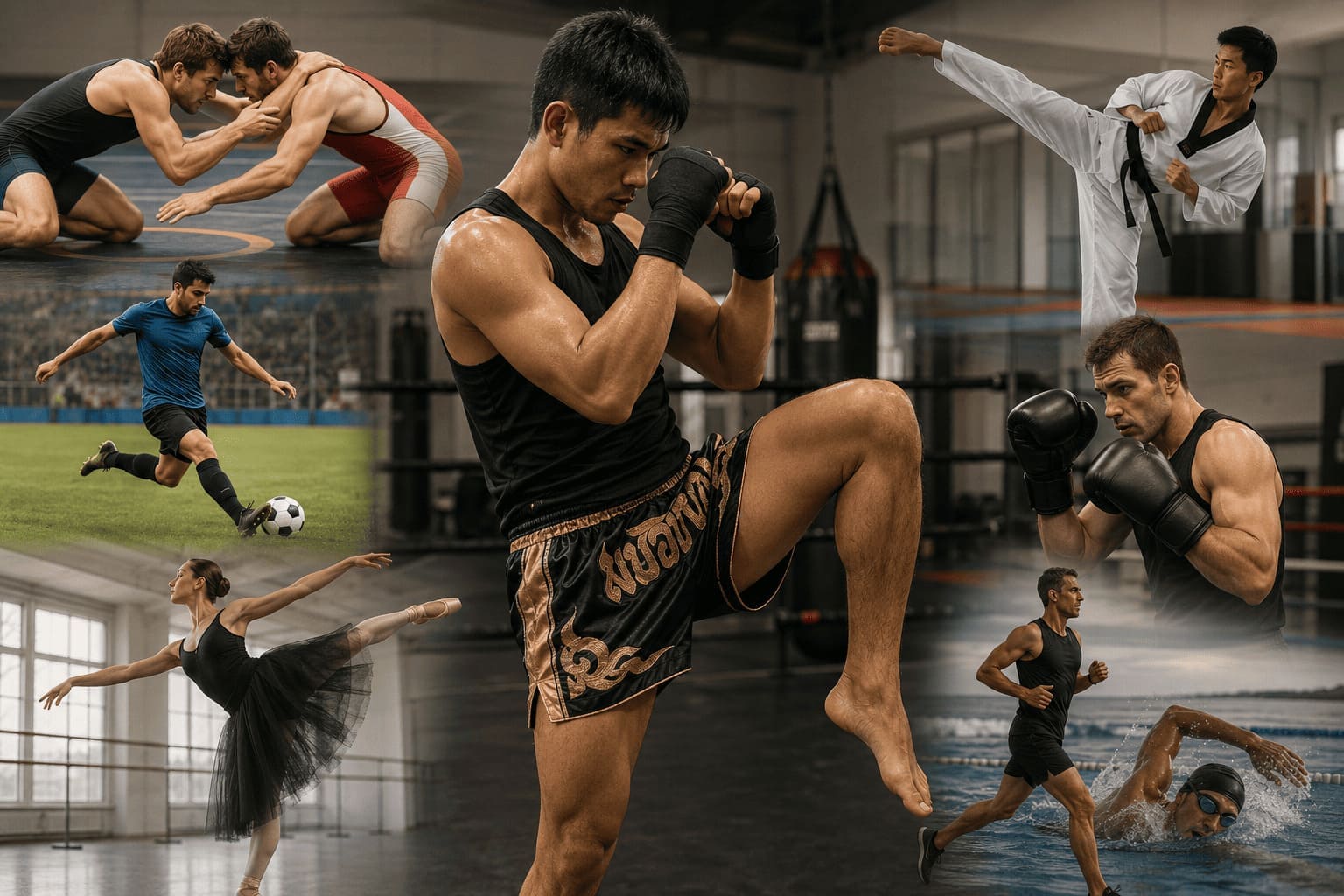
Wrestlers and judokas walk in with the single most valuable transferable skill in Muay Thai: comfort in close-range grappling. The clinch, where fighters fight for head and neck control before throwing knees, terrifies most beginners. It doesn’t terrify someone who has spent years fighting for underhooks. Their base is lower, their balance under pressure is better, and they already understand that a fight for position is won in small increments, not one big move. What they need to add is striking under fatigue and the specific grip patterns of Thai clinch, which differ from a double-leg attempt but rhyme with it closely enough that most wrestlers pick it up fast.
Soccer: The Underrated Powerhouse
This one surprises people. Soccer players bring hip mobility that most other athletes spend years chasing, the kind needed to throw a full roundhouse kick without straining the groin on day one. Ninety minutes of running, cutting, and changing direction also builds a specific kind of endurance that maps onto Muay Thai’s pace better than steady-state cardio does. And years of controlling a ball with the feet translate into footwork awareness that most striking beginners lack entirely. Soccer rarely gets mentioned in these conversations, which is a mistake. It quietly ranks near the top.
Ballet and Dance: A Surprisingly Strong Start
Balance, rhythm, and body awareness are the three hardest things to teach a raw beginner, and dancers already have all three. A former ballet student can often land a spinning technique or hold a one-legged check within their first month, something that takes other beginners far longer. The gap shows up on the offensive side. Dance doesn’t teach anyone to generate force through the hips the way a kick requires, and it certainly doesn’t teach anyone to stay calm while someone else is trying to hit them back.
Taekwondo and Karate: Kicks Yes, Hands No
Distance management and kicking mechanics transfer well from these backgrounds. A taekwondo athlete usually has a sharper sense of range than a total beginner, and the leg is already conditioned to some degree. The catch is the hands. Traditional taekwondo and many karate styles use limited hand technique compared to Muay Thai, so a lot of these athletes arrive with a kicking game well ahead of their peers and a jab that needs to be built almost from scratch.
Boxing: The Paradox
Boxers should be the easiest transfer in the sport. Their hands are fast, their head movement is often excellent, and they already know what it feels like to trade under pressure. Here’s the paradox: years of pure boxing can leave a fighter overtrained in exactly the wrong stance for kicks. Boxing rewards a narrow, squared base built for slipping and rolling. Muay Thai rewards a slightly wider, more angled stance that lets a fighter check kicks and load the rear leg. Breaking that habit takes real, deliberate practice, and more than one boxer has found their hands to be the best part of their game while their feet were the part holding them back. For a deeper look at how the two disciplines actually differ in the ring, see Muay Thai vs Boxing: Who Would Win.
Swimming and Running: Great Engine, No Combat Skill
Pure endurance sports build the best cardiovascular engines of any background on this list. That matters enormously in later rounds. What they don’t build is any combat-specific coordination at all: no clinch sense, no kicking mechanics, no comfort with incoming contact. A marathon runner will outlast plenty of people in round five and still get outclassed technically the whole way through.
The Head-Start Table
Rough estimate of how many months of technical adjustment a background can save a beginner, based on typical coaching observations rather than any formal study.
| Background | Estimated head-start |
| Wrestling / Judo | 4-6 months |
| Soccer | 3-4 months |
| Ballet / Dance | 2-3 months |
| Taekwondo / Karate | 2-4 months (kicks yes, hands minimal) |
| Boxing | 2-3 months (partially offset by stance rebuild) |
| Swimming / Running | 1 month (conditioning only) |
| No athletic background | 0 (baseline) |
The Boxer’s Paradox, Revisited
It’s worth sitting with this one a bit longer, because it trips up a lot of genuinely talented athletes. A boxer’s instincts aren’t wrong. They’re specialized. Years of drilling a narrow stance and a specific set of head-movement reflexes builds real skill, just skill tuned to a sport where kicks and knees don’t exist. Coaches often see this play out in the first few sparring sessions: the boxer’s hands are clearly the best in the room, but their legs get checked or kicked out because the stance simply wasn’t built to defend against them. None of this means boxing is a bad background. It means the adjustment period looks different than most people expect, front-loaded on offense, back-loaded on defense.
Starting From Zero: Not a Death Sentence
Here’s the part that matters most and gets said the least: no sports background, including the ones ranked at the top of this list, teaches a person to stay relaxed while getting hit. That skill only comes from actual training, from getting caught with a leg kick in week three and coming back in week four anyway. Every fighter on every list above still had to learn that, usually the hard way.
So if none of this describes you, if you’ve never wrestled, kicked a ball, or thrown a punch in your life, that’s genuinely fine. The gap closes faster than most beginners think, often within a few months of consistent classes. What actually predicts who becomes a good Muay Thai fighter isn’t the sport listed on an old team roster. It’s whether someone kept walking through the gym door. For a full breakdown of what those first months should actually look like, the beginner’s guide to Muay Thai training is a good place to start.