

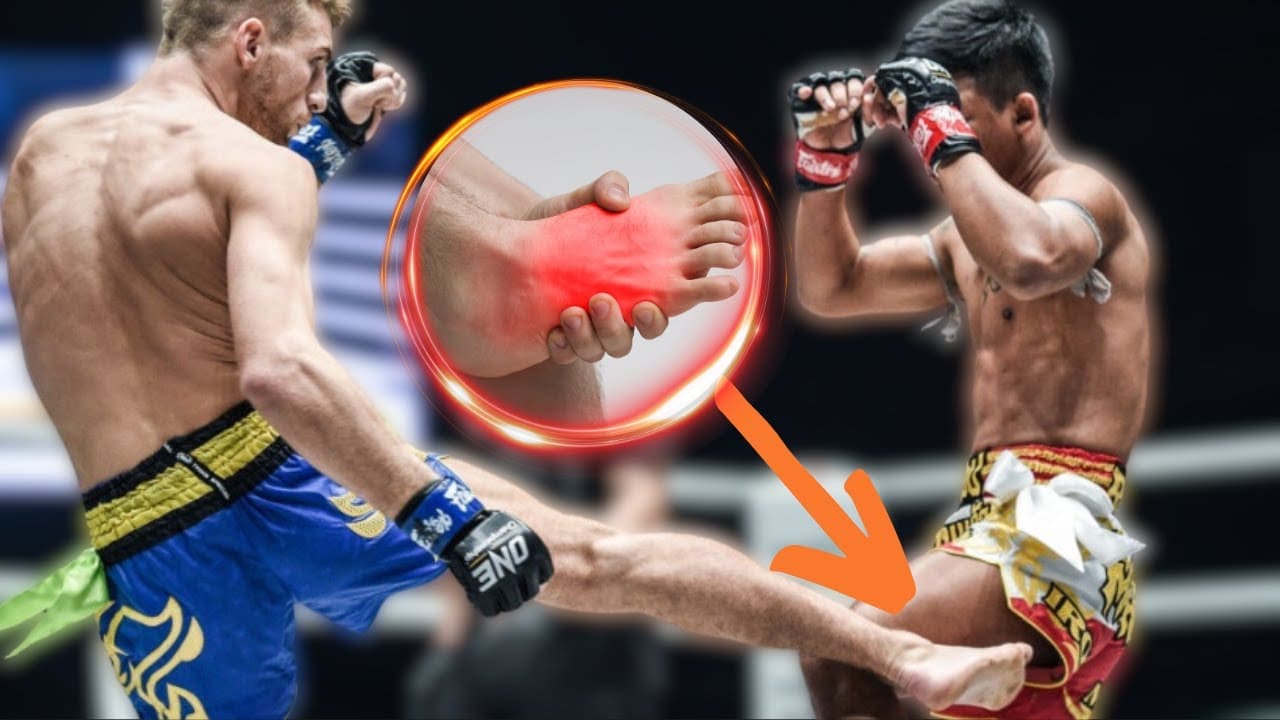
Absorbing leg kicks on the thigh is a losing strategy. It might survive one sparring round or even one fight, but the muscle takes damage that compounds. Bruised tissue swells, the leg stiffens, mobility drops, and the next kick lands on ground that’s already softened up. Fighters who never learn to check end up limping out of their own gyms. The fix isn’t toughness. It’s a technique, and like every technique it can be taught, drilled, and fixed when it breaks down.
Checking is the practical middle ground between eating a kick and getting fancy with a catch. Done right, it turns the shin bone into a wall the opponent’s shin has to smash into. Done wrong, it’s just a different way to get hurt.
Check Mechanics, Step by Step
The check starts at the knee, not the foot. Lift the knee up and slightly across the body, driving it toward the incoming kick rather than just raising the leg straight up. The shin should end up close to vertical, angled a few degrees inward, presenting a flat surface rather than a soft edge.
Weight stays on the standing leg the entire time. This sounds obvious until it’s tested live: many beginners lean back or hop away as they lift, which shifts weight onto the checking leg right as impact arrives and turns a solid block into a wobble. The standing leg should be slightly bent, hips low, foot planted so the whole structure can absorb force without buckling.
Contact should happen on the upper third of the shin, the thick part just below the knee, not near the ankle where the bone is thinner and more exposed. Meeting the kick too low is how ankles get rolled. The goal is to catch the opponent’s shin on the densest part of the defending shin, at the moment their kick is still accelerating rather than after it’s already traveling at full speed.
Reading the Kick Before It Lands
Watching the leg is too late. By the time a kicking shin is visible, the hip has already committed and the check has to be reactive rather than timed. The real tell is in the hips and shoulders. A rear-leg kick starts with a small hip turn and a weight shift onto the lead foot before the kicking leg ever leaves the ground. A lead-leg kick often shows a shoulder dip or a slight step to close distance first.
Coaches drill this by having a partner throw only the setup, no kick, over and over, until the trainee’s eyes stop dropping to the legs. That eye discipline is the whole game. Once someone starts reading hips instead of shins, checks stop feeling rushed.
Distance matters too. Kicks thrown from too close rarely give enough warning to check cleanly, so footwork that maintains kicking range, not clinch range, buys the half-second a good check needs.
Check, Evade, or Catch?
Not every kick calls for the same answer. Trying to check everything leads to slow, telegraphed leg lifts that get feinted around. The decision usually comes down to distance, power, and what happens after.
| Situation | Best response | Why |
| Hard rear leg kick at range | Check | Absorbs power safely; opponent’s shin takes the punishment |
| Fast, light kick meant to set up a follow-up | Evade (step back or angle off) | Checking a feint wastes the check and eats the real strike behind it |
| Kick thrown from close, telegraphed body kick | Catch (trap the leg) | Close range makes a catch realistic and opens a sweep or counter |
| Kick to the lead leg while pressing forward | Check | Stopping the leg while advancing keeps momentum without stalling |
| Kick when hands are already occupied or low | Evade | A check needs the guard up; if it isn’t, moving is safer |
Does Checking Hurt?
Yes, and that surprises a lot of newer trainees who expect the technique to feel painless once it’s done “correctly.” Bone meeting bone always hurts on some level. Early on, even a well-executed check can leave the shin sore for days, sometimes with visible swelling along the ridge.
That soreness fades as the bone adapts. The outer layer of the shin, the periosteum, thickens with repeated low-grade stress, and bone density along the impact zone increases over months of consistent training. This is the same process covered in the site’s shin conditioning guide, and checking kicks in sparring is, in effect, conditioning in reverse: instead of striking pads or a bag, the shin is absorbing an opponent’s shin under real pressure. Rushing this by checking full-power kicks too early, before any conditioning base exists, is how stress fractures happen. Build the tolerance gradually, and the same bone that used to bruise from a light check will eventually stop a hard one without much reaction at all.
Drills That Build the Reflex
Solo work builds the shape before partner work adds speed and unpredictability.
Shadow checking. Standing in a fight stance, practice lifting the check leg on a rhythm, focusing only on knee position and shin angle, no partner, no pressure. A mirror helps catch a foot that lifts instead of a shin that rotates.
Wall drill. Standing close to a wall or post, lift the check leg and tap the shin lightly against it, checking that the leg lands vertical rather than angled forward or back.
Partner check-or-move. A partner throws light kicks and calls out “check” or “move” a split second before kicking, training the body to switch responses on demand rather than defaulting to one option.
Thai pad checks. Holding pads at kicking height, a coach throws kick-height strikes for the trainee to check live, gradually increasing pace and power over weeks rather than days.
Random sparring rounds. Eventually the checks need to happen without any warning at all, buried inside normal sparring exchanges, which is the only way to know if the reflex actually works under pressure.
Five Checking Mistakes
- Lifting the foot instead of the shin. The knee comes up but the shin stays loose or angled down, so the kick lands on the ankle or shin edge instead of the flat bone. This is the single most common beginner error.
- Checking inward too far. Rotating the shin so far across the body that the kick slides off the side rather than meeting it square wastes most of the check’s power-absorbing surface.
- Checking late. Reacting to the leg rather than the hip means the check arrives after the kick has already built speed, which multiplies the impact instead of softening it.
- Dropping the hands while lifting the leg. Many fighters focus so hard on the leg that the guard drops, leaving the head open to a follow-up right hand.
- Standing flat-footed on the support leg. No bend in the standing knee means no give in the structure, so the whole body absorbs the shock as a jolt through the hip and lower back instead of a controlled block.
FAQ
Does checking a kick ever break bones? It can, on either side. A hard kick met by an undertrained shin can fracture, and a well-conditioned check can occasionally injure the kicker’s shin instead. This is exactly why conditioning has to come before checking hard kicks, not after.
How long before checking stops hurting? Most trainees notice a real drop in soreness after two to three months of regular sparring and pad checks, though the timeline depends heavily on how often the shins get worked and how gradually intensity increases.
Should beginners check every kick they see coming? No. Early on, evading is safer while the shin builds tolerance. Checking should be introduced against light kicks first and scaled up only as conditioning and timing both improve.



4 Comments