

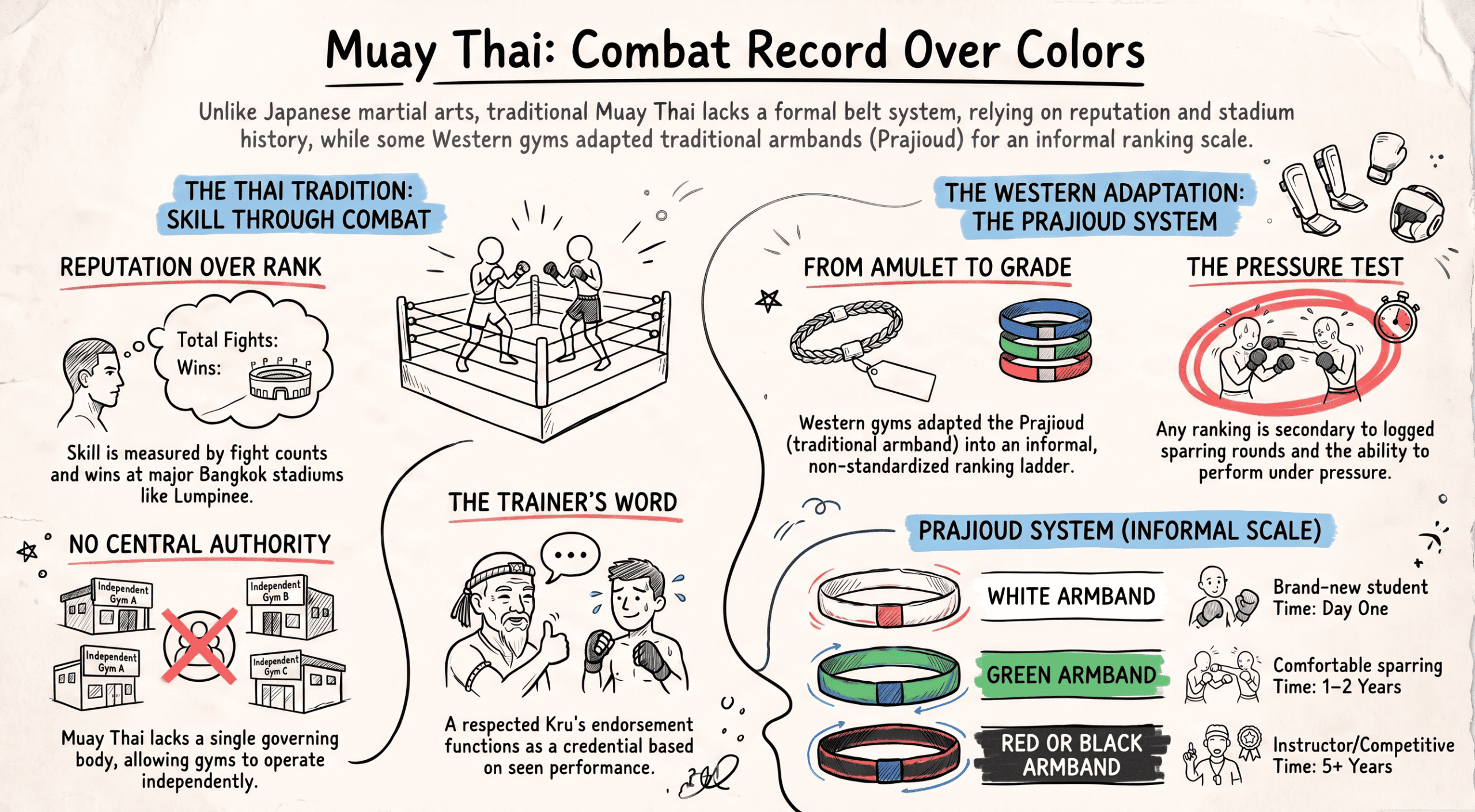
No, muay thai doesn’t have belts. Not in Thailand, not in the stadiums where the sport was built, not in the tradition that trains it. I’ve heard the belt question at nearly every gym I’ve walked into, usually from a beginner who grew up around karate or taekwondo and expected the same color-coded ladder here. It doesn’t exist, and once you understand why, the sport starts to make a lot more sense.
Why Thailand Has No Belts
Muay thai grew up as a fighting art tied to gambling, village pride, and stadium income, not as a school subject with grades. Nobody sat down and designed a curriculum with checkpoints. Fighters learned by sparring, clinching, and getting hit, then testing what they’d absorbed in an actual ring against an opponent trying to knock them out.
That history matters. Belt systems came out of Japanese martial arts, where Jigoro Kano built the judo ranking ladder in the late 1800s partly as a teaching tool for large groups of students. Karate and taekwondo borrowed the idea and spread it worldwide. Muay thai never went through that phase. Thai gyms trained small groups of fighters who were often heading toward a real fight within weeks, not hobbyists progressing through a syllabus.
There’s also no single governing body handing out national rank the way judo or karate federations do. Stadiums, promotions, and camps all operate somewhat independently. A ranking system needs one authority everyone agrees to answer to. Muay thai in Thailand never had that, and honestly, it never needed it.
How Skill Is Really Measured in Thailand
Ask a Thai trainer how good a fighter is and you won’t get a color. You’ll get a fight count, a list of opponents, maybe a stadium name. Skill in muay thai gets measured almost entirely through combat record and reputation.
The clearest marker is the number of professional fights someone has had, especially at the two major Bangkok stadiums, Lumpinee and Rajadamnern. A fighter with two hundred bouts at that level commands instant respect walking into any gym in the country. Nobody needs to see a certificate.
Weight class titles matter too, and so does who a fighter has beaten or lost to. Thai muay thai culture tracks lineage closely: who trained under which camp, who they sparred with, whose style rubbed off on their own. A trainer’s word carries weight as well. If a respected kru vouches for a fighter’s clinch game or kicking power, that endorsement functions almost like a credential, because trainers have seen thousands of fighters come through and know what real skill looks like against a resisting opponent.
None of this is formalized on paper. It lives in conversation, in gym gossip, in fight cards. That’s the system, and it’s worked for a very long time.
Armband Grading in Western Gyms (Prajioud Systems)
Outside Thailand, plenty of gyms felt the pressure to give students something visible to work toward. Belts felt off-brand for muay thai, so many Western schools adapted the prajioud instead, the woven armband Thai fighters traditionally wear into the ring as a symbol of their camp and their teacher’s blessing.
These grading systems are informal and vary a lot from gym to gym. There’s no international body certifying them, and a purple armband at one school might mean something completely different at another down the street. Treat any table like this as a rough sketch of a common pattern, not a rulebook.
| Armband Color | Typical Skill Level | Rough Time to Reach It |
| White | Brand-new student, learning basic stance and guard | Day one |
| Yellow | Basic strikes and footwork developing | 2-4 months |
| Orange | Combinations flowing, some clinch exposure | 6-12 months |
| Green | Comfortable sparring, defense improving | 1-2 years |
| Blue | Solid all-around fundamentals, teaching beginners occasionally | 2-3 years |
| Brown | Advanced clinch and counter-striking | 3-5 years |
| Red or Black | Instructor-level or competitive fighter status | 5+ years |
Some gyms add stripes within colors, or skip a color entirely. Others don’t use armbands at all and just track sparring hours informally. There is genuinely no standard here, and that’s the honest answer.
Is a Belt System a Red Flag?
I go back and forth on this one, and I’ll admit I lean skeptical. On one hand, a grading system gives beginners something concrete to chase, and that keeps people motivated during the slow, frustrating months before muay thai starts feeling natural. Kids’ classes especially benefit, since children respond well to visible progress markers.
On the other hand, a belt or armband can create false confidence. I’ve met people wearing an advanced color who freeze up the moment a real opponent starts pressuring them in sparring. Rank on paper and rank in a fight are not the same thing, and muay thai’s whole identity is built around the second one.
My honest take: a gym using a grading system isn’t automatically a bad sign. But a gym that treats those colors as a substitute for actual sparring and fight experience is worth a second look. Ask how the gym tests for each level. If the answer involves pad rounds judged by an instructor with zero live sparring requirement, be cautious. If it involves controlled sparring, clinch rounds, and conditioning checks, that’s a gym taking the tradition seriously even while borrowing a Western format.
How to Gauge Your Level Without a Belt
Forget colors for a second. Here’s a rough framework I’d actually trust, built around three questions.
How long have you trained, consistently? Not how long since you signed up, how many months of actual regular sessions. Someone training three times a week for a year has more real skill than someone who’s had a membership for three years but shows up occasionally.
How many sparring rounds have you logged? This is the number that matters most and gets ignored the most. Pad work builds tools. Sparring is where you learn to use them under pressure, read an opponent, and manage your own panic. A fighter with two hundred sparring rounds under their belt (pun intended) is simply sharper than one with twenty, regardless of how long either has been “training.”
Can you do this checklist, under pressure, against a resisting partner?
- Hold a tight guard while moving, not just standing still
- Throw a full combination and reset your stance immediately after
- Check a low kick reflexively, without thinking about it first
- Clinch, control, and land at least one knee before breaking
- Read one basic feint and avoid reacting to it
If most of that is shaky, you’re still building fundamentals, whatever color you’re wearing. If it’s solid, you’re further along than any armband color would suggest. Thai fighters never needed a chart to know where they stood. They knew because they’d been tested, over and over, by someone trying to hurt them. That’s still the only test that counts.
If you’re just starting out and want a fuller roadmap of what the first months actually look like, a beginner’s guide to muay thai training is a better starting point than chasing a color. And if you want to understand how judges actually score a real fight in Thailand, the 10-point must scoring system explains the framework stadiums use, which tells you a lot more about “real” skill than any armband does.
FAQ
Does muay thai have a belt system like karate? No. Traditional muay thai in Thailand has never used belts. Skill gets judged through fight record, stadium reputation, and trainer endorsement instead of a color-graded ladder.
What are the colored armbands some gyms use called? They’re often based on the prajioud, the woven armband Thai fighters wear into the ring. Western gyms adapted the concept into an informal grading system, but there’s no universal standard behind it.
How long does it take to get good at muay thai? There’s no fixed timeline, but most people start feeling genuinely comfortable with fundamentals somewhere between one and two years of consistent training, assuming regular sparring is part of that time.
Is it bad if my gym uses a belt or armband ranking system? Not necessarily. It becomes a concern only if the gym treats the colors as a substitute for real sparring and pressure testing rather than a motivational add-on alongside it.
How do Thai fighters know their own rank if there’s no belt? Through fight count, opponents faced, stadium history, and word from their trainers. In a culture built around gambling on real fights, reputation earned in the ring always outranked anything written on paper.