

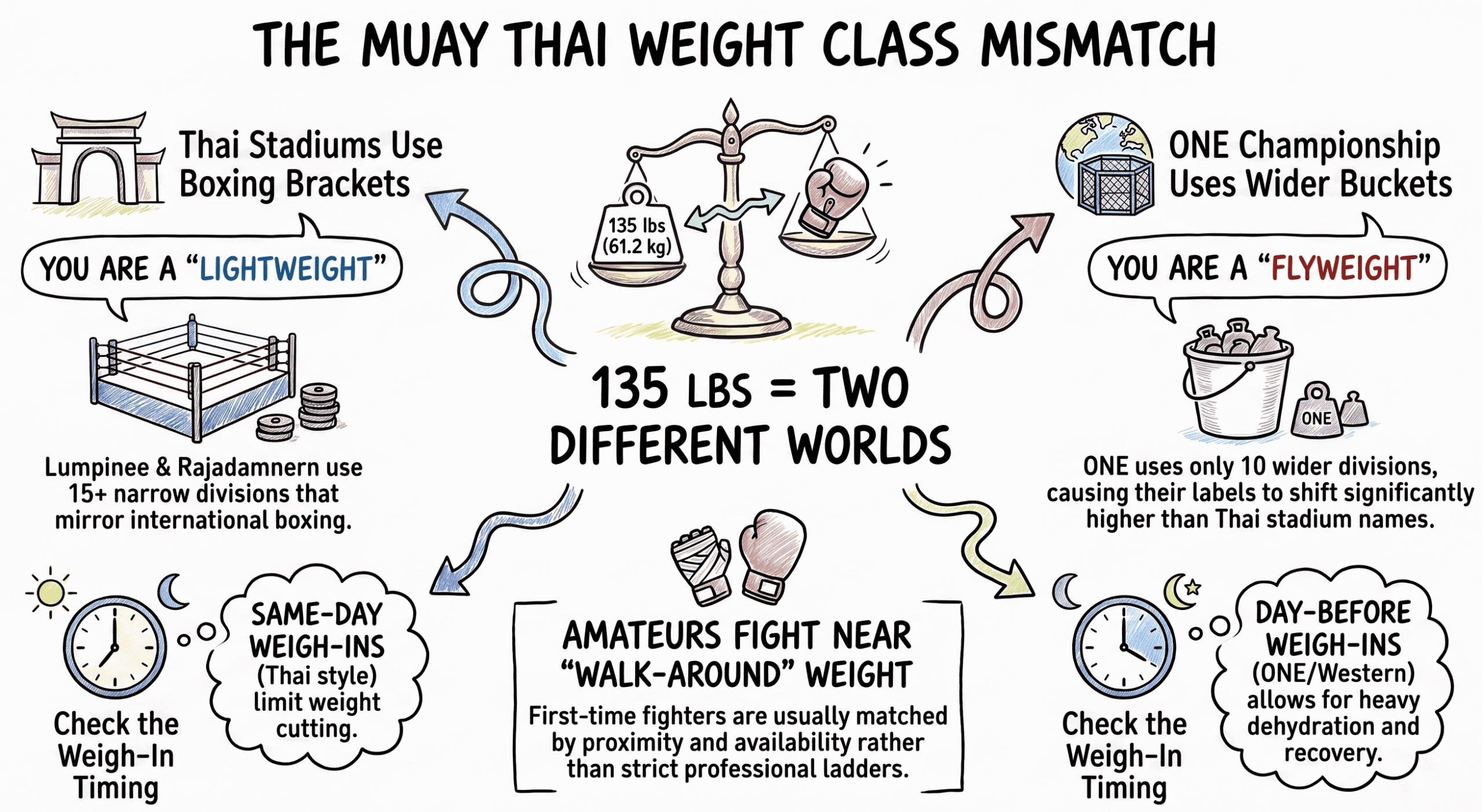
A fighter walking around at 135 pounds is a lightweight the moment he steps on the scale at Lumpinee Stadium. Put that same body on ONE Championship’s scale and he barely squeezes into flyweight, right at the cap. Nothing about the fighter changed between those two weigh-ins. What changed is the naming system built around him, and that gap sits at the center of muay thai weight classes and why they trip up newcomers more than almost any other rule in the sport.
So does muay thai have weight classes? Yes, several of them, and that’s the actual source of the confusion. There’s no single governing body that runs every ring in the world, so no single ladder of muay thai weight divisions applies everywhere. Thailand’s two flagship stadiums use one scale. ONE Championship, the sport’s biggest global promotion, uses another. Amateur federations in North America run a third, adapted from international kickboxing rules. A fighter can hold a title in one system and not even recognize his own division name in the next.
Full Weight Class Table (Pounds and Kilograms)
The clearest way to see the mismatch is to hold one bodyweight still and watch the label change underneath it. Below are four real bodyweights, shown against the four systems this article covers.
| Bodyweight | Lumpinee / Rajadamnern | ONE Championship | Typical US/Canada Amateur Card |
| 118 lb / 53.5 kg | Bantamweight | Flyweight | Bantamweight |
| 126 lb / 57.2 kg | Featherweight | Flyweight | Featherweight |
| 135 lb / 61.2 kg | Lightweight | Flyweight (at the cap) | Lightweight |
| 145 lb / 65.8 kg | between Junior Welter and Welter | Bantamweight (at the cap) | Welterweight |
| 160 lb / 72.6 kg | Middleweight | Lightweight | Middleweight |
| 175 lb / 79.4 kg | Light Heavyweight | Welterweight | Light Heavyweight |
Read that middle row again. A 135-pounder is a lightweight in Bangkok and a flyweight at ONE. Same scale, same number, two different divisions with two very different reputations attached to them.
Lumpinee and Rajadamnern Divisions
Lumpinee Stadium
Lumpinee runs the ladder most Western fans think of when they picture “real” muay thai. It follows the international boxing scale almost exactly, which is why the names sound familiar even to people who’ve never watched a fight in Thailand.
| Division | Pounds | Kilograms |
| Mini Flyweight | 105 | 47.6 |
| Junior Flyweight | 108 | 49.0 |
| Flyweight | 112 | 50.8 |
| Bantamweight | 118 | 53.5 |
| Featherweight | 126 | 57.2 |
| Junior Lightweight | 130 | 59.0 |
| Lightweight | 135 | 61.2 |
| Junior Welterweight | 140 | 63.5 |
| Welterweight | 147 | 66.7 |
| Middleweight | 160 | 72.6 |
Divisions above middleweight exist on paper but rarely produce meaningful title action. Most of Lumpinee’s championship history sits between flyweight and welterweight, and that’s not an accident.
Rajadamnern Stadium
Rajadamnern, the older of the two stadiums and Lumpinee’s traditional rival, uses a near-identical scale and the same weight names. Fighters cross between the two venues constantly, sometimes within the same month, and a title earned at one carries real weight (no pun intended) when it comes to booking fights at the other. The differences between the two stadiums show up in judging conventions and ring reputation more than in how they slice up the scale.
Why Thai Divisions Run Lighter Than Western Ones
The scale itself isn’t structurally different from international boxing. What’s different is where the action clusters. Thai fighters, on average, sit lighter than Western fighters, so the flyweight through welterweight range carries the sport’s deepest talent pools and its most prestigious belts inside Thailand. Walk into a Western gym and the busiest divisions shift up, usually into welterweight through middleweight, because that’s where most Western adult male practitioners actually sit once they’ve trained down to fight shape. Nobody redrew the ladder. The fighters filling it are simply a different average size on each side of the Pacific.
ONE Championship Divisions
ONE runs a much wider gap between classes than either Bangkok stadium, and it applies the same weight limits across muay thai, kickboxing, and MMA under its banner.
| Division | Pounds (limit) | Kilograms (limit) |
| Atomweight | 115 | 52.2 |
| Strawweight | 125 | 56.7 |
| Flyweight | 135 | 61.2 |
| Bantamweight | 145 | 65.8 |
| Featherweight | 155 | 70.3 |
| Lightweight | 170 | 77.1 |
| Welterweight | 185 | 83.9 |
| Middleweight | 205 | 93.0 |
| Heavyweight | up to 265 | up to 120.2 |
Ten divisions cover the same total weight range that Lumpinee splits into fifteen or more. That’s the whole mechanism behind the naming mismatch: fewer, wider buckets mean a fighter can sit near the bottom of one ONE division and still outweigh someone at the top of a neighboring Thai stadium class.
Amateur Divisions in the US and Canada
North American amateurs don’t fight under one national commission the way boxers do. Coverage is split across a handful of sanctioning bodies, and which one runs a given card usually comes down to region and promoter more than anything else.
- IFMA-affiliated national federations (USA Muaythai, Muay Thai Canada, and similar bodies) run the amateur pathway tied to international competition, including national team selection.
- IKF (International Kickboxing Federation) sanctions a large share of North American amateur and semi-pro muay thai and kickboxing cards.
- USMF (US Muaythai Federation) and comparable regional groups cover local and state-level shows, often with their own weigh-in and matchmaking rules.
- State and provincial athletic commissions get involved once a card includes pro bouts, even if the amateur undercard runs under a separate federation’s rules.
IFMA’s own bracket structure, used at world and continental amateur championships, splits senior competitors into roughly a dozen kilogram-based brackets, spaced closely enough (often just a few kilograms apart) that a small cut can bump a fighter into a neighboring class. IKF and USMF cards generally borrow the familiar boxing-style names, but the exact cutoff for each one can shift slightly from event to event, so a fighter’s actual bracket often gets confirmed only once the promoter locks the card.
Weigh-In Rules: Day-Before vs Same-Day
Two different weigh-in cultures explain a lot of the confusion fighters run into when they move between promotions. The traditional Thai stadium model leans toward weigh-ins held close to fight time, sometimes the morning of the bout, which limits how much water a fighter can safely cut and rehydrate before stepping in. ONE Championship and most Western pro promotions run day-before weigh-ins instead, letting fighters dehydrate down to make weight and then rehydrate over roughly 24 hours before they fight at a walk-around weight noticeably above the number on the scale.
That single day of recovery time changes everything about how a fight camp plans a cut. A fighter under a same-day system has to stay close to fight weight for days beforehand. A fighter under a day-before system can cut harder and heavier, then show up to the cage or ring carrying ten or more extra pounds that their same-weight-class opponent, cutting less aggressively, might not be carrying at all.
How to Pick Your First Fight Weight
Most first-time amateurs in the US or Canada end up fighting closer to their everyday walk-around weight than they expect. Coaches generally steer new fighters away from aggressive cuts for a debut, since the goal is a clean, competitive match, not a size advantage bought through a risky weight cut.
A few things typically decide where a beginner actually lands on fight night:
- Everyday walk-around weight, measured over a normal week, not after a hard training camp.
- How many opponents exist nearby. Thin divisions at smaller shows sometimes force a fighter up or down a bracket just to get matched.
- Cutting experience. First-timers are usually advised to cut 3 to 5 percent of bodyweight at most, if anything.
- The promotion’s specific rulebook, since IKF, USMF, and local commissions don’t all draw their lines in the same place.
Anyone building a full training plan around a debut fight benefits from working backward from these questions early, well before a fight date gets locked in. The beginner’s training guide on this site covers the conditioning side of that runway in more depth. Once the weight class is set, understanding how a bout actually gets scored matters just as much. The 10-point must scoring system explains how judges read a fight regardless of which stadium or promotion is running the card.
FAQ
Does muay thai have weight classes? Yes. Every major promotion and sanctioning body runs its own set of weight classes, but they don’t share one universal ladder. Lumpinee and Rajadamnern use a scale close to international boxing, ONE Championship runs its own wider ten-division system, and North American amateur federations follow yet another structure borrowed from kickboxing rules.
Why do the same pounds get a different division name in Thailand versus ONE Championship? Because the two systems slice the weight range into different numbers of buckets. Lumpinee splits the scale into fifteen or more narrow divisions. ONE covers the same range with roughly ten wider ones. A fighter sitting near the edge of a ONE bracket can land in a completely different-sounding Thai division at the identical bodyweight.
What’s the real difference between day-before and same-day weigh-ins? Day-before weigh-ins give a fighter close to 24 hours to rehydrate after cutting water weight, so they often walk into the ring or cage well above their weigh-in number. Same-day weigh-ins, closer to the traditional Thai stadium approach, leave far less room for that kind of rehydration, which limits how aggressively a fighter can safely cut in the first place.
What weight class should a first-time amateur expect to fight in? Most debut fighters in the US or Canada end up close to their normal walk-around weight, since coaches generally discourage large cuts for a first bout. The exact bracket depends on the sanctioning body running the card and how many opponents are available near that weight at the specific event.
Can a fighter be a different weight class in Thailand than at home? It happens often. A fighter who competes as a welterweight on a North American amateur card might register closer to lightweight or even featherweight once they fight under a Thai stadium’s scale, simply because the divisions are drawn more tightly and the labels don’t line up one to one.


2 Comments