You’re thirty-four, you just found a gym near your office, and there’s a voice in your head telling you that everyone in there started as a teenager. Maybe you’re twenty-seven and scrolling through fighter highlight reels, wondering if the door already closed on you. Maybe you’re fifty and just curious whether your knees will survive a single class.
Here’s the short version, up front, so you don’t have to read six paragraphs to get it: you are not too old to start Muay Thai. Not at 27, not at 34, not at 48. If you want it as a hobby, a fitness habit, a way to feel capable in your own body again, age is close to irrelevant. Gyms train beginners in their 50s and 60s every week.
What changes with age is the ceiling, not the floor. If your dream is a professional fight card in Thailand under Lumpinee or Rajadamnern rules, walking in at 25 or older to start from zero makes that path unrealistic. Not impossible in some technical sense, but unrealistic enough that you should hear it plainly rather than get strung along. The muscle memory, reflexes, and years of low-level sparring that top Thai fighters build usually start in childhood. That’s the honest version. Everything else, amateur fights, gym-level competition, years of solid training, real skill, stays on the table no matter your birth year.
What “Too Old” Actually Means
“Too old for Muay Thai” isn’t one question. It’s three different questions wearing the same sentence.
Too old to train as a hobby? No. There’s no age limit on learning to hold your hands up, throw a clean roundhouse, or feel your conditioning improve week over week.
Too old to compete in amateur fights? Depends on the decade, and we’ll get specific below, but generally no, well into your 30s and sometimes your 40s.
Too old to become a professional Muay Thai fighter with a real career, ranked fights, a shot at titles? If you’re starting past your mid-20s, yes, realistically. Professional Thai boxing rewards a foundation laid over ten or fifteen years, and starting the clock at 26 doesn’t leave room to catch up to someone who started at 8.
Once you separate those three goals, the fear mostly dissolves. Most people asking “am I too old” are asking about the hobby or the amateur-fight version, and the answer there is almost always yes, you can.
Starting in Your Late 20s, 30s, 40s and Beyond
Late 20s: Still Wide Open
If you’re 25, 27, 29, you are, frankly, still young in training terms. Your joints recover fast. Your nervous system adapts to new movement patterns quickly. Amateur fights are absolutely realistic if you put in a year or two of consistent training first. Plenty of people start at this age and end up fighting within eighteen months. The only thing standing between you and a decent amateur record is time in the gym, not your birth certificate.
Your 30s: The Window Is Still Open, Just Different
Amateur fights are still realistic in your 30s. So is serious skill development. What changes is recovery speed: you won’t bounce back from a hard sparring session the way you did at 22, and that catches a lot of new students off guard. The fix isn’t to train less. It’s to train smarter, with more attention to sleep, mobility, and knowing when a nagging ache needs three days off instead of one. People in their mid-30s regularly step into their first smoker fight and do just fine.
Your 40s: Technique Over Impact
By your 40s, the priority shifts. You can absolutely train hard, get technically sharp, and improve your conditioning dramatically. What you want to dial back is repeated hard-contact sparring, the kind that adds up in small doses over years and shows up later as joint pain or worse. Focus on technique, pad work, controlled sparring, and strength work that protects your joints. Some people in their 40s do still take amateur fights, and that’s a personal call best made with a coach who knows your history, not a stranger on a forum.
50 and Beyond: Health First, Everything Else Second
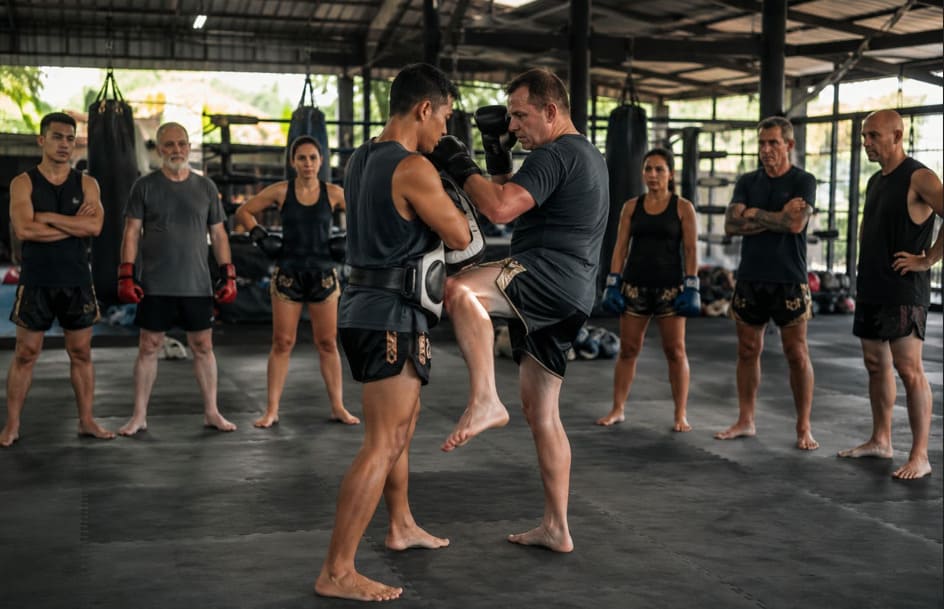
Starting at 50, 55, 60, you can still build real skill and get in the best shape you’ve been in for years. Fighting is a much smaller consideration at this stage, and most gyms will steer you toward technical classes over full-contact sparring. That’s not a downgrade. It’s the sport adjusting to what your body actually needs, and plenty of people find the technical side of Muay Thai just as satisfying as the fight side ever was.
How Training Should Change With Age
The training itself needs to shift as you get older, and good coaches already know this even if they don’t announce it out loud.
Warm-ups should get longer. A 25-year-old might get away with five minutes of jumping rope before pads. At 40, you want fifteen or twenty minutes of mobility work, joint circles, and gradual heart-rate buildup before anything explosive happens.
Hard sparring should shrink as a share of your training. Technical sparring, where both people are working at 30 or 40 percent power, teaches almost everything hard sparring teaches, minus the cumulative damage. Save the harder rounds for when you actually have a fight booked.
Strength work stops being optional. This is the part beginners over 30 skip most often, and it’s the one that matters most. A basic strength program, two sessions a week, built around squats, hinges, and pulling movements, protects your joints and keeps your power output from declining as fast as it otherwise would. It’s one of the biggest reasons Muay Thai works so well as a full-body fitness system when the program is built with your age in mind.
Recovery becomes a training variable you actually track, not an afterthought. Sleep, hydration, and knowing the difference between “sore” and “injured” matter more with each decade.
Late Starters Who Fought
This isn’t a fringe story you’ll only hear once. Search any Muay Thai forum or Reddit thread and you’ll find the same pattern repeated by dozens of different people: someone started at 28, or 35, or 41, put in two or three years of consistent training, and ended up taking an amateur fight they were proud of. It comes up often enough that it’s become something of a running theme in online Muay Thai communities, not a rare exception passed around like a legend.
The common thread in these stories isn’t talent. It’s consistency, a coach willing to build a smart plan around an older body, and a realistic goal. Nobody in these stories was chasing a Lumpinee title. They were chasing a version of themselves that could handle three rounds against another honest amateur, and that goal turns out to be a lot more available than most people assume before they walk through the door.
Talk to Your Doctor If…
Muay Thai is demanding on the body, more so if you’re carrying an old injury or a condition you haven’t fully dealt with. Before you start, or before you push into harder sparring, talk to a doctor first if any of the following apply to you:
- You have a history of heart issues, high blood pressure that isn’t well controlled, or you’ve never done a stress test past your 40s
- You’ve had a concussion in the last year, or several over your lifetime
- You have joint problems, arthritis, or a previous surgery in the knees, hips, or spine
- You take blood thinners or medication where bruising or bleeding risk is a real concern
- You’ve been sedentary for years and are jumping straight into high-intensity training with no ramp-up
None of this means you can’t train. It means you walk in with information instead of guesswork, and that’s exactly the kind of caution a good coach will respect.
FAQ
Is 27 too old to start Muay Thai? No. Twenty-seven is still early enough to build real skill, and amateur fights are a realistic goal within a year or two of consistent training.
Is 30 too old to start Muay Thai? No. Recovery is a bit slower than it was at 22, but people in their 30s regularly start from zero and end up fighting, or simply get into the best shape of their lives without ever stepping in the ring.
Can you really start Muay Thai in your 40s or 50s? Yes. Expect the focus to shift toward technique, conditioning, and controlled sparring rather than repeated hard contact, and expect a longer warm-up. That shift protects you, not holds you back.