
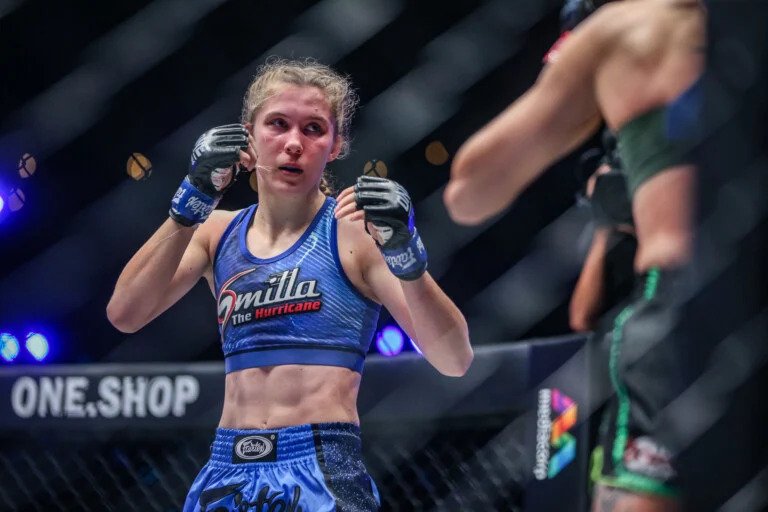
The human body keeps growing whether or not a promotion approves. Smilla Sundell found that out in public. The Swedish fighter won the ONE Women’s Strawweight Muay Thai World Championship at 17 years and 5 months, a younger age than anyone had ever won a world title in the organization, and within about two years her own skeleton had begun to argue with the 125-pound limit. The story of Smilla Sundell is partly a sports story and partly a biology lesson, and the two keep interrupting each other in useful ways.
She was born on November 12, 2004, in Sundbyberg, a small city just north of central Stockholm. Nobody plans a Muay Thai career from Sundbyberg. What happened instead was a chain of family decisions, a vacation, and one teenager’s refusal to get on a plane home.
Karate first, then a holiday that went wrong in the best way
Sundell started karate at five, for self-defense, which is the reason parents give for most martial arts enrollments and the reason kids forget by week three. Around the age of 10 or 11 she saw Muay Thai on a family trip to Thailand. When she was 12, her parents’ work took the family to Ko Samui, and she and her sister started training at Yodyut Muay Thai.
A 12-year-old’s nervous system is extremely good at soaking up movement patterns. Motor learning researchers have a lot of fancy terms for this, but the short version is that children pick up coordinated skills through sheer repetition faster than adults, and they do it without the self-consciousness that makes a 35-year-old beginner stiff. A kid on Ko Samui hitting pads twice a day is building the timing of a teep and a switch kick into the wiring before any of it has a chance to feel foreign.
Young Thai-based fighters also compete early, and often. The ethics of that system are messy, and the debate around children fighting for money doesn’t resolve cleanly for anyone. Sundell arrived in it from the outside, as a foreign kid whose family had a choice, which puts her in a very different position from a Thai child sending purse money home. Still, the mechanism was the same: lots of fights, lots of rounds, and a fight IQ built by experience rather than theory.
Fifteen, alone, and moving to Pattaya
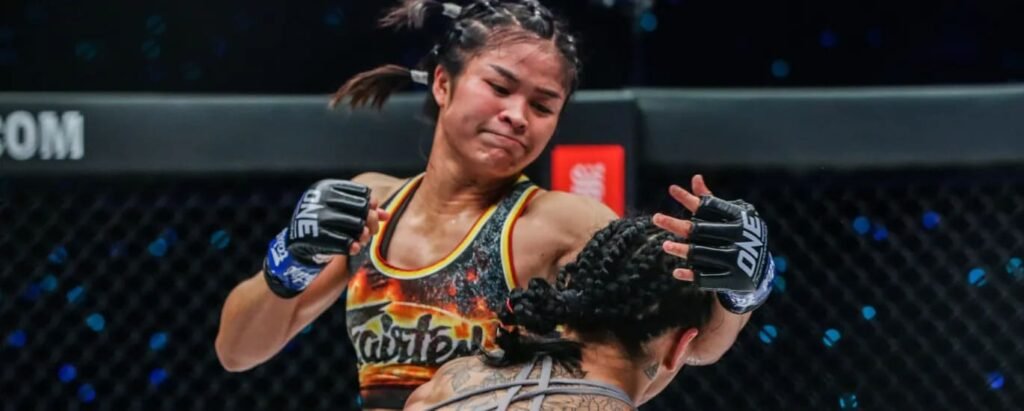
When Sundell was 15, her family went back to Sweden. She stayed. In October 2019 she moved to Pattaya and joined Fairtex, the gym that had produced Stamp Fairtex, whose career she had watched and wanted to copy. She lived and trained there until 2025.
Parents reading this will have a reaction, and that reaction is reasonable. From a training standpoint, though, the move made sense. Ko Samui had given her a foundation. Fairtex gave her a fight team with a pipeline into international promotions, sparring partners who were already on television, and a schedule built around people whose job is fighting. Anyone weighing a similar jump can see why the gym mattered as much as the country. Picking a camp is a real decision with real consequences, and a guide on choosing a camp in Thailand covers the questions a teenager in her position would have needed answered: who runs the fighters, who books the fights, and what the housing looks like.
By early 2021, at 16, she was ranked number one among female featherweights by WBC Muaythai. A ranking list is a dry document, but think about what it records here: a high school age girl from suburban Stockholm sitting at the top of a Thai sport’s rankings while living in a gym dormitory in Pattaya.
What did Smilla Sundell actually do in ONE?
Her ONE Championship Muay Thai run was short and loud. Five fights, five wins, three of them stoppages.
| Date | Opponent | Event | Result |
| Feb 25, 2022 | Diandra Martin | ONE: Full Circle | Win, TKO (three knockdowns), R3 |
| Apr 22, 2022 | Jackie Buntan | ONE 156, Singapore | Win, unanimous decision, 5 rounds (won strawweight title) |
| May 26, 2023 | Milana Bjelogrlić | ONE Friday Fights 18 | Win, unanimous decision, R3 |
| Sep 29, 2023 | Allycia Rodrigues | ONE Fight Night 14 | Win, TKO (punches and elbows), R3 (title defense) |
| May 4, 2024 | Natalia Diachkova | ONE Fight Night 22 | Win, TKO (knees and punches to the body), R2 (missed weight, stripped) |
The Buntan fight is the one people remember. Jackie Buntan was an experienced American striker, and the bout went the full five rounds in Kallang. Five championship rounds is a long time to hold composure at 17. Sundell took the decision, and ONE later named her its Super Series Female Fighter of the Year for 2022. She also collected two $50,000 performance bonuses during her time with the promotion, which is a lot of money for anyone and an absurd amount for someone who can’t legally rent a car in most US states.
The Rodrigues defense in September 2023 was arguably her best performance: a Brazilian former champion stopped in the third round by punches and elbows. Then came the Diachkova fight, which was a win on paper and a loss on the scale.
The scale: a short lesson in why teenagers can’t stay small
At the ONE Fight Night 22 weigh-ins, Sundell came in at 126.5 pounds, one and a half pounds over the strawweight limit. She was stripped of the belt before the fight. Under the rules only Diachkova could have won the title that night. Sundell beat her by body shots in the second round anyway, and walked out without a belt she had defended once.
A pound and a half sounds trivial. To an adult who has been 125 pounds for ten years, it would be. To a woman who was 17 when she won the title and 19 when she missed weight, it tells you something about physiology rather than discipline. Growth doesn’t simply stop on a birthday. Bone density keeps climbing through the late teens and into the twenties, and muscle mass responds to years of heavy training by accumulating, which is the point of the training. An athlete can drain water and glycogen for a weigh-in, but you cannot dehydrate a femur.
ONE also makes cutting harder than most promotions by design. After a death linked to weight cutting in 2015, it moved to a system of hydration testing alongside the scale, so fighters have to make weight while still passing a urine test for adequate hydration. The upshot is simple: your natural weight has to live near your division, not ten pounds above it. For a fighter who has outgrown her class, the only honest fix is a different class, and the ladder of weight classes across promotions matters more than fans tend to think. The rungs are narrow at the bottom and the women’s ladder at ONE doesn’t go very high.
That last detail decided her next move. Sundell later competed at bantamweight, and in August 2025 she was reported as removed from the ONE roster because her weight had gone past the heaviest women’s division the promotion offers. The same body that made her a champion had grown out of every box ONE had for it.
Las Vegas, grappling, and a second sport
Sundell spent 2024 and 2025 working on wrestling, grappling, and Brazilian jiu-jitsu, and picked up BJJ tournament wins in North America along the way. In October 2025 the Las Vegas promotion Tuff-N-Uff announced it had signed her.
Her pro MMA debut came on January 22, 2026, at Tuff-N-Uff 151, against Miranda Barber. She finished it with knees and elbows at 4:54 of the first round, which is a very Muay Thai way to end an MMA fight. On June 5, 2026, at Tuff-N-Uff 154, she stopped Maya Samuels-Stewart with punches and knees in round two. Two fights, two TKOs.
Her striking record is generally listed at 36 wins (23 by knockout), 5 losses, and 1 draw. Put next to an MMA record of 2-0, it makes a lopsided résumé. She has thousands of rounds of experience standing up and only a handful of minutes of professional cage time.
The Contender Series question
The next test is already booked. Sundell is scheduled to fight Aline Pereira, the sister of two-division UFC champion Alex Pereira, on October 13, 2026, at Dana White’s Contender Series in Las Vegas, at 135 pounds. The prize on that show is a UFC contract, and Sundell has said openly that reaching the UFC and winning a title there is the goal.
From a purely mechanical standpoint the matchup is fascinating. Both women come from striking: Pereira holds a Karate Combat title, and Sundell brings a clinch and knee game sharpened in Pattaya. The question the Contender Series will answer is not whether Sundell can strike. She has answered that one many times. The question is what happens when somebody tries to put her on her back, and whether two years of grappling homework can hold up against a fighter who knows exactly where the Muay Thai specialist is weakest.
What her path tells a Western teenager with a Thailand dream
For anyone in North America who reads her story and starts looking at flights, a few things are worth pulling out of it, because the romantic version skips most of them.
- She started young and trained for years before anyone noticed. She moved to Ko Samui at 12, and the ONE title came five years after that.
- Family logistics made it possible. Her parents’ jobs put her in Thailand in the first place, and she had years of structure before she lived at a gym on her own at 15.
- The gym mattered more than the country. Fairtex connected her to a pro team and to promotions. A random beach camp would not have done that.
- Her body changed, and her career had to change with it. Every young fighter should plan for moving up at least one division, because the scale will eventually insist on it.
- She added skills before she needed them. The grappling started while she was still a Muay Thai name, not after the door had closed.
The fifth point is the one most people miss. Sundell didn’t wait for the scale to end her strawweight career before she started learning to wrestle. She saw the arithmetic coming, the pounds that no diet would remove, and started building a second sport on top of the first. Whatever happens on October 13, that planning was the smartest thing a 20-year-old ex-champion could have done.