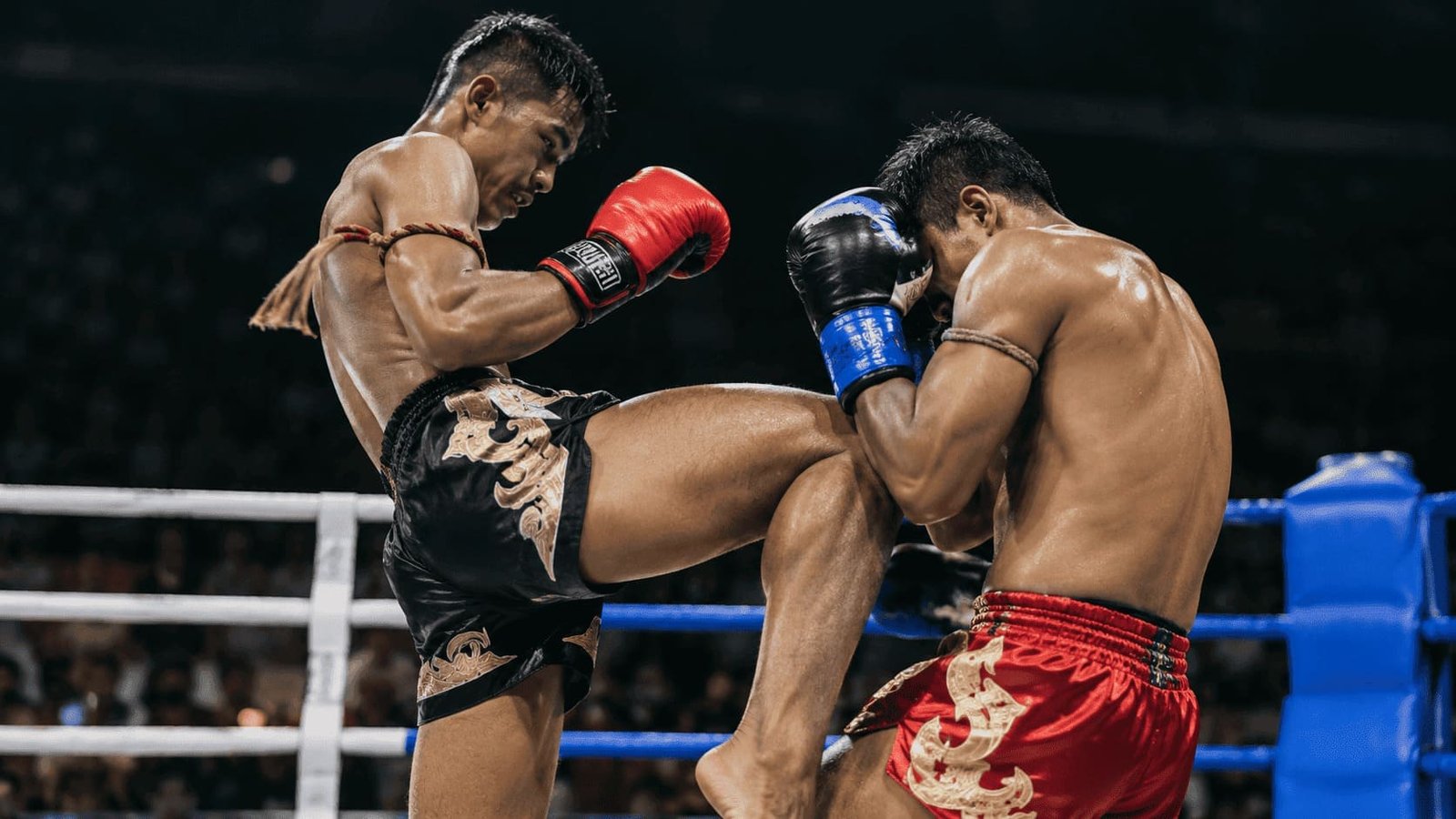
The bell rings and he comes forward. He does not feint much. He does not look for the pretty kick. He wants your neck, and when he has it he will drive his knee into your ribs until the referee pulls you apart. Then he will come forward again.
That is muay khao. The words mean “knee boxing,” and the fighter who uses the style is called a knee fighter. The style is simple to describe and hard to live with. Many people who train Muay Thai for a few years have met one in sparring. Most remember it.
What muay khao looks like from the inside
The knee fighter has one job. He closes distance and he stays there. Everything else serves that job.
He walks down the middle of the ring with his hands high and his elbows tight. He takes kicks on the shin or the arms because a kick costs him less than a step back would. When he is close enough, he reaches. Two hands behind the head, forearms on the collarbones, or one arm over and one under. Then the knees come.
There are several kinds of knee, and a good muay khao fighter throws all of them:
- The straight knee (khao trong), driven up and forward into the stomach or the solar plexus.
- The curved knee (khao khong), swung around from the side into the ribs and the floating ribs.
- The short, snapping knee thrown inside the clinch, over and over, to the thigh and the hip.
- The long knee thrown on the way in, when the opponent is still at kicking range and thinks he is safe.
- The jumping or stepping knee, used less often, when the opponent drops his hands or backs into the ropes.
The knees are only half of it. The other half is balance. In the clinch the knee fighter turns you, off-balances you, and dumps you when you lift a leg. Thai judges like that. A fighter who is thrown looks like a fighter who is losing. If you want to know exactly what is legal in there, the rules around clinch work and sweeps are worth learning before you start grabbing necks in sparring.
The body of a knee fighter
The style favors certain bodies. Tall fighters with long legs make the best of it, because a long thigh turns a knee into a spear. Long arms help too. They reach the neck from farther away and they give better leverage once the lock is on.
But height is not required. Short, strong fighters use muay khao well. They get under the arms, they push the hips in, and they grind. The shorter knee fighter often wins by pace. He is simply there, every second, and he does not stop.
What the style does require is gas. Clinching is heavy work. You are carrying another man’s weight on your neck and shoulders while you try to lift a knee. A tired knee fighter is a fighter leaning on his opponent and waiting for the break. Many fighters find out in their first real clinch fight that the problem was never their running. It was tension, breathing, and wasted effort in the lock. The piece on gassing out in round two explains that well, and it applies to knee fighters more than to anyone.
Why Thai judges respect the knee
In Thai scoring, a clean technique that visibly hurts or unbalances the opponent counts for a great deal. Knees to the body do both. They make a man bend. They slow him down in round four, when the fight is decided. A kick that lands and is ignored scores less than a knee that makes the other fighter wince and back away.
The clinch also gives the knee fighter control. When he holds the neck, the other man cannot kick, cannot punch properly, and cannot show the judges anything. Control reads as dominance. Dominance wins rounds.
There is a cost. Fans at the big stadiums sometimes grow bored with long clinches, and referees break them faster than they once did. The modern knee fighter has had to learn to do damage quickly inside the lock and to punch and kick on the way in.
Famous muay khao fighters
The style has produced some of the best fighters in the sport. Three names come up whenever Thai trainers talk about knees.
| Fighter | Nickname | Era | Titles and honors (selected) |
| Dieselnoi Chor Thanasukarn | “Sky-Piercing Knee” | Late 1970s to 1985 | Lumpinee lightweight champion from 1981, 1982 Sports Writers Association of Thailand Fighter of the Year |
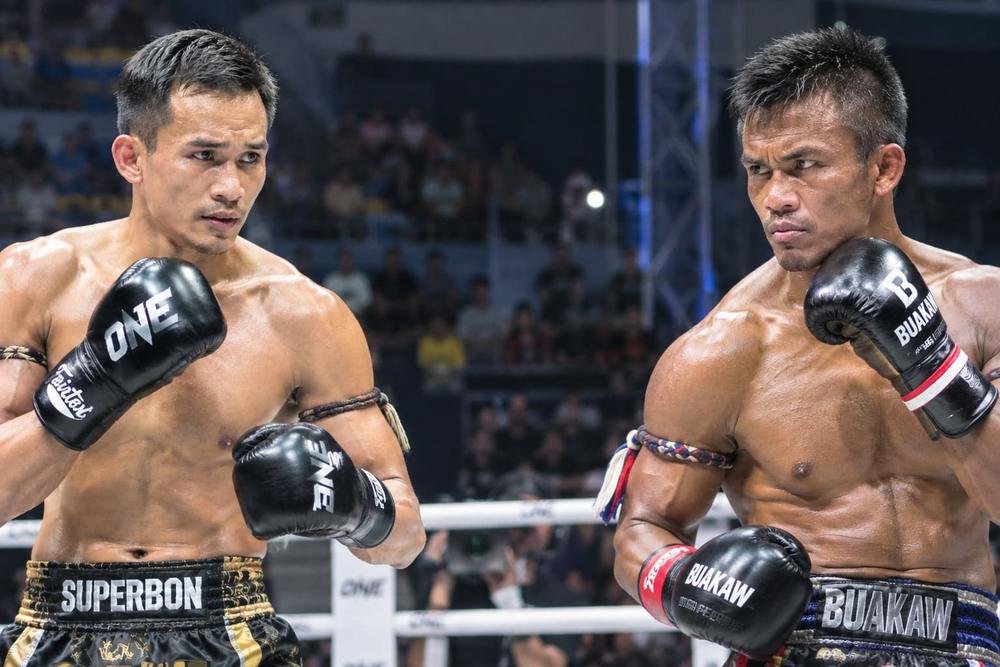
| Petchboonchu FA Group | “Deadly Knee of the Mekong” | 2000s to about 2015 | Lumpinee titles in four divisions between 2007 and 2013, Rajadamnern super lightweight title in 2014, 2013 Siam Kela Fighter of the Year |
| Yodwicha Por Boonsit | None widely used | 2010s onward | 2012 Lumpinee super featherweight champion, 2012 Fighter of the Year honors, 2020 WBC Muay Thai super welterweight title |
Dieselnoi
Dieselnoi stood about 188 cm, which is very tall for a lightweight. He used every inch. He won the Lumpinee lightweight title in 1981 and did not lose it in the ring. He lost it because nobody would fight him. Promoters ran out of opponents, and in the end he was stripped and he retired.
On December 24, 1982, he beat Samart Payakaroon, the most gifted technical fighter of the age, at a catch weight. He also beat Sagat Petchyindee twice in 1984. His record is usually given as 110 wins, 5 losses, and 4 draws. Trainers still show his fights to students who think the knee is a crude weapon.
Petchboonchu
The Mekong river is in Petchboonchu’s nickname, and the knee is too. He won Lumpinee belts at bantamweight, featherweight, super featherweight, and lightweight, and he took the lightweight belt twice. He fought Saenchai, Nong-O, Singdam, and Yodwicha. Those were hard years to be a champion. He pressed forward in all of them. After his fighting days he turned to promoting and training.
Yodwicha
Yodwicha arrived in 2012 and had a year that few fighters ever have. He won the Lumpinee super featherweight title and was named Fighter of the Year. He beat Saenchai, Singdam, and Nong-O. His rivalry with Petchboonchu gave Bangkok two knee fighters trying to out-knee each other, which is not a pretty thing but is a very honest one. He later fought heavier, won an IFMA world title at 71 kg in 2018, and was still collecting belts in 2024.
Where muay khao sits among the styles
Thai trainers usually describe a handful of fighter types. The knee fighter is one. The others are the technical fighter, the puncher, the kicker, and the elbow fighter. Each style answers the others in different ways, and a fight between two styles is often more interesting than a fight between two fighters of the same kind. There is a longer breakdown of the five Muay Thai styles if you want to see how they match up.
The knee fighter’s natural problem is the technical fighter, the muay femur type, who moves, times, and scores from range. His natural prey is the fighter who stands still and trades.
How to fight a muay khao fighter
You cannot wish him away. He will come. So you plan for what he does and you make it expensive.
- Do not back up in a straight line. A straight retreat ends at the ropes, and the ropes are where he wins. Step off at an angle. Make him turn and reset his feet.
- Teep him often. The push kick to the stomach or the hip stops his walk. It does not have to hurt. It has to break his rhythm and tell the judges who controls the distance.
- Kick the body on the way out, not on the way in. If you kick as he comes forward, he catches it or eats it and clinches. Kick after you have stepped off the line.
- Punish the entry. The moment he reaches for your neck, his head is close and his hands are busy. Now is the time for a short hook, a straight right, or an elbow. Elbow fighters have always given knee fighters trouble for this reason.
- Fight for inside position early. If he gets his arms inside yours, you are in trouble. Get your forearm across his throat or collarbone, or your hands on his biceps, before he settles.
- Keep your hips in and your posture tall. When your hips drift back, his knees have room. When your hips are close and your head is up, the knee has nowhere to go.
- Knee him back. A knee fighter who is never touched grows confident. Answer his knees with your own, even short ones, and let the judges see that you are not only defending.
- Break the rhythm, then leave. When the clinch breaks, do not wait for him. Move, kick, and get back to your range.
None of this works if you are exhausted. The knee fighter wins late. He makes you carry him for three rounds so that you have nothing left in the fourth. So the plan for him starts months before the fight, in the clinch rounds you do at the end of training, when you are already tired and it is hardest to keep your posture.
Training the knee yourself
If you are the one walking forward, the work is plain and it is not glamorous. You clinch every session. You throw knees on the bag until your hips know the motion without thinking. You learn to breathe while someone hangs on your neck. You learn to lock your hands and to turn a man with your forearm and your hip instead of your arms.
Start with the straight knee on the heavy bag, hands on the bag as if on a neck. Then add the curved knee. Then clinch with a partner at half speed and count the knees you can throw before the break. Do it for five rounds. By the end your legs will be heavy and your form will tell you the truth about your conditioning.
A good knee fighter does not look fast. He looks inevitable. You get there by doing the same dull thing, correctly, many thousands of times.