

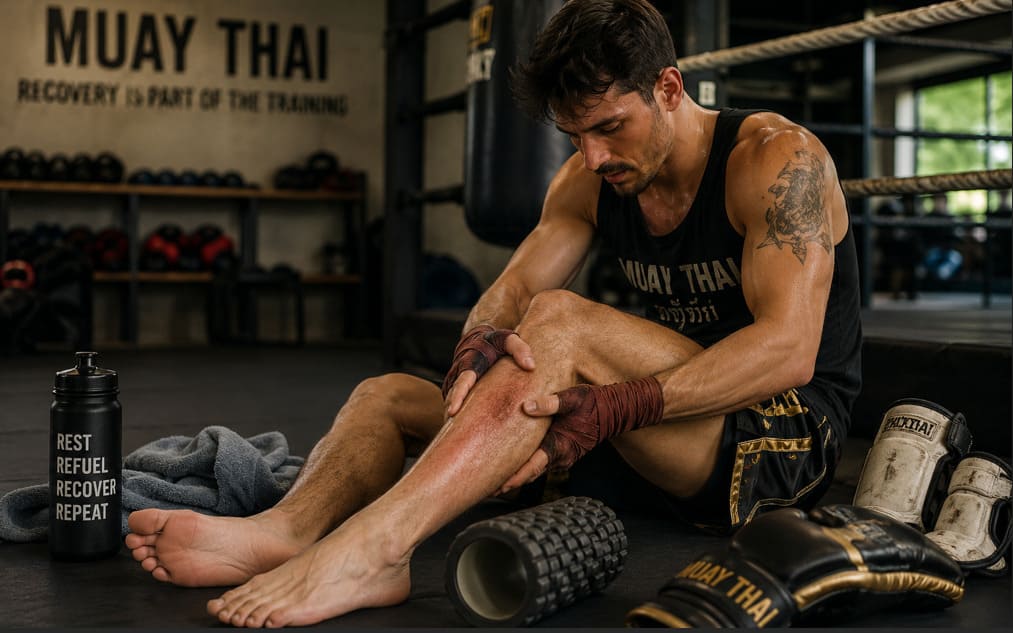
You know the ache. Not the good kind, the one that shows up two mornings after a hard bag session, when your shins throb every time your foot hits the floor and your shoulders feel like they belong to someone else. We chase progress in this sport with a kind of stubbornness that makes recovery feel optional. It isn’t. The body doesn’t get stronger during the round of pad work. It gets stronger in the hours after, while you sleep, eat, and give the tissue time to rebuild. Skip that part often enough and the gains stall, then reverse.
This piece is about the part of training nobody puts on the schedule: the rest.
How Many Rest Days You Need
A beginner training two or three times a week can usually train every session day without a dedicated rest day, because the volume and intensity are both low enough that the body recovers between sessions on its own. Once you move into four or five sessions a week, that changes. Somewhere in there you need at least one full day where you don’t touch pads, bags, or sparring gear at all.
Amateur competitors training six days a week are a different story. They need built-in lighter days, not just rest days, because the accumulated fatigue from clinch work, sparring, and conditioning compounds fast. A rough guide: hobbyists, one rest day a week; regular gym-goers training four to five times, one full rest day plus one light technical day; competitors in fight camp, one full rest day and at least one deliberately easy session. None of this is rigid.
Listen to what your legs tell you on the walk to the gym. If they’re heavy before you’ve even started, that’s information, not weakness. Ignore that signal often enough and minor fatigue turns into the kind of injury that costs you months instead of a Tuesday.
Sore Shins: Normal Ache or Warning Sign
Shin soreness after bag work is close to universal for anyone building their kicks. The bone remodels under repeated impact, and that process comes with a dull, bruised feeling that peaks a day or two after training and fades within three or four days. That’s normal. It’s uncomfortable, not dangerous.
The warning signs look different. Sharp, localized pain that gets worse during a kick rather than easing into it. Pain that lingers past a week with no improvement. Swelling that doesn’t go down, or a spot on the shin that hurts to the touch even when you’re not training. Those point toward a stress reaction or something worse, and they mean stop, not push through.
Ice helps in the first 48 hours after a session that leaves your shins genuinely hot and swollen, mostly by taking the edge off pain and puffiness. For the everyday ache, time and lighter loading do more than ice ever will. If you’re still building shin toughness from scratch, our shin conditioning guide covers the pacing and technique that keep this process safe rather than reckless.
Sleep: The Real Performance Drug
We talk a lot about diet and supplements in this sport and not nearly enough about sleep, even though it does more of the heavy lifting than either one. Somewhere between seven and nine hours a night is the general range most adults need to let the body repair tissue and let the brain lock in what it learned that day, including the footwork drill you finally got right in round three.
Cut that down to five or six hours for a stretch of days and you’ll notice it before any test could tell you. Reaction time slows first. Technique that felt automatic yesterday turns clumsy, and your mood dips right along with it. None of this needs a lab. Any fighter who has trained on four hours of sleep after a bad night knows the feeling of moving through wet cement.
Active Recovery Options
Rest day doesn’t have to mean couch day. Light movement on a day off often speeds recovery more than total stillness, because it keeps blood moving through tired muscle without adding new training stress.
A thirty-minute walk works. So does a slow swim, mobility work on the hips and ankles, or a gentle bike ride at a pace where you could hold a conversation the whole time. Ten minutes of hip openers and ankle circles on a rest day costs you almost nothing and pays back in a looser clinch and cleaner roundhouse the next session. The test is simple: if you finish the activity more relaxed than you started, it counts as active recovery. If you finish it breathing hard, you just trained.
Thai Massage: Tradition Meets Practicality
Walk into any camp in Thailand and you’ll find Thai massage woven into the routine, often the evening after a hard session. It’s worth being honest about what it actually does. The stretching and pressure loosen tight muscle, improve short-term mobility, and feel genuinely good after a day of pads and clinch work. Fighters who get it regularly often say their hips and shoulders move more freely the next morning.
What it isn’t is medical treatment. Thai massage won’t fix a stress fracture, resolve a real injury, or replace a doctor when something is actually wrong. Treat it as a recovery tool with real benefits, not a cure for anything more serious than tight muscle.
8 Signs of Overtraining
Overtraining rarely announces itself with one dramatic symptom. It shows up as a pattern, and the earlier you catch the pattern, the shorter the setback.
- Your resting heart rate in the morning is noticeably higher than usual for several days running.
- You’re irritable or short-tempered in ways that don’t match your normal mood.
- Your performance has plateaued or dropped despite training just as hard, or harder.
- You’re catching colds or getting sick more often than normal.
- Sleep feels broken or unrefreshing even when you get enough hours.
- Old injuries or nagging aches are flaring back up.
- You dread training sessions you used to look forward to.
- Your appetite has changed noticeably, either gone or constant.
One or two of these on a bad week means nothing. Three or more sticking around for two weeks means it’s time to back off before your body forces the issue.
The Deload Week
Amateurs training hard for months without a break are setting themselves up for exactly the list above. A deload week, roughly every four to six weeks, where volume and intensity both drop by a third or more, gives the joints and nervous system a chance to catch up with the muscle.
This isn’t a week off. Think shorter sessions, less sparring, and more technical drilling at half speed. That kind of discipline is what separates fighters who last years in this sport from the ones who burn out in eighteen months.
FAQ
Is it normal for shins to hurt every time after Muay Thai training? Yes, especially early on. Dull, bruised soreness that peaks a day or two later and fades within a few days is part of how the bone adapts. Sharp pain, swelling that won’t go down, or pain that keeps getting worse is not normal and needs a break from kicking drills.
How do I know if I need a rest day or a deload week? A rest day fixes short-term fatigue from the last session or two. A deload week is for fatigue that has built up over weeks or months, usually signaled by a plateau, poor sleep, or two or more items from the overtraining list above showing up together.
Can I still do cardio on a rest day? Light cardio like walking or an easy swim is fine and often helps recovery. Anything that leaves you breathing hard or sore the next day defeats the purpose of the rest day.


One Comment