
Kick height comes down to three muscle groups, not general flexibility. The hip flexors on the standing leg and the kicking leg both need length. The hamstrings and adductors need range to let the leg travel through its arc without the hip stalling out. That’s the whole list. A fighter can be flexible in the shoulders, the back, the ankles, and still kick low, because none of that tissue is involved in the movement.
The thoracic spine matters too, though for a different reason. It doesn’t raise a kick, but a stiff upper back limits rotation in the clinch and in the wind-up before a kick fires, so it earns a spot in the routine even though it’s not the limiting factor for height itself.
The adductors deserve a specific mention too. They get stereotyped as “groin muscles” and ignored until something pulls. On a roundhouse or a switch kick, the leg crosses toward the centerline before it rotates outward, and a short adductor stops that crossing motion early, which shows up as a kick that looks rushed and low even when the hip itself has decent range.
What Actually Limits Your Kick Height
Most beginners assume they need “flexible legs” in some vague sense. What actually happens is more specific. The hip flexor on the standing leg has to lengthen to let the pelvis tilt and rotate. The hamstring and adductor on the kicking leg have to allow the leg to swing up and across the body without yanking on a short muscle. If any one of those three is tight, the kick stops early and the body compensates by leaning back or dropping the shoulder, which kills power and balance at the same time.
This is why a fighter with tight hamstrings can still throw a passable roundhouse. The hip does most of the work. Flexibility training for kicks should target hip mobility first and treat hamstring length as a secondary piece, not the main event.
Dynamic Warm-Up (Before Training)
Before training, the goal is blood flow and range, not depth. Five minutes of dynamic movement wakes up the hip flexors, hamstrings, and adductors through their full range without holding any position long enough to affect force output. Leg swings, hip openers, and light rotational movement all belong here. Nothing gets held past a second or two. Pair this with the rest of a standard warm-up, since raising heart rate matters as much as the stretching itself before any pad work or speed drills begin.
Static Stretching Routine (After Training)
Static holds, 30 to 45 seconds each, belong after training, not before it. Holding a stretch that long tells the muscle to relax and lengthen, which is exactly what you want when the goal is long-term range. It is not what you want right before throwing kicks at full speed. Research on this is consistent enough to state plainly: static stretching immediately before an activity can temporarily reduce the muscle’s ability to produce force. The effect fades within an hour or so, but nobody wants reduced power for their first three rounds of sparring. Save the long holds for the cool-down, when the muscle is warm and there’s no upcoming performance demand.
The 12 Exercises
1. Frontal Leg Swings
Standing swings, front to back, holding a wall for balance. 2 sets of 15 per leg, dynamic warm-up.
2. Lateral Leg Swings
Same setup, swinging side to side across the body. 2 sets of 12 per leg, dynamic warm-up.
3. Hip Circles
Standing on one leg, tracing large circles with the free knee, both directions. 10 circles each direction, per leg.
4. Walking Lunge with Rotation
Step into a lunge, rotate the torso toward the front leg. 8 reps per side, one pass down the room.
5. Inchworm to Downward Dog
Walk the hands out from standing to a plank, push into downward dog, walk back. 5 slow reps, opens the hamstrings and thoracic spine together.
6. Kneeling Hip Flexor Stretch
Half-kneeling, back knee down, tuck the pelvis and push the hips forward. Hold 30-45 seconds per side, static, after training.
7. Standing Hamstring Fold
Feet hip-width, soft knees, fold from the hips and let the head hang. Hold 45 seconds, static.
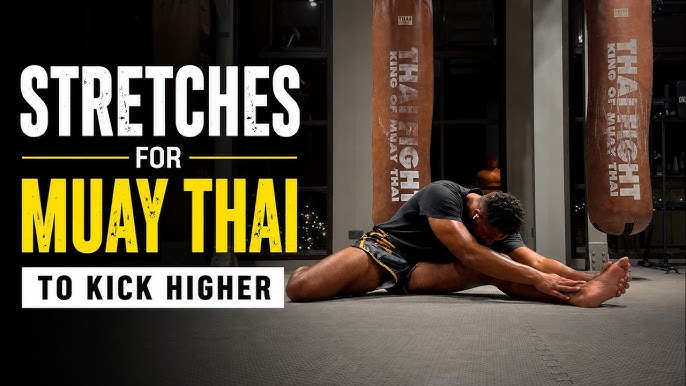
8. Butterfly Stretch
Seated, soles of the feet together, knees drop toward the floor with gentle forward pressure. Hold 30-45 seconds.
9. Frog Stretch
On hands and knees, knees spread wide, hips sink back toward the heels. Hold 30 seconds, builds slowly over weeks.
10. Figure-4 Stretch
Lying on the back, ankle crossed over the opposite knee, pull the far thigh toward the chest. Hold 30-45 seconds per side, targets the glute and hip rotators that drive kick rotation.
11. Thread the Needle
On hands and knees, thread one arm under the body and rotate through the upper back. Hold 30 seconds per side, thoracic spine mobility for clinch work.
12. 90/90 Hip Switch
Seated with both knees bent at 90 degrees, one leg in front and one to the side, rotate to switch which leg is forward. 8 slow switches per side, trains the internal and external hip rotation a roundhouse actually uses.
How Fast Flexibility Improves
Nobody gets a noticeably higher kick after one week of stretching. Most people notice a real difference in hip range somewhere between four and eight weeks of consistent work, meaning most days, not once a week when it’s convenient. The frog stretch and the kneeling hip flexor stretch tend to be the slowest movers because they target dense tissue that adapts gradually. Figure-4 and the 90/90 switch often loosen up faster since they’re training rotation and control as much as raw length.
Consistency beats intensity here. Fifteen minutes a day for six weeks does more than an occasional hour-long stretching session. The tissue needs repeated, moderate exposure, not one brutal push that leaves it sore and guarded for the next three days.
Progress also isn’t linear. A fighter might feel stuck for two weeks and then notice a jump in range almost overnight. That’s normal. What stalls progress is skipping days, not lacking some special gift for flexibility that other people supposedly have.
Do You Need Splits?
No. A full split is a party trick, not a kicking requirement. Watch any high-level roundhouse and the standing leg turns, the hip snaps through, and the kicking leg travels on an arc that never resembles the straight-line range of motion a split demonstrates. Hip rotation raises the kick. Forcing the legs into a wider split adds very little on top of that.
Chasing a split can even work against a fighter’s training time. Hours spent forcing end-range splits flexibility are hours not spent on the hip rotation drills, the clinch mobility work, and the standing-leg pivot that actually raise a kick. Train the hips, keep the hamstrings reasonably loose, and skip the splits obsession entirely.