
Picture a jump rope and most people see a thin nylon cord with ball-bearing handles, the kind built for blur-speed double-unders on a CrossFit floor. Now picture what actually hangs by the ring post in a real Muay Thai camp in Thailand. It is thick. It is stiff. It looks like a leftover piece of plumbing tubing with two wooden handles screwed on. That rope will never spin fast, no matter how hard anyone swings it, and that is exactly the point. Thai camps did not accidentally end up with the wrong equipment. They chose the opposite of the fitness-world default on purpose, and the reason has almost nothing to do with cardio.
Why Every Thai Camp Starts With the Rope
Walk into a gym in Pattaya or Chiang Mai at four in the afternoon and the rope comes out before the wraps do. Before pads, before the bag, before a single kick gets thrown, fighters skip. It is the universal warm-up across camps that otherwise disagree on almost everything else in a session. Ask a trainer why and the answer rarely mentions calories. It mentions shoulders, forearms, and feet, because a heavy rope trains all three at once in a way that running never touches.
The Heavy PVC Rope Difference
The ropes Thai camps use typically weigh somewhere around one to one and a half pounds, sometimes more at the older, dustier camps that have used the same rope for a decade. Compare that to a speed rope, which weighs a few ounces and exists purely to spin as fast as physically possible. The heavy PVC version does the opposite job. Every swing loads the shoulders and forearms the way a clinch fight does, where a fighter has to hold frame, fight for underhooks, and keep arms up for minutes at a time without them turning to jelly. Muay thai training equipment has always leaned toward tools that double as strength work in disguise, the same instinct that put heavy bags, medicine balls, and rope-and-tire drag sleds into camps long before “functional training” became a gym marketing phrase. A thin speed rope trains footwork and coordination. It does very little for the arms. The heavy rope trains footwork, shoulders, and grip endurance together, which is why swapping a heavy rope for a speed rope defeats most of what the drill is actually for.
Thai Skipping Technique
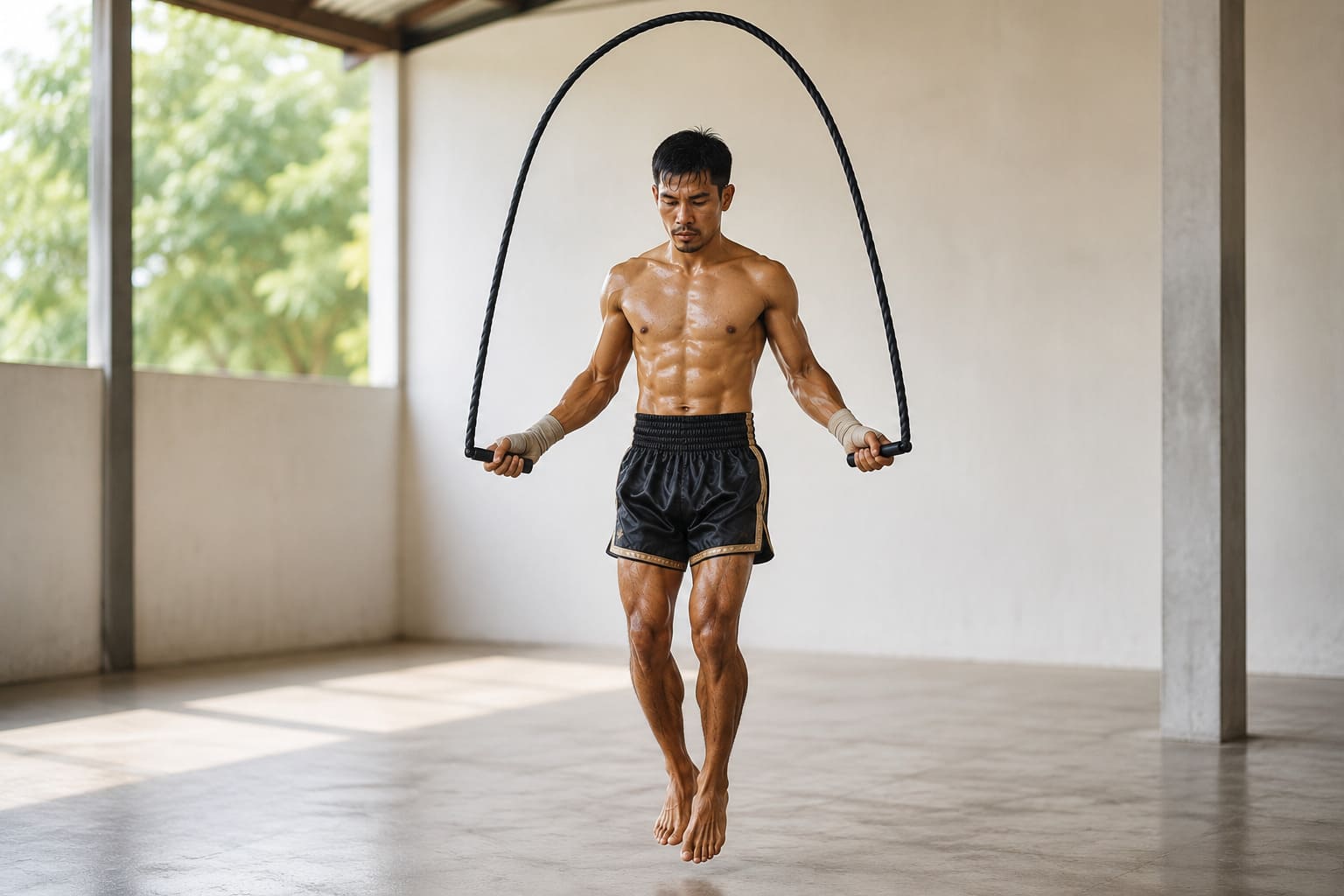
Watch a Thai fighter skip and it looks nothing like the two-footed bounce most beginners default to. There is no big jump. Feet barely leave the ground, weight stays forward on the balls of the feet, and the rope turns over in an alternating rhythm, left foot, right foot, almost like a slow jog with a rope involved. Heels never touch down. Knees stay soft and slightly bent the whole time, absorbing each landing instead of stamping it into the floor. Elbows tuck close to the ribs rather than flaring out, because that is the same elbow position a fighter needs in the clinch thirty minutes later. The whole thing looks unhurried, almost lazy from a distance, but the low hop height and forward foot placement mirror exactly how a Nak Muay moves around the ring: light, economical, never fully planted.
The Camp Protocol
Most camps run the rope for fifteen to thirty minutes before anything else starts, and it is rarely one unbroken block. It gets split into rounds that match fight length, usually three minutes of work followed by one minute of rest, repeated five or six times. That structure is not arbitrary. It conditions the body to the exact work-rest rhythm a fight uses, so the first time a fighter feels that three-minute burn is in the warm-up, not in round two against an opponent. By the time gloves go on, shoulders are already primed, calves are already firing, and the footwork rhythm from the rope carries straight into padwork. Some trainers layer variations into later rounds, faster turnover, single-leg hops, or a boxer’s shuffle step, but the core rhythm stays the same drill it always was.
Beginner Progression Week by Week
Someone who has never managed ten consecutive skips without tripping should not try to copy a fighter’s rhythm on day one. Week one is about the rope hitting the ground, period. Ten minutes of slow, two-footed jumps with long rest breaks between attempts is enough, and tripping every few seconds is normal, not a sign of failure. Week two introduces the alternating-foot pattern from a standstill, marching in place with the rope passing under one foot at a time before adding any real hop. By week three, that marching turns into an actual light skip, still slow, still two or three short sets rather than one long round. Week four is where the first real three-minute round shows up, even if it falls apart twice in the middle and needs a restart. Somewhere around week five or six, the rounds start looking like the camp version: continuous, low to the ground, arms relaxed. Nobody skips like a ten-year Muay Thai veteran in a month. The goal at every stage is simply more continuous minutes than the week before, not speed.
Rope Types Compared
| Rope Type | Typical Weight | What It’s Built For | Main Drawback |
| Heavy PVC (Thai camp style) | 1-1.5 lb | Shoulder, forearm, and grip endurance; clinch conditioning | Slower to spin, harder to learn on |
| Speed rope | 2-4 oz | Coordination, double-unders, cardio speed | Almost no strength benefit for arms |
| Standard fitness rope | 6-10 oz | General cardio, beginner coordination | Doesn’t replicate either extreme well |
No Rope? No Problem
Plenty of Thai gyms have a corner with a ceiling too low for a rope to clear, and fighters still skip there every single day. The trick is skipping with no rope at all, just the footwork, the arm rotation, and the rhythm, running entirely on imagination. Hands turn small imaginary handles at the hips, feet do the exact alternating hop they would with a real rope, and the whole drill runs for the same three-minute rounds. It looks a little strange the first time someone sees it from outside. Ask any trainer who grew up doing it in a cramped shophouse gym and they will say it works just as well for footwork and rhythm, even if the shoulders miss out on the load. No rope, no ceiling, no excuse.