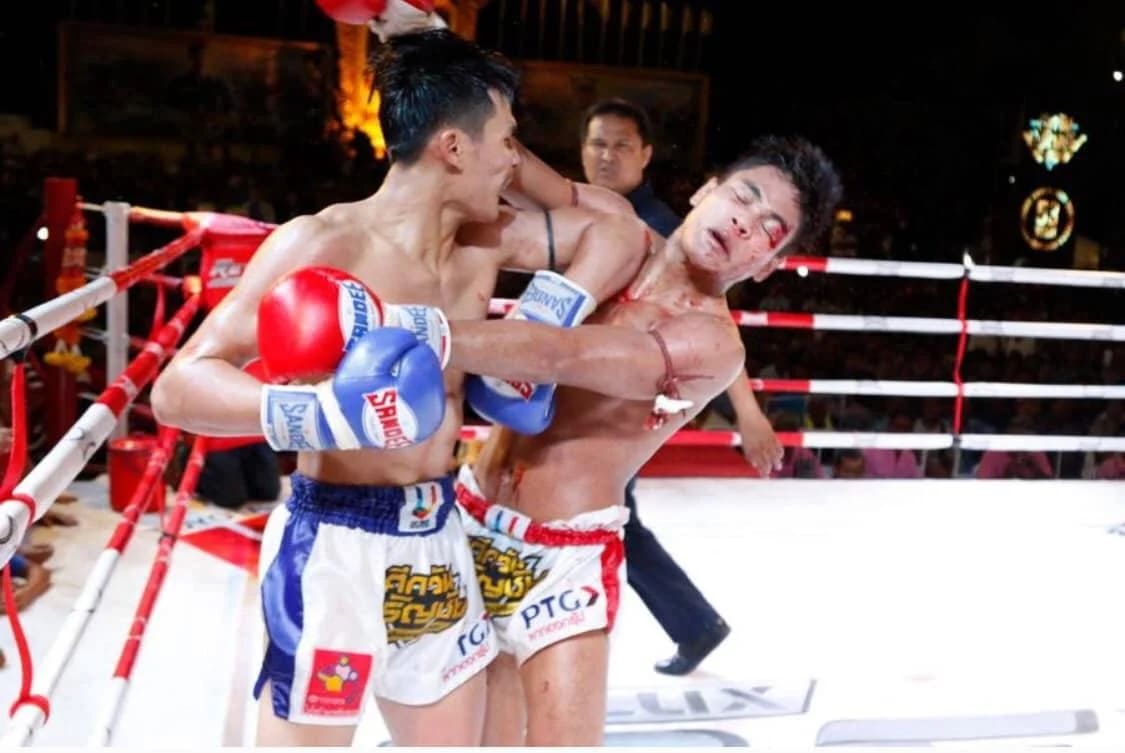
Most Americans who train Muay Thai for years will never take a live elbow to the face. Not once. They will spar hundreds of rounds, compete in amateur smokers, maybe even turn pro in a regional promotion, and still never feel what the art’s signature weapon actually does at full speed. That is not an accident and it is not a flaw in their training. It is a rule.
Elbows are the single most restricted strike in the sport that invented them. In Thailand they are thrown without hesitation. In most American gyms and amateur circuits, they are drilled on pads, capped at controlled contact, or banned outright. The gap between what elbows are supposed to do and what most students ever experience live is enormous, and understanding that gap changes how a fighter should prioritize training time.
Why Elbows Are Muay Thai’s Signature
Every striking art has a finishing weapon. Boxing has the hook. Kickboxing has the head kick. Muay Thai has the elbow, and among all eight limbs the art uses, nothing else carries the same reputation. A hard elbow does not need knockout power to end a fight. It needs geometry: a small, dense, sharp point of bone driven into soft tissue at close range.
That is the whole story of why elbows matter so much in the clinch and in the pocket. Punches spread force across a padded fist. Elbows concentrate it into roughly two square inches of bone with almost no cushioning. The result is skin splitting open, not just bruising. Referees stop Muay Thai fights on cuts more often than on flash knockdowns, and the elbow is usually the reason why.
The 8 Elbow Strikes
There is no single universal numbering system across every Thai gym, and English transliterations of the Thai names vary from camp to camp. But the eight core strikes below cover what almost every serious Muay Thai curriculum teaches, grouped by how they are typically introduced.
The Core Three
Every beginner who advances past basic punches and kicks eventually learns three elbows first. Sok tat is the horizontal elbow, thrown like a hook but with the arm folded, sweeping across the centerline into the jaw or temple. It is the easiest elbow to land because it travels the same path a hook does, so opponents read it late. Sok ti is the downward elbow, chopped from high to low across the eyebrow or the bridge of the nose. This is the cut-maker. Fighters throw it after slipping a jab or off a clinch tie-up, dropping the point of the elbow straight down onto whatever is in front of it. Sok ngat runs the opposite direction: an upward, rising elbow that travels underneath the chin, functionally an uppercut with a blade instead of a fist. It works best at very close range, often off a failed takedown attempt or a collapsing clinch.
The Clinch and Follow-Up Elbows
Once a fighter has control of the clinch, three more elbows become available that rarely show up in open space. Sok phung, sometimes called the smashing elbow, drops the fighter’s full bodyweight down through a bent elbow onto the top of an opponent’s head or eyebrow while both fighters are tied up. It is short, brutal, and depends entirely on head control. Sok sub is the thrusting elbow: instead of swinging, the fighter drives the elbow straight forward like a spear point, usually into the nose or mouth at extreme close range where there is no room for a hook. And then there is the double elbow, a combination rather than a single named strike in most Western curricula, where a fighter throws one elbow off each arm in quick succession, using the recoil of the first to load the second. Trainers usually introduce it only once a student can throw the first six strikes cleanly.
The Spectacle Elbows
The last two get the highlight reels. Sok klap is the spinning or reverse elbow, thrown by rotating the whole body a half turn and whipping the elbow around behind the fighter’s own head. It carries enormous power because the entire torso adds momentum, but it also blinds the fighter mid-rotation, which is exactly why it gets saved for the moment an opponent is already hurt or overcommitted. Sok loi, the jumping elbow, adds a leap into the downward chop, using gravity and hip drive together. Both strikes look spectacular in a highlight clip and both carry real risk if they miss, since a spinning or jumping fighter who whiffs is badly out of position for whatever comes next.
Cutting vs Knockout Elbows
Here is the distinction most casual fans miss: elbows rarely knock people out, and they are not really designed to. An elbow’s short travel distance means it generates less raw force than a full hook or a kick from the hip. What it does instead is open the skin, and an open cut changes a fight completely.
Blood in the eyes blinds a fighter within a round. Referees and ringside doctors in Thailand will stop a bout on a deep cut even if the fighter being cut is winning on output, because the risk of a blinded fighter taking unnecessary damage outweighs letting the fight continue. So the elbow’s job is not to end the fight in one shot. Its job is to force a stoppage through accumulated damage to the skin, which is a slower, uglier kind of finish than a knockout but just as final.
Where Elbows Are Legal
Legality is not uniform, and this is the part beginners get wrong most often when they watch a Thailand fight card and assume the same rules apply everywhere.
| Organization / Setting | Elbows Allowed? | Notes |
| Traditional Thai stadiums (Lumpinee, Rajadamnern) | Yes, full contact | Sharp elbows are standard; cuts are part of how fights get scored and stopped |
| ONE Championship | Yes, full contact | Standing elbows are permitted under the promotion’s Muay Thai and kickboxing rulesets |
| IFMA international amateur (senior divisions) | Yes, with standard gloves | Padded competition gloves are worn, but the elbow strike itself is not removed |
| US amateur circuits (most state-sanctioned events) | Often banned or restricted | Many amateur commissions prohibit elbows entirely or require elbow pads that blunt the strike |
| Glory and K-1 style kickboxing | No | These rulesets exclude elbow strikes entirely, treating the sport as kickboxing rather than Muay Thai |
| Everyday gym sparring | Rarely thrown live | Reserved for pads and drilling; live sparring usually removes or heavily restricts elbows for safety |
That last row explains the opening claim. A fighter can compile a full amateur record in the United States, spar three times a week for years, and still never throw or receive a live elbow outside of padded drilling. The strike that defines the sport, statistically, is the one most American practitioners experience the least.
Training Elbows Safely
The obvious problem with elbows is that a training partner is not a heavy bag. Nobody wants to be the person standing across from a live sok ti. Gyms solve this a few different ways, and a serious student should expect to move through all of them rather than treating pad work as the finish line.
Pad holders take the first and heaviest load. A coach holding Thai pads or elbow pads absorbs full-speed, full-power elbows so the striker learns real mechanics: hip rotation, weight transfer, the snap at the end of the motion. This is where power actually gets built, because nothing about the movement changes just because the target is padded.
Shadow drilling comes next, ideally in front of a mirror, focusing on the rotation of the hips and shoulders rather than arm speed. Most beginners try to throw elbows with the arm alone, which produces a weak, slapping strike. The power comes from the same hip drive that generates a hard hook.
Controlled partner drilling, sometimes called touch-elbow sparring, lets two students throw elbows at reduced speed and stop just short of contact, or make only light touch contact, so each person learns timing and distance without risking a cut. This is usually gated behind a coach’s supervision and often behind a rank or experience requirement, precisely because it is the step where a mistake actually breaks skin.
Full-contact elbow sparring, when it happens at all, is typically reserved for fighters actively preparing for a bout under rules that permit elbows. Even then, many gyms cap it to a handful of rounds close to fight week rather than making it a weekly habit, because the cut risk to both training partners is real and neither one has a fight to recover for on a random Tuesday.
Elbow Defense
Defending against an elbow that a training partner will never actually throw is its own quiet problem, and it is one most American practitioners never solve because they never have to. The standard answers are the same ones used against any close-range strike: keep the lead hand up and tight to the temple rather than dropped, control range so the elbow’s short arc never reaches full extension, and use the clinch itself as a defense by getting an over-hook or head position before the opponent can free an arm to throw. Fighters who train primarily in the US often default to slipping and covering the way they would against a hook, which works reasonably well against sok tat but does little against the downward chop of sok ti or the rising line of sok ngat, since both travel on angles a boxing-style guard was never built to intercept. That mismatch between a Western defensive instinct and a Thai offensive weapon is exactly why gyms that take the art seriously eventually put a padded elbow in front of every student, even the ones who will never see one thrown for real once they step into competition.