

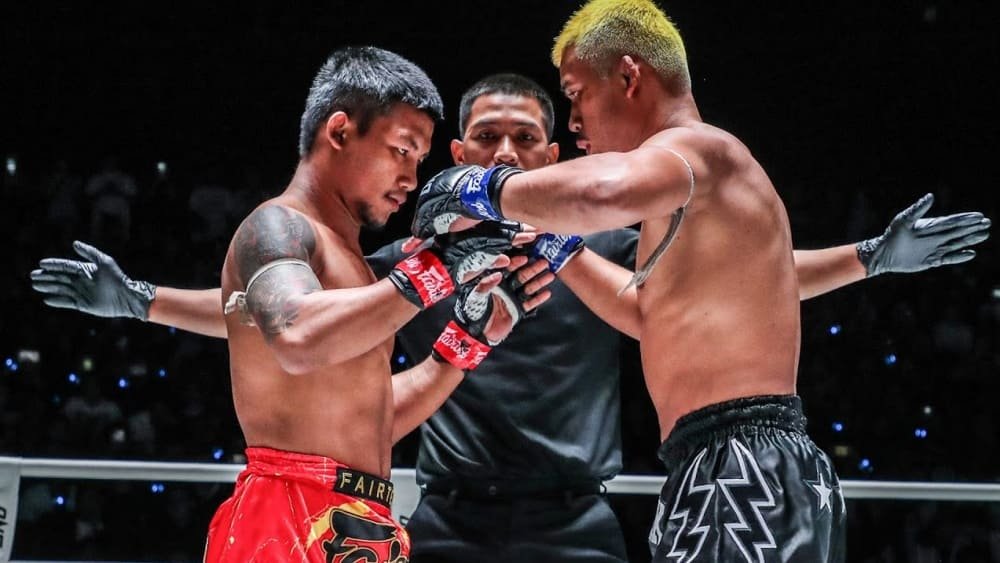
Nong-O Gaiyanghadao was a long-reigning ONE bantamweight Muay Thai champion and a genuine Thai great when Jonathan Haggerty knocked him out at 2:40 of the first round in April 2023. The venue was Lumpinee Stadium. The gloves were four ounces. Under the stadium’s own five-round rules, that same exchange happens during the feeling-out period, Nong-O gets twelve more minutes to read the problem, and most people who follow Thai boxing would have backed him to solve it.
He had nine minutes instead. He never left the first three.
Every argument about ONE’s ruleset lives inside that fight. The promotion did not invent a new martial art. It changed four or five numbers, and the numbers changed what wins.
The two rule sheets, side by side
| Rule | ONE Championship Muay Thai | Thai stadium Muay Thai |
| Gloves | 4oz open-finger MMA gloves, identical for every athlete | Laced boxing gloves assigned by division: roughly 6oz up to 126 lb, 8oz to 147 lb, 10oz above that |
| Rounds | 3 rounds of 3 minutes, 1-minute rest. World title bouts go 5 rounds of 3 minutes | 5 rounds of 3 minutes, 2-minute rest |
| Scoring | Round by round, ties broken by knockdowns, then damage, then number of clean strikes, then aggression and ring generalship | Cumulative impression of the whole fight, and the later rounds carry most of the weight |
| Clinch | Legal, sweeps and throws included, but referees separate fast when the work stalls | Central to the sport and allowed to develop over long exchanges |
| Weight | Walking-weight system: hydration test and weigh-in 24 to 48 hours out, urine specific gravity of 1.025 or lower, no IV rehydration | Weigh-in the morning of or the day before, no hydration testing |
| Setting | Cage on the big numbered cards, Lumpinee’s ring on the Friday shows | Ring, sarama music, full wai kru |
Read that grid twice and you can predict the style difference without watching a single fight.
Four ounces changes what defense means
A 10oz glove is a shield. Thai fighters spend years learning to hide behind one, catching hooks on the forearms, eating three punches to land one kick, taking the round back later. Shrink the glove to four ounces and the shield stops existing. Punches slip between the hands, elbows find the gaps in a high guard, and cuts open on shots that would have been absorbed in Bangkok. Boxing suddenly pays in a sport where it historically paid very little.
Open fingers created a problem of their own. Eye pokes turned into a recurring complaint on ONE cards, and in August 2025 Chatri Sityodtong told the Bangkok Post the promotion had spent months testing a redesigned four-ounce glove for Muay Thai only, with a covered thumb, more room for hand wrapping, and a shape that makes it harder to flex the fingers forward into someone’s face.
This is where most explainers oversell their case. Fans on both sides speak with total confidence about whether small gloves are more dangerous than big ones, and neither side has the data to be that certain. Less padding means more visible damage and more stoppages. Fewer rounds also means fewer total head shots absorbed across a career, and a fight that ends in round one is a fight nobody spent nine minutes getting hit in. Both things are true at once.
Three rounds delete the third act
Traditional stadium Muay Thai is written for five. Rounds one and two are reconnaissance, round three is where the fight is decided, rounds four and five are where a fighter who is ahead protects the lead and a fighter who is behind has to go get it. Thai gamblers price the fight round by round because the shape of it is that predictable.
ONE compressed the whole story into nine minutes, and the compression is not neutral. Round one is now a scoring round. A slow start is not patience, it is a lost third of the fight.
The clearest evidence came in September 2023, when Superlek Kiatmoo9 beat Rodtang Jitmuangnon by unanimous decision at ONE Friday Fights 34, in a 140-pound catchweight bout at Lumpinee that had been agreed at three rounds rather than five. A second-round knockdown swung it. Afterward Chatri called the fight a strategic error on Rodtang’s part for asking for three, and he was right: Rodtang is a pressure fighter who buries opponents in accumulated volume, and volume needs time.
So who actually wins a round?
ONE’s judges score round by round and break a tied fight with a fixed order of criteria: knockdowns first, then damage of any kind, then the number of clean strikes, then aggression and ring generalship. Damage sits near the top. Volume sits below it. Nobody is going to win a close ONE round for looking composed while backing up.
Thai judging asks a different question entirely, and if you have never seen the two systems compared, how Thai judges score is worth an hour of your time before you argue with anyone about a decision.
The traditional side has not stood still either. Rajadamnern moved its five-round product onto round-by-round scoring in March 2026, requiring a winner in every round and putting scores on display during the fight. Some of what ONE is criticized for pushing is being adopted a mile away from ONE’s own Friday venue.
The clinch is legal on paper
On paper the clinch is fully in. ONE allows knees, sweeps, and throws, and a legal throw can even end the fight as a knockout. In practice the referee is holding a stopwatch in his head. If neither fighter is working, the break comes within a few seconds, and the tolerance varies noticeably from official to official.
Long-time fans have a fair complaint here, and the sharpest version of it is a question: at what point is this kickboxing with smaller gloves and elbows? The clinch in stadium Muay Thai works as a slow contest of posture, grip, and balance, and a muay khao specialist can spend thirty seconds building the position before the first knee ever lands. Nobody watching in Bangkok calls that a pause in the action. Cut it at five seconds and that entire craft has nowhere to happen.
Knee fighters have adapted rather than disappeared. The adaptation is brutal and simple: score inside the first two seconds of contact, or lose the position.
The hydration rule nobody else copies
This is the part of ONE’s rulebook I would defend without hesitation, and it exists for a grim reason. In December 2015, 21-year-old Yang Jian Bing died of complications from dehydration while cutting weight for a ONE event. Within weeks the promotion banned dehydration cutting outright.
What replaced it is unusually strict. Athletes log daily weights through a portal, get assigned a class based on that tracked walking weight, and cannot drop a division inside eight weeks of a fight. Hydration testing and the weigh-in happen together, 24 to 48 hours out. A doctor reads a urine sample on a refractometer, and anything above a specific gravity of 1.025 fails, which means no weigh-in until the athlete rehydrates and passes. IVs are banned as a rehydration method. Miss the mark and the bout can still go ahead at catchweight if both athletes land within 105 percent of each other’s hydrated weight, with the one who failed surrendering a slice of the purse.
Practically, ONE fighters compete near the weight they live at, which is why the divisions look heavier than the ones you see in Thai stadium weight classes. A ONE lightweight and a Lumpinee lightweight are not the same animal. Nearly every other major promotion in combat sports still runs on next-day weigh-ins and a sauna, and that remains hard to justify.
What a Thai fighter has to unlearn
A Thai pro arriving in ONE has usually had a hundred-plus fights built on a rhythm that no longer pays. The first thing to go is the coast: there is no banking the fight early and managing round five. The second is the guard, because the block that worked behind 8oz gloves leaks badly behind 4oz. The third is glove-checking the clinch to reset and breathe.
What gets added is hand speed and elbow entries. Watch how many Thai fighters in ONE now open with a lead hook rather than a probing teep. No coincidence there, and no betrayal of anything either. Rules shape technique, always have. Kard chuek fighters bound their fists in rope, and their sport looked different too.
Watch one of each this week
Here is the fastest way to feel the difference rather than read about it. Pull up a ONE Friday Fights main event, which streams free on YouTube from Lumpinee, and a five-round Rajadamnern or RWS fight from the same month. Watch nothing but round one in each.
In the ONE fight, both athletes are already hunting. In the five-rounder, you will see two fighters gathering information, testing range with teeps, and giving away a round they fully intend to buy back. Then check the third round of each. The ONE fight is being closed out by then. The stadium fight is only starting to turn.
Neither format is the real Muay Thai. Five rounds is the version the sport built its scoring culture around, and it rewards a kind of intelligence that three rounds barely has room for. Three rounds with four-ounce gloves produces the highlight reel that pulled several million new people toward a sport they would otherwise never have clicked on. If you only ever watch one of them, you are getting an incomplete picture of what Thai fighters can do.
Questions people actually ask
Is ONE Championship real Muay Thai?
Yes, in the sense that punches, kicks, knees, elbows, clinching, sweeps, and throws are all legal, and most of the roster is Thai. The scoring priorities and the glove size make it a distinct competitive format, closer in feel to a striking sport built for television than to a Lumpinee card. Plenty of good coaches disagree about whether that matters.
Why does ONE use 4oz gloves for Muay Thai?
To increase finishes and make hands a real weapon. Less padding removes the high-guard shield that Thai fighters rely on, so punches and elbows land clean far more often. ONE introduced a redesigned four-ounce Muay Thai glove in late 2025 to reduce eye pokes, keeping the same weight while covering the thumb.
Are ONE Muay Thai fights three rounds or five?
Three rounds of three minutes for regular bouts, five rounds of three minutes for world title fights, with a one-minute rest either way. Thai stadium bouts run five rounds of three minutes with two-minute rests, so a ONE non-title fight is barely more than half the fighting time.
Can ONE fighters still cut weight?
Not by dehydration. Athletes are tracked at their walking weight, cannot change divisions inside eight weeks of a bout, and must pass a urine specific gravity test of 1.025 or lower before they are allowed on the scale. Gradual cuts through diet and training still happen, but the sauna-suit water cut that defines fight week elsewhere is off the table.

One Comment