
Ask a gym in Chiang Mai or Phuket whether you can fight and the answer is almost always yes. Sometimes within two weeks of you walking through the door. Getting a fight in Thailand was never the hard part, and any guide treating it as an achievement is selling you a camp package. The hard part is being matched against someone near your size and near your ring experience, on a card where an actual person has thought about whether the pairing is fair.
That decision is not yours. It belongs to whoever books you. Which means the gym you picked will shape your night far more than the six weeks of training you did beforehand.
How a fight actually gets made
Nobody fills out an application. Fights move through relationships: your gym owner or head trainer knows a promoter, the promoter has a card to fill at a stadium, and a phone call settles it, often in the same week. There is no sanctioning body vetting your readiness in the way a state athletic commission would back home. The filter is one man’s judgment about whether putting you in the ring will embarrass him.
So the question that matters when choosing a camp is not how many world champions it has produced, but whether it has a reputation with promoters worth protecting. A camp that sends fighters out monthly and expects to keep doing so has a reason to say no on your behalf. A gym that is mostly a tourist business with a ring attached has a reason to say yes to everything, because filling a promoter’s card is currency.
When a trainer says “you can fight,” find out which of three things they mean. A gym interclub against another foreigner, usually with shin guards and no official record. A tourist-stadium bout on a card sold to people holding beer. Or a registered card where the result goes in a book.
Nobody is going to make you wait
In the US or Canada, two to three years of training before a first amateur bout is normal. In Thailand a gym will put you on a card after a week if you ask. Most fights get taken on one to three weeks of notice, and a month at a camp will usually surface something inside the first two or three weeks.
This is not, by itself, a scam. Thai fighters grow up without fight camps because there is nothing to camp for: a teenager at a decent gym fights monthly and stays ready year round. Applied to you, the same system removes the one thing you actually lack, which is ring time. A Thai 19-year-old with “ten fights” has ten fights plus a childhood of them. You have ten fights.
Full-time training, two sessions a day six days a week, commonly runs 8,000 to 10,000 baht a month, or roughly 300 to 500 baht for a drop-in session. Cheap enough that most people arrive with time to spare. Spend some of it watching cards at the venue you would be fighting at, before you agree to anything. One evening in the cheap seats tells you more about the level than any conversation with a trainer will.
The purse, and where the money comes from
Your fight money is not the interesting money in the building. Traditional Thai stadium cards are funded overwhelmingly by gamblers, who buy most of the tickets and drive the gate that pays everybody. Alongside the official purse there is the side bet, the derm pan, negotiated between camps and backers and sometimes printed on the program to make a fight look attractive. Gamblers also tip fighters directly for a performance they liked.
None of that flows to a debuting nak muay farang. Foreigners starting out report figures in a range that varies enormously by venue and by whatever deal the gym cut.
| Where you fight | Typical first purse for a foreigner | Who is paying | What comes with it |
| Gym interclub or smoker | Usually nothing | The gym | Headgear and shin guards common, no official record |
| Provincial festival or temple fair card | Around 1,000 to 3,000 baht, widely reported | Local promoter, funded by gate and betting | Real Thai opponent, real record, minimal ceremony |
| Tourist stadium in Phuket, Chiang Mai, the islands | Roughly 2,000 to 5,000 baht, sometimes a cut of ticket sales | Stadium promoter | Matchmaking quality swings wildly card to card |
| Registered Bangkok stadium circuit | Reported from around 5,000 baht up to 60,000 depending on the promotion | Promoter | Registration paperwork, proper officials, five rounds |
Two things distort those numbers. Many fighter-focused gyms train foreigners free in exchange for a purse split, 50/50 being common, which turns a “3,000 to 5,000 baht” headline into 1,500 in your hand. Trainers expect a cut of what is left, and paying it is not optional if you want corner work again. More than one foreigner has finished a night netting less than the gas money to the venue.
Fight for the experience. Treat anything you get paid as a souvenir.
Festival cards, tourist stadiums, and the real rings
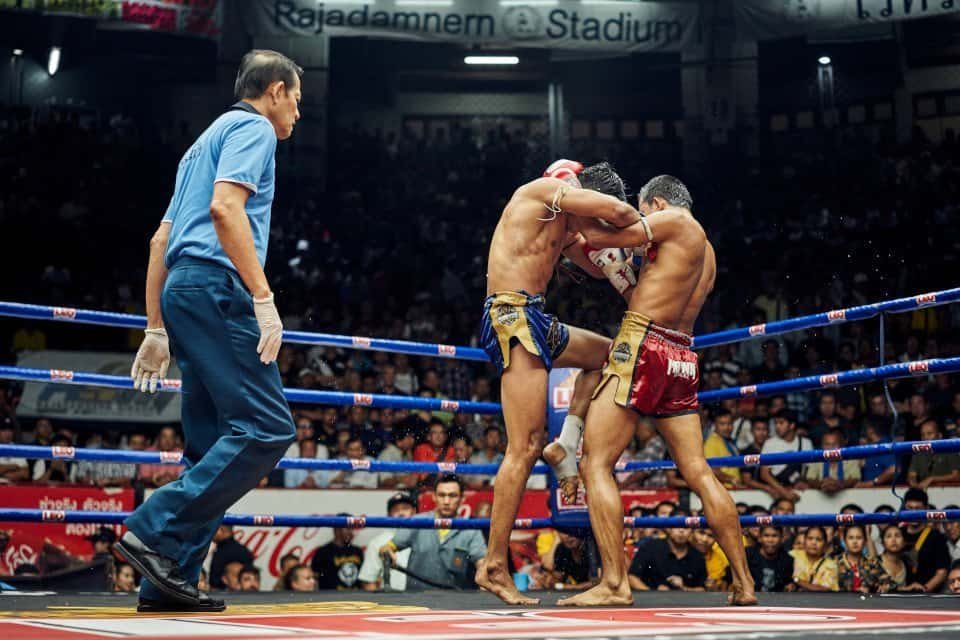
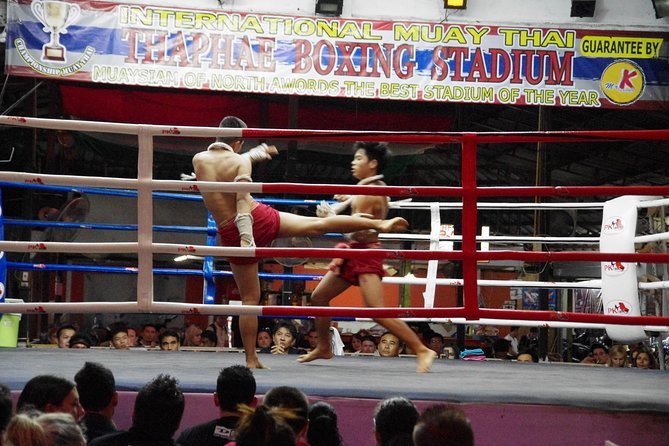
Rajadamnern opened in 1945, seats about 3,500, and now runs seven nights a week. The schedule tells you what kind of night you are looking at: traditional cards of eight or nine bouts over five rounds, and shorter entertainment-branded cards of seven bouts over three. Lumpinee runs its own weekly promotions, including the Friday ONE Lumpinee shows. Phuket has Bangla and Patong, Chiang Mai has Thapae, and the provinces have temple fair cards that appear and vanish with the festival calendar.
Here is the part most guides get backwards. Gambling is not what makes foreigner matchmaking bad. Gambling is what makes Thai matchmaking good. A betting market needs a genuine contest, so where money rides on both corners the pairing has to be close or nobody takes the other side. Mismatches cluster on cards where nobody is betting at all: the tourist show that needs a farang on the poster, the influencer fight in Chiang Mai, the bout where a tuk-tuk driver gets talked into the other corner for a few thousand baht. Some of those are theater. Some are one-sided in your favor, and you fly home thinking you are better than you are.
Paperwork, medicals, and the book
Professional Muay Thai in Thailand sits under the Boxing Act of 1999, administered through the Sports Authority of Thailand and its boxing committee. On the registered stadium circuit that becomes one concrete object: a fighter’s registration book. WBC Muaythai’s published rules state that under SAT rules a fighter competing in the country must be fully registered with an up-to-date boxer’s book, minimum age 16 inside Thailand. The book also carries mandatory rest periods after a knockout, the closest thing the system has to a medical suspension.
Below that level, requirements vary by venue and honestly by promoter. Sanctioned events require a doctor to examine you around the weigh-in and certify you fit. A provincial festival card may amount to a physician at ringside and nothing else. Do not read “nobody asked me for anything” as evidence that you are covered. Western commissions want bloodwork, dilated eye exams and neurological screening depending on your age and record. Assume none of that happens here, and arrange it yourself if you have any reason to.
The insurance point is the one people skip. Check your travel policy for a combat sports exclusion before you fly, not after you have a broken orbital bone in a Bangkok hospital. Plenty of standard policies exclude contact sports unless you buy the add-on.
The work permit question nobody answers cleanly
Straight version: none of the routes foreigners actually use permit you to work in Thailand. Tourist entry does not. The DTV explicitly bars you from Thai employment, local income, or holding a work permit under it, and an ED visa through a Muay Thai school is a study permission, not a labor one. Accepting prize money for a fight is income from work on a strict reading, and Thai lawyers who write about the DTV say as much.
In practice, thousands of foreigners fight on tourist entries every year, and enforcement against them is rare enough that I could not find a documented case. That is not the same as it being legal. A proper work permit needs a Thai employer sponsoring you against salary thresholds around 50,000 baht a month for Western nationals, which is unavailable to essentially every foreign fighter who is not already a name.
So the honest answer is that this is unresolved on paper and tolerated in practice. Your gym saying “no problem” is not legal advice, and if the exposure genuinely matters to you, the person to ask is a Thai immigration lawyer. The long-stay visa routes solve your stay, not your status in the ring.
Weight, short notice, and the morning weigh-in
Local Thai cards typically weigh fighters the morning of the fight. WBC Muaythai’s own rules carve out an exception allowing same-day weigh-ins in Thailand under the Boxing Board of Control, while everywhere else it happens 24 to 30 hours out. The practical consequence is that Thai fighters compete close to their walking weight and nobody is water-loading down eight kilos.
Do not import a Western weight cut into that system. You will have hours, not a day, to rehydrate, and the guy across from you did not cut anything.
Gloves are set by weight class and supplied by the promoter, not chosen by you. The Thai convention runs 6 oz up to 126 lbs, 8 oz from there to 147 lbs, and 10 oz above, so a lighter fighter goes in with less padding than they trained in. Expect the rest to move too: opponents change 48 hours out, a five-round bout becomes three, elbows go from allowed to taped and back.
How to tell you are being fed to a local prospect
Records are the first tell, and they mislead in both directions. A Thai record reading 118-32-4 is unremarkable, because he started at eight years old on temple fair cards. Ask for a number and you may get a shrug, because plenty of those fights were never written down anywhere.
Warning signs worth taking seriously:
- Your gym cannot name the opponent, their camp, or their weight.
- A real size gap gets waved off as normal.
- Someone at the gym is putting money on your fight.
- You are the only foreigner on a card of ranked locals.
- The gym gave you free training specifically in exchange for taking fights.
Gyms have been known to oversell a foreigner’s level to a promoter to land the booking, then back the other corner.
Not every mismatch is malice, though. Thailand’s talent pool above about 75 kg is thin. At 95 kg, the promoter may have nobody appropriate within a hundred kilometers, and the choice is a bad matchup or no fight. A trainer who tells you that outright is doing his job.
Before you say yes: run the list
- Get the opponent’s name, gym, weight and fight count. Write them down. Vague answers to all four is your answer.
- Ask who is promoting and at which venue, then watch a card there yourself before committing.
- Confirm the format: rounds, round length, elbows or no elbows, glove size.
- Ask the purse and the gym’s cut in actual numbers, days out, not in the changing room afterward.
- Ask who pays if you get hurt, then read your own policy for a combat sports exclusion.
- Ask whether anyone at the gym is betting on the fight, and watch how the question lands.
- Ask what happens if your opponent is swapped at the weigh-in.
- Set your limits on weight and experience gap before you are on the scale with everyone watching.
None of this makes you difficult. It makes you a fighter rather than a booking. The trainers worth staying with are the ones who have told a student no at some point, out loud, and lost a promoter a favor doing it. If yours has never turned down a fight on someone’s behalf, you are not being managed. You are being scheduled.
Common questions
How long do I need to train before I can fight in Thailand?
Long enough that your gym will stake its name on you, which for a complete beginner means a couple of months rather than a couple of weeks. Gyms will book you far sooner if you push. The timeline is the one variable you control, unlike the opponent.
Do foreigners really get easier fights in Thailand?
Sometimes, on tourist cards where the promoter wants the visiting fighter to have a good night. Sometimes the exact opposite, against a local with fifty fights who needs the win. Without a betting market forcing a close pairing, nothing guarantees the matchup is honest in either direction.
What will I actually get paid for a first fight?
Anywhere from nothing at an interclub to a few thousand baht on a local card, varying by region, venue and the split your gym takes. Foreigners starting out commonly report 3,000 to 5,000 baht before the gym’s cut, and small provincial shows run lower. Nobody covers their trip with it.
Do I need a work permit to fight in Thailand?
Strictly speaking, taking prize money is work, and tourist entries, DTV and ED visas all prohibit working. In practice foreigners fight on tourist entries constantly and enforcement is rare. The gray area stands, so treat a gym’s reassurance as an opinion and get a lawyer’s view if the risk matters to you.