

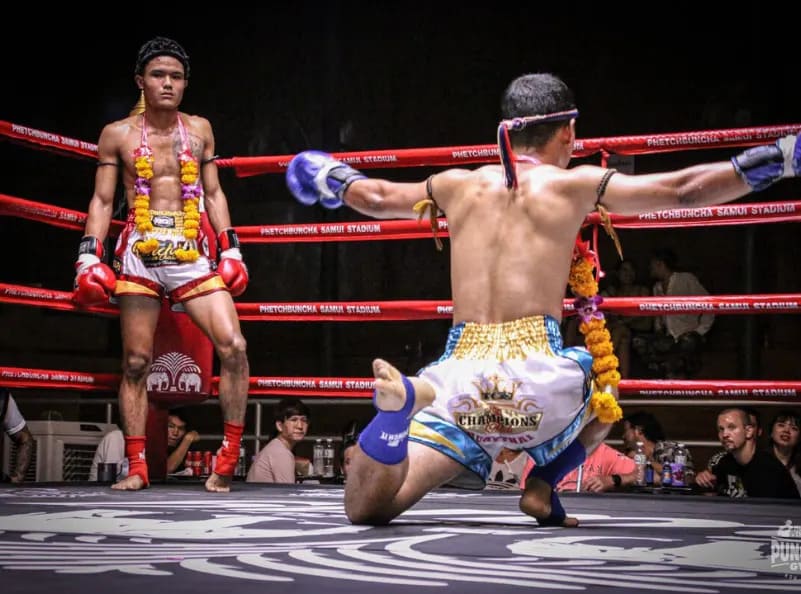
The oboe cuts through the arena noise first, a thin, reedy wail that sits somewhere between a snake charmer’s pipe and a human voice in mourning. Then the drums answer, patient at first, tapping out a heartbeat rhythm underneath the wail. A fighter climbs into the ring wearing a rope headband called a mongkol and cloth armbands called pra jiad, drops to the canvas, and touches forehead to the mat three times. The crowd, if it knows what it’s watching, goes quiet.
That combination of sound and movement is wai kru ram muay, and it happens before nearly every serious Muay Thai fight in Thailand. Wai kru means paying respect to the teacher. Ram muay is the personal dance that follows, unique to each fighter, shaped by whoever trained them. Together they turn the first minutes of a fight card into something closer to a small ceremony than a warm-up.
What Wai Kru Ram Muay Means
Wai kru comes from a much older Thai custom of honoring teachers, extended in Muay Thai to cover trainers, camp founders, and even parents. The gesture is the same one Thai students still perform for schoolteachers today, just adapted for the ring: hands pressed together, a bow, gratitude made physical before anything else happens.
Ram muay is where things get more personal. Once the bowing portion ends, the fighter rises and performs a short dance around the ring, often circling the perimeter before settling into the center. No two are identical. A fighter trained in one camp might move sharply and low, while one from another camp arcs through wide, sweeping gestures. The dance is part memory, part signature, and part psychological theater aimed squarely at the opponent standing across the ring.
The Ritual Step by Step
Most versions share a loose skeleton, even though the details vary by camp and by individual. Three bows toward the corner or toward a chosen direction typically open the sequence, commonly described as paying respect to teacher, parents, and country, or to Buddha, in some interpretations. From there the fighter often moves into a series of stances that trainers and commentators frequently describe using nicknames rather than fixed doctrine.
One recurring motion gets called the “Garuda bird flight,” an outstretched arm-sweeping gesture said to reference the mythical bird of Thai and Hindu legend. Another common stance gets described as the “hunter,” a low, alert crouch, sometimes paired with a mimed drawing of a bow. Other fighters weave in movements associated with monkeys, archers, or warriors preparing for battle. It is worth being honest here: there is no single universal choreography written down somewhere. These are commonly cited symbolic elements passed down through camps, and a ram muay learned in Chaiya looks different from one learned in Bangkok’s stadium gyms, sometimes dramatically so.
The dance usually closes with the fighter walking the ring’s perimeter, occasionally pressing a palm against each corner post, before returning to their corner for final preparations. The oboe keeps playing through all of it. Nothing about the pace of the ritual is rushed.
Reading a Fighter’s Ram Muay
Longtime fans of the sport will tell you they can often guess a fighter’s camp, or at least their home region, before a single kick lands, just by watching the ram muay. Fighters from the south sometimes carry a rougher, more compact style of movement, tracing back to Muay Chaiya traditions. Fighters trained around the northeast may show a different rhythm entirely, shaped by regional lineages that trace all the way back to the country’s five recognized regional styles of Muay Thai. The ram muay, in other words, functions almost like a dialect. It carries information about where a fighter comes from, long before the referee calls both corners to the center.
A trainer’s personal flourishes also survive inside a fighter’s ram muay for years, sometimes decades, after that trainer has stopped working corners. Watch enough fights from a single gym and the family resemblance becomes obvious. Two fighters who never trained together on the same day still move through eerily similar sequences, because both learned the same dance from the same source.
The Sarama: Music That Guides the Fight
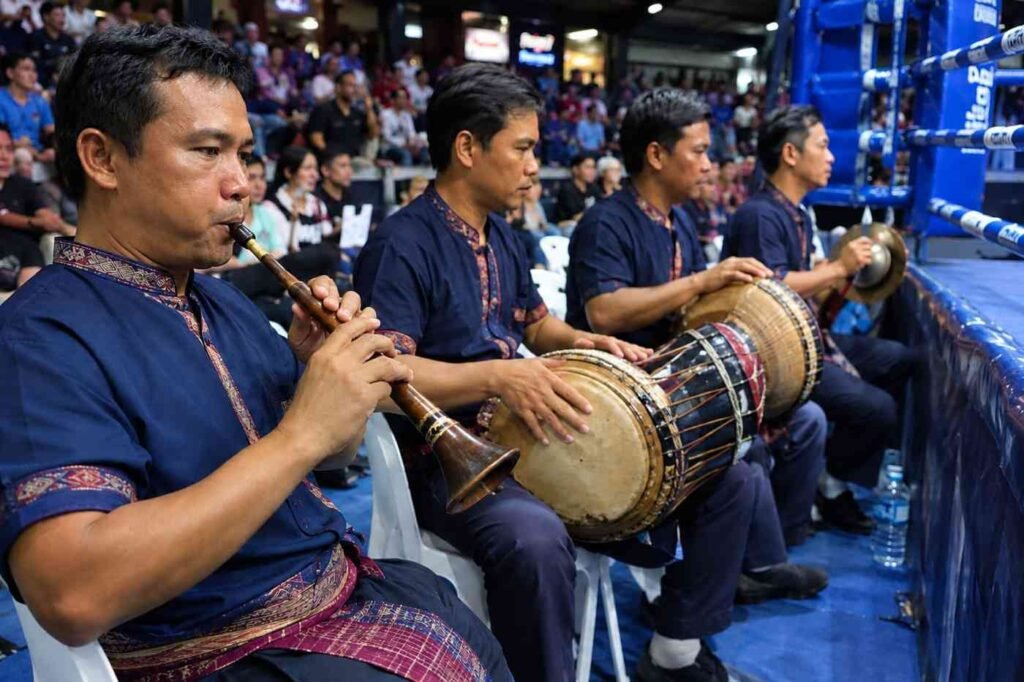
The music itself deserves its own attention, because it is doing more than setting a mood. Sarama is the traditional ensemble that plays live at ringside through wai kru and, in most Thai stadiums, through the entire fight. It typically features a pi, a Thai oboe with that distinctive nasal wail, alongside a pair of hand drums and small cymbals called ching that click out the tempo.
During wai kru, the music stays slow and stately, matching the deliberate pace of the bows and stances. Once the bell rings for round one, though, the band shifts. The tempo climbs. Musicians watch the fight closely and are widely said to speed up their playing as the action intensifies, particularly when fighters trade heavy exchanges or a fighter starts pressing hard for a finish. Slower rounds, or moments when both fighters are feeling each other out, tend to get a more restrained, unhurried accompaniment.
Whether the music actually influences a fighter’s pacing, or simply tracks what is already happening in the ring, is a question fans and old-timers still debate over drinks after fight nights. Either way, the effect on an arena is unmistakable. A crowd that hears the sarama accelerate knows, often before the announcer says a word, that something is about to happen.
Wai Kru in Western Competitions
Outside Thailand, the ritual’s status gets murkier. Many international Muay Thai federations and larger promotions, including several in Europe and Asia that run under Thai-affiliated sanctioning bodies, require or strongly encourage wai kru ram muay before bouts, treating it as part of the sport’s identity rather than optional decoration. Some promotions trim it down to a brief, thirty-second version to keep broadcasts moving.
US amateur and smaller regional shows are far less consistent. Plenty of American gyms teach their fighters a short ram muay and expect it at local and regional amateur events, especially ones run by organizations with strong ties to Thailand-based sanctioning. Just as many US shows, though, particularly ones that blend Muay Thai with kickboxing rules or run under mixed martial arts-style promotion, skip the ritual entirely and move straight to the referee’s instructions. There’s no single governing body enforcing it across every American cage or ring, so whether a fighter performs wai kru often comes down to their gym’s traditions and the specific promotion’s rulebook rather than any universal requirement.
Learning Your First Ram Muay
A beginner curious about trying this does not need years of training to start. Most gyms that take the ritual seriously will teach a simplified version early on, often within the first few months, long before a student ever steps into competition. Start with the bows. Kneel, press palms together, and touch the forehead to the floor three times, slowly, without rushing the motion for anyone watching.
From there, ask a trainer to show one or two simple stances rather than attempting to piece together a full sequence from videos. A basic Garuda-style arm sweep or a low hunter’s crouch is plenty for a first attempt, and most instructors are happy to walk a nervous beginner through it step by step. Watching senior students or fighters at the gym perform theirs, then asking questions afterward, tends to teach more than any written description ever could.
Nobody expects a beginner’s first ram muay to look polished, and it shouldn’t. The point was never performance for its own sake. It’s a small act of gratitude toward the people who taught the movements, and that intention matters more than getting every gesture exactly right.
One Comment