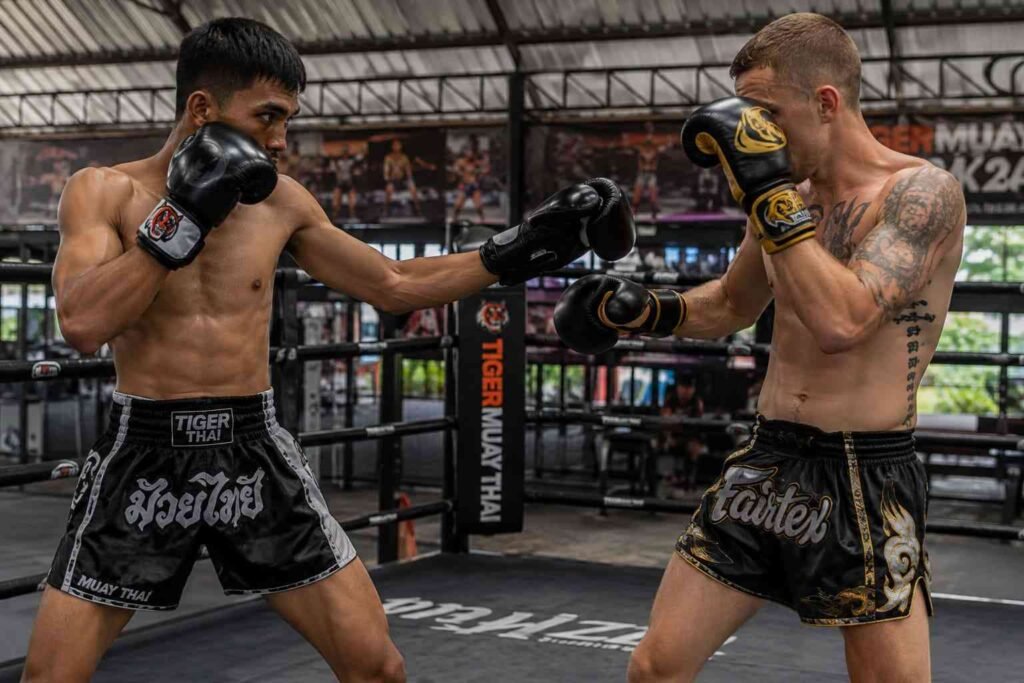
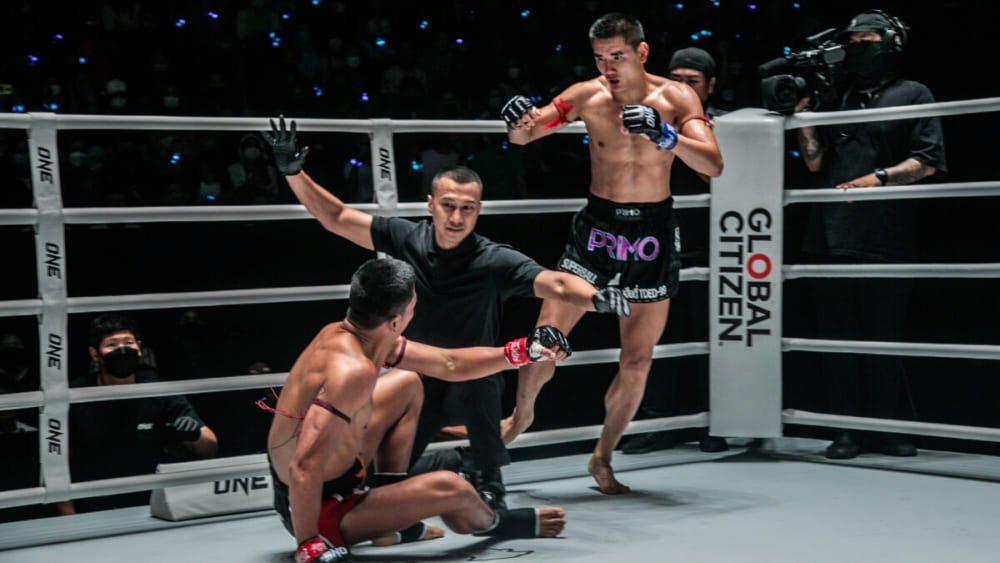
He had four amateur boxing fights behind him and he moved better than anyone else in the beginner class. Six weeks into Muay Thai, a teenager about forty pounds lighter put him on the canvas three times in one light sparring round and never threw a punch to do it. Every sweep landed at the same moment: the split second both his heels were off the floor.
The bounce is what did it. In a boxing gym that bounce is cheap and useful, because nobody in the room is kicking your lead leg, catching it in the air, or scooping your standing foot away. Add shins and the same habit opens a window where you cannot check, cannot kick, and cannot brace against anything. Thai fighters gave up the bounce for a reason, and it has nothing to do with being lazy or flat footed.
The physics your coach probably skipped
A shin check is a two-part movement. One leg has to accept your entire body weight while the other lifts, turns the shin outward, and meets the incoming kick with bone. Both halves need a foot that is already loaded and gripping the mat. Catch a body kick while you are airborne and the kick just takes you with it, which is why the guy who slips punches beautifully still gets folded by a mid kick he saw coming.
Your own kicks run on the same rule. The Thai roundhouse starts at the support foot, which pivots most of the way around so the hip can turn over the top, and that pivot needs friction and weight to work against. A foot in the air has neither. Watch a beginner throw a right kick out of a bounce and you see the hip stall halfway, the shin land as an ankle slap, and the whole body spin off balance afterward.
Then there is the stamina bill, which is larger than people expect. A Lumpinee or Rajadamnern bout asks for fifteen minutes of work across five rounds, and Thai judges weight the late rounds most heavily. Fifteen minutes is a long time to be paying rent on your calves so you can look springy in round one. Thai fighters spend the opening round close to strolling. Nobody wants to be the man whose legs are empty at the moment the scoring actually starts.
Ring size feeds into this too, though not the way most people assume. Lumpinee’s own rulebook allows two sizes inside the ropes, 4.90 m (16 ft) and 7.30 m (24 ft), and 24 feet is plenty of room to run for fifteen minutes. Almost nobody uses it that way. Backing up reads as losing under Thai scoring, so the extra floor goes on small angle changes and on baiting someone into a kick. Boxing footwork grew up managing distance, because distance is most of a boxing match. In a Thai ring you win by standing in front of a man and hurting him.
Four movements, and what each one buys you
Strip Thai footwork down and there are four things happening, repeated in different orders at different speeds.
| Movement | What it sets up | Common error |
| Step and slide | Closing or opening distance while stance width never changes, so a kick or a check stays available on every single step | Rear foot lags, the stance stretches out long, the hip cannot turn and the kick dies |
| Switch step | Switch kicks, stance changes, and hiding which leg is about to come | An audible hop on the same rhythm every time, which hands your opponent a countdown |
| Pivot off the lead foot | An angle the instant a combination ends, before the return kick arrives | Turning on the heel instead of the ball of the foot, which locks the hip |
| Backward angle step | Leaving kick range and finishing on their open side | Straight-line retreat that walks you into the ropes with your weight sitting on the back foot |
Step and slide is the one to build first and the least interesting thing in the gym, which is precisely why beginners skip past it. Lead foot moves, rear foot follows the same distance, stance restored. Forward, backward, left, right, always that order, always with the same gap between your feet at the end of the step as at the start. Get it right and you can throw a left kick on any step of a five-step advance. Get it wrong and there are three steps in that sequence where you own nothing.
The switch step is where Western fighters get greedy. Saenchai changes stance constantly and it looks like sorcery on video, though what he does is far less exotic than a highlight reel suggests. He swaps his feet to change which weapon sits closest, off different rhythms and different entries so you cannot time it. Copy the switch without the rhythm changes and you have given the other guy a metronome. Practice switching in place with no kick attached until it stops looking like a hop.
Pivoting is the most underused movement in almost every Western gym. People finish a combination and stand there admiring it, square, both shoulders forward. A quarter turn off the lead foot after your last punch moves your head off the line the return kick is already traveling on. The backward angle step does the same work going the other direction: step back at roughly 45 degrees toward their open side instead of straight back, and you exit kick range while ending up somewhere they have to reset to face.
Three habits that mark you as new
Crossing your feet. Moving left in an orthodox stance by bringing the right foot across the left is a sweep waiting to happen, and everyone experienced in the room can see it coming. One rule covers it: lead foot first when you go left, rear foot first when you go right. Three weeks of nagging yourself about it and it becomes automatic.
Retreating in a straight line. Straight back is the path your opponent is already traveling on, at speed, with a loaded rear leg behind them. You are going backward off your back foot while they come forward off a full stance. Almost every rope pin in beginner sparring starts there, usually with a teep to the chest. Angle out on the second step at the latest.
Standing square after a combination. The last punch lands, the feet settle level with each other, the hands drop an inch, and for about a second you have no stance at all. Thai fighters treat the end of a combination as the start of the next movement rather than a pause. Land your last shot and pivot, or step off at an angle, but never stop with your weight parked in the middle and your chest open.
Where this advice gets oversold
Plenty of guides claim Thai fighters never bounce and never touch boxing footwork, which falls apart the second you watch enough film. Samart Payakaroon fought out of a boxing base, moved his feet like a boxer, and was good enough at the boxing part to knock out Lupe Pintor in five rounds in January 1986 for the vacant WBC super bantamweight belt, all while being a four-division Lumpinee champion. Bouncing is not forbidden. Samart earned that movement over a decade of stadium fights, and his weight was still there for him when the kick came.
Nobody fully agrees on where your weight belongs either. Ask five coaches and you get lead foot flat with the rear heel floating, weight on the balls of both feet, or an even split with both heels barely brushing the canvas. All three camps produce fighters who kick hard and check well, and the argument has been running for decades without resolution. What every camp agrees on is the part that decides fights: your heels do not both leave the floor at the same time, and your weight never settles back onto them. The finer details of stance and weight matter, but they matter less than that one constraint.
A drilling block you can run tonight
Pick a line on the mat. All of it works in a corner of the gym before class, and none of it needs a partner.
- Line walk, three rounds of two minutes. Step and slide the length of the line, then back, then sideways in both directions. Every fourth step, throw a lead teep or a rear kick without breaking the rhythm of the feet. What to watch: the width between your feet when you finish a length. If it grew or shrank, your rear foot is not following properly.
- Switch step, 40 reps with no kick, then 20 with one. The standard is silence. If your training partner can hear you switch, so can someone standing across from you in a ring. Do half the reps starting from a forward step and half from standing, so the movement never gets welded to one entry.
- Pivot and answer, 20 per side, three sets. Throw jab and cross, pivot 45 degrees off the lead foot, then teep immediately with whichever leg is now closer. What to watch: your lead heel should lift as you turn. Glued heel means the hip cannot follow, and the teep turns into an arm push with no weight behind it.
One caveat about agility ladders, since they come up in every footwork conversation. They build coordination and make decent conditioning, but the foot pattern in a ladder shares almost nothing with the pattern of a stance you have to kick out of. Plenty of good coaches disagree with me and run ladders weekly with fighters who move fine. For the specific problem of getting swept, ten minutes of shadow footwork with kicks attached beats ten minutes of ladder work.
What changes when hands get on your neck
The clinch rewrites most of this, and nobody warns you. Once someone has an inside grip behind your head, distance stops being something you manage with steps and becomes a matter of hips, posture, and elbows. Your feet get smaller jobs. Stay underneath you, stay staggered, and never let them line up parallel to your opponent’s. Square feet in the clinch means you get walked backward across the ring or turned off your base, and once you are turned the knees start landing on the wrong side of the ribs.
Step and replace is what rescues you there, a strange payoff for a drill done on a line on the floor. A man pushing you backward in a clinch wants you moving on a straight track where he can keep his hips under yours. The counter is a short step back at an angle with the rear foot and then the lead foot recovering the stance, the same shape you drilled walking the line. Same footwork, compressed to about a third of the distance and done while somebody is hanging off your neck.
So take one thing to your next session. Stop moving your feet during the moments when you have nothing to throw and nothing to avoid. Standing still with your weight balanced and both heels near the floor looks worse on video than dancing does, and it puts every Thai weapon within one movement of your feet.