
A taekwondo black belt walks into a Muay Thai gym for the first time. He’s fast. His roundhouse snaps out and back before most people in the room finish their combination, and his hip flexibility makes the coach’s eyebrows go up. Then sparring starts.
He throws his signature kick at a padholder’s thigh. It lands, snaps back to chamber exactly the way fifteen years of tournament habit trained it to, and the coach stops the round. “Leave it there,” he says. “Push through. Turn your hip over like you’re trying to kick through the wall behind him.” The taekwondo guy tries it once, twice, and by the fifth attempt his kick looks nothing like the crisp, retracting strike that used to score points on an electronic scoring vest. It looks heavier. Slower to reset. And it hurts the pad a lot more than it did five minutes ago.
That scene plays out in gyms all over the world, and it’s the fastest way to understand what actually separates these two arts. Both are kicking sports. Both come from proud national traditions and both will make you fitter, faster, and more coordinated than you were before you walked in. But the kicks themselves are built for two completely different jobs, and mixing them up without adjusting is how people get their legs checked hard in week one.
Two Kicking Philosophies
Taekwondo was built for scoring. Modern Olympic taekwondo runs on a point system that rewards speed, precision, and technically clean strikes to approved target zones, and the entire kicking arsenal evolved around that scoring logic. A kick that lands cleanly and recoils instantly is worth more than one that grinds forward, because the judges (and now the electronic sensors in the hogu and headgear) are measuring contact and technique, not damage.
Muay Thai has the opposite goal built into its bones. Every strike exists to disable, not to tick a box. Judges score effectiveness and the visible impact a strike has on an opponent, and there’s no faster way to visibly hurt someone with your shin than to swing it through the target rather than snap it back off. The sport grew up in a culture where fighters bet on outcomes and where clinching, elbows, and knees were always part of the toolkit. Taekwondo, by contrast, spent the twentieth century narrowing its rule set toward Olympic sport, trading some of its street-combat roots for cleaner competition mechanics.
Kick Mechanics: Snap vs Swing
The Snap
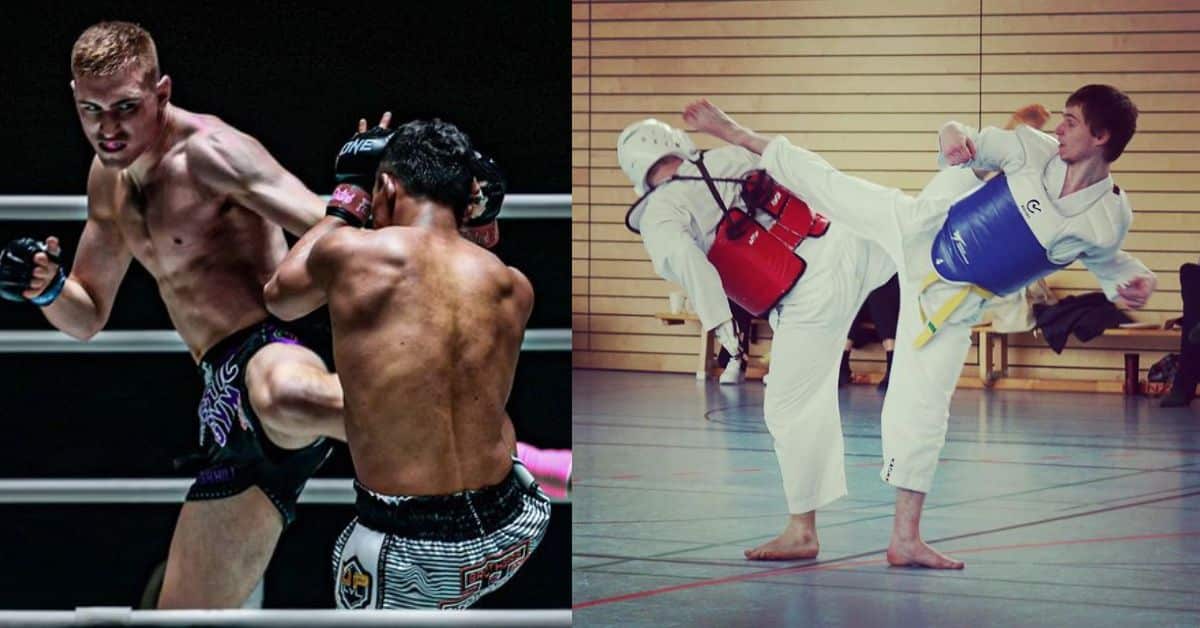
A taekwondo roundhouse chambers the knee high and tight, whips the shin and foot out in an arc, and retracts almost as fast as it extended. The point of contact is brief, often the ball of the foot or the instep, and the kinetic chain reverses direction the instant it connects. That reversal is what makes the kick look almost like a whip crack. It also means less total force transfers into the target, because a lot of the kick’s energy gets redirected back toward the fighter rather than driven forward through the opponent.
The Swing
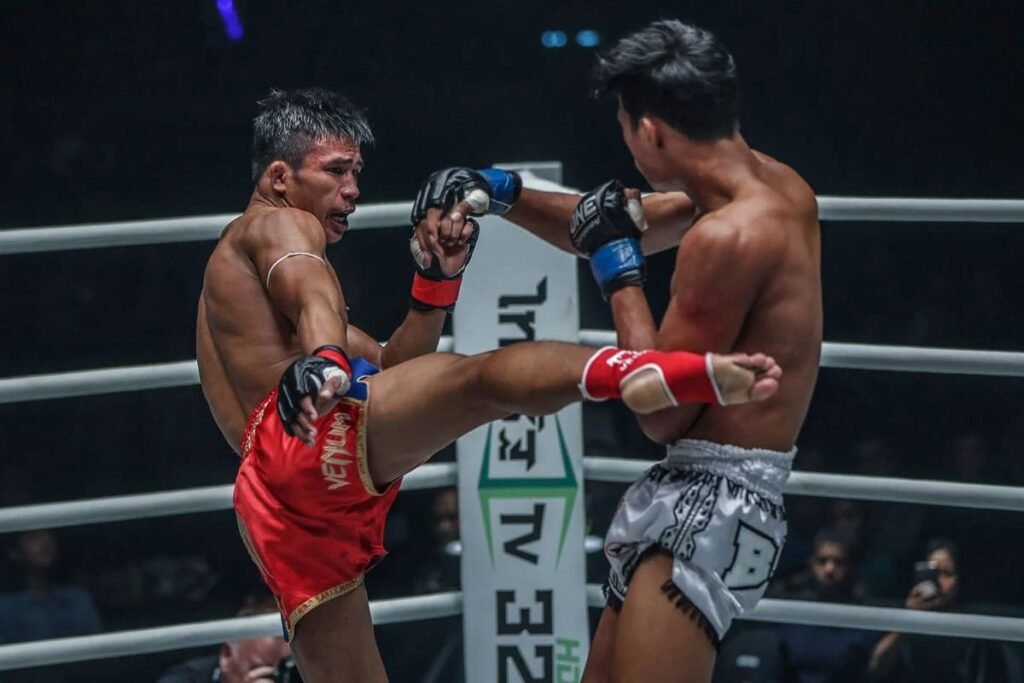
A Muay Thai roundhouse, the classic kick you see in every highlight reel, works almost the opposite way. The hip rotates fully through the target, the leg stays extended well past contact, and the shin, not the foot, absorbs and delivers the impact. Coaches describe it as “kicking through” the target, sometimes aiming a full foot or more past where the opponent is actually standing. There’s no recoil to speak of. The leg follows through like a baseball bat, and the whole body rotates behind it, hips, shoulders, even the trailing arm swinging for counterbalance.
The biomechanical difference comes down to what each sport is optimizing for. Taekwondo trades power for retraction speed, since a kick left hanging out there is a kick that can be caught or countered under sparring rules that don’t reward it. Muay Thai trades retraction speed for the mass and duration of contact, since the sport’s entire logic runs through maximizing force transfer into bone and muscle. Neither is “wrong.” They’re solving different problems.
Contact Level and Competition
This is where the two sports diverge just as sharply as the kicks do. Olympic-style taekwondo sparring is light to moderate contact with protective gear, electronic scoring, and matches that stop and restart constantly to reset position and confirm points. It rewards accuracy and tempo over toughness.
Muay Thai is full contact, period. Fighters wrap their hands, wear light gloves, and absorb shin kicks, elbows, knees, and clinch work for three to five rounds with essentially no scoring pause. There’s no vest buzzing to confirm a point landed. You know a kick worked because your opponent staggers, or because your own leg is throbbing after checking one. That single difference, point sparring against full contact, shapes almost everything else about how each sport trains, from conditioning drills to how fighters are taught to absorb pain rather than avoid it entirely.
Which Is Better for Kids vs Adults
For young kids, taekwondo is usually the smarter first sport. The belt system gives children constant, visible milestones. The contact level is low enough that parents don’t spend every class wincing, and the structure teaches discipline, listening skills, and body control before a child’s growth plates and coordination are ready for anything heavier. Most reputable Muay Thai gyms won’t even take contact sparring seriously with kids under a certain age for exactly that reason.
Adults chasing fitness, self-defense, or a genuine outlet for stress tend to get more out of Muay Thai, and often faster. There’s no years-long belt ladder standing between you and real sparring. The full-body conditioning hits harder in less time, and the clinch and elbow work give adults tools that translate more directly to a real confrontation than a point-scoring kick to a padded vest ever will. None of this means adults can’t thrive in taekwondo or that kids can’t handle Muay Thai eventually. It’s a matter of what each sport optimizes for at each stage of a person’s development, and adults simply have the joints, patience threshold, and risk tolerance that full contact demands.
Fighters Who Combined Both
It’s well known that a number of successful mixed martial arts fighters started in taekwondo before crossing into striking arts like Muay Thai or into full MMA careers. The flexibility and hip mobility taekwondo builds, along with kicks thrown from angles that a pure Muay Thai or boxing background rarely produces, have given plenty of fighters an edge that’s hard to replicate through Muay Thai training alone. A spinning back kick or a tornado kick that looks flashy in a taekwondo ring can land as a genuine fight-ending strike once a fighter learns to load it with Muay Thai-style power instead of tournament-style snap.
The reverse crossover happens too, just less dramatically. Muay Thai fighters who add taekwondo footwork sometimes pick up kicking angles and lead-leg speed they never developed grinding through years of low kicks and knees. Neither background makes someone a finished fighter. What both crossovers show is that the two kicking systems aren’t rivals so much as two different tool sets that, combined intelligently, cover more ground than either one alone.
Transitioning From TKD to Muay Thai
If you’re coming from a taekwondo background and thinking about stepping into a Muay Thai gym, expect an adjustment period, not a wall. Your speed, flexibility, and kick variety are real assets, and most coaches notice them within the first week. What takes longer to unlearn is the instinct to retract. Every rep, remind yourself to finish through the target instead of snapping back to guard, and don’t be surprised if your hips are sore in places they’ve never been sore before. That soreness is your body learning to rotate fully instead of partially.
Shin conditioning is the other adjustment nobody warns you about enough. Years of point sparring rarely toughen the shins the way Muay Thai’s kicking style demands, so go slow on the bag at first and let the conditioning build over weeks rather than days. Beyond that, lean on what taekwondo already gave you. Your footwork and lead-leg speed are genuine advantages once you learn to load them with hip rotation instead of pure snap, and plenty of coaches will tell you a kicker with your background usually adapts to the ring faster than a total beginner. Stick with the basics long enough to let the new mechanics feel automatic, and the crossover starts paying off faster than most people expect.