
When Lumpinee Stadium opened its new building on Ram Inthra Road in February 2014, a small sign went up near the ring. In English it read: “Ladies please don’t touch the stage.” Not the canvas. Not the ropes. The entire structure was off limits, and so were the women who had spent years fighting in provincial rings hoping for a call that could never come.
The sign is gone. Women fight inside both of Bangkok’s national stadiums now, and Rajadamnern hands out three women’s championship belts. Most of that happened between November 2021 and December 2023, which is fast for a sport that measures its traditions in centuries. Before celebrating the change, though, it helps to understand what the rule was actually about, because the version that circulates in English usually gets the reasoning wrong.
The belief under the bottom rope
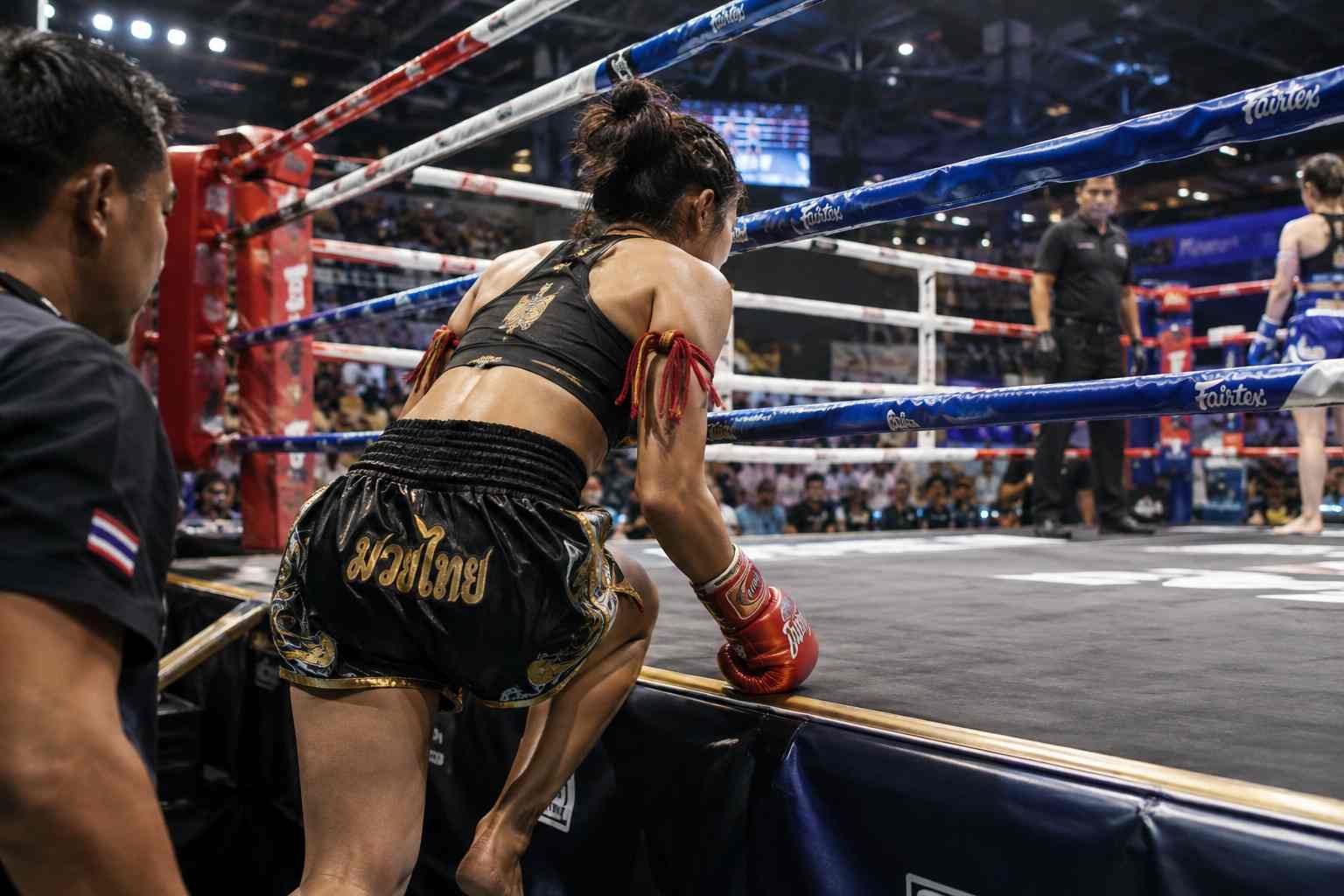
Thai custom ranks the body vertically. The head is the highest and most spiritually charged part of a person; the feet are the lowest. Men enter a Muay Thai ring by climbing over the top rope, which keeps the head above everything being passed. Women have traditionally ducked under the bottom rope instead.
The reasoning has nothing to do with skill or toughness. Female bodies, and menstruation in particular, are held to weaken the protective power worked into the ring and into the sacred headband a fighter wears for the wai kru. The belief applies whether or not a woman is menstruating at the time. It runs on the same logic as the rule that a woman cannot hand an object directly to a monk, which is why a monk blessing a female fighter’s mongkhon returns it on a folded cloth. This is a spiritual accounting system, not a boxing regulation, and it predates anyone’s opinion about whether women can throw a good elbow.
Here is where most English-language guides oversell the outrage. They flatten the custom into “Thai people think women are dirty,” which is crude and, more to the point, is not how many Thai fighters describe it themselves. Speaking to the BBC in 2017, the veteran Thai fighter Sawsing said she had never challenged the tradition, and framed following it as paying respect to teachers and past masters. There is also a detail that complicates the sanitary reading entirely: Nong Toom, the most famous transgender fighter in the sport’s history, enters over the top rope. The custom tracks a social category, not a set of glands.
What the rule actually cost
Barred from Lumpinee and Rajadamnern, a Thai woman could win everything else and still not become a star. Those two rings are where reputations get made, where the promoters watch, and where the sponsorship money follows. A career with a hard ceiling attracts less investment at every stage, from a gym deciding which kids to feed to a beverage company deciding whose shorts to print.
The ban was never total across the country. From 1995 some smaller venues around Bangkok opened up, with Rangsit and Asawindam stadiums putting women’s cards on national television and giving the sport its first real domestic audience. But the pay stayed lopsided. In that same 2017 BBC piece, Sawsing put numbers on it: a successful female fighter might earn around 40,000 baht for a bout, while male fighters started closer to 70,000.
So the talent leaked out. Loma Lookboonmee left Muay Thai for mixed martial arts at Tiger Muay Thai in 2017 and became, in September 2019, the first Thai fighter of any gender signed by the UFC. Phetjeeja Lukjaoporongtom started at seven and could not find a gym that would train girls, so her father built one at the family home in order for her to keep going. Neither of those stories is a tragedy. Both are what happens when the front door is locked.
The four years that broke it
| Date | What happened |
| 1995 | Restrictions lift at smaller venues. Rangsit and Asawindam begin promoting women’s cards, some televised nationally |
| 13 Nov 2021 | First women’s card inside the Lumpinee ring. Sanaejan Sor.Jor.Tongprajin beat Buakaw Mor.Kor.Chor.Chaiyaphum over five rounds for a WBC Muaythai world title at 105 lb (47.6 kg) |
| 5 Aug 2022 | Rajadamnern hosts women for the first time since opening in 1945. Aida Looksaikongdin, 19, beat Iran’s Zahra Shokouhi on points |
| 23 Dec 2023 | First women’s Rajadamnern stadium title. Somratsamee Manopgym beat Turkey’s Sevgi Doğan at 118 lb (53.5 kg) |
| Jan 2026 | Rajadamnern confirms a third women’s division with official rankings and a belt |
The Lumpinee decision did not arrive as a moral awakening, and pretending otherwise does the story no favors. In early 2021 the Army was weighing whether to hand the stadium to the private sector or convert it into a museum. Management responded with a rebrand: women’s fights, mixed martial arts events, and a ban on gambling to pull in an audience that had never come for the odds. Opening the ring to women was one item on a commercial rescue list.
Rajadamnern’s route was similar. Global Sport Ventures launched the Rajadamnern World Series in 2022 with a modernized ruleset and, from July 2023, worldwide distribution through DAZN. A promotion selling itself to a global broadcast audience cannot easily explain why half the athletes are ineligible.
Meanwhile ONE Championship had spent years demonstrating that women’s Muay Thai sells. Stamp Fairtex beat Janet Todd in February 2019 for the inaugural ONE atomweight Muay Thai world title and became the organization’s first two-sport world champion in the process. Allycia Hellen Rodrigues of Brazil has held that same belt since August 2020 and defended it five times, most recently over Phetjeeja by split decision in June 2026. The money reaching the top of that division is on a different scale from Thai stadium purses: when Stella Hemetsberger defended the ONE women’s strawweight Muay Thai title at Lumpinee on 15 August 2026, she took home a $50,000 performance bonus on top of her purse.
Prize money inside Thailand moved too, if not as far. Somratsamee Manopgym, the first woman to win a Rajadamnern belt, took a 3 million baht cash prize for winning an RWS tournament, a figure no Thai woman could have competed for at all four years earlier. That is the part worth holding onto. The rope was symbolic, but the ceiling above it was financial, and symbols do not pay for a gym, a nutritionist, or the years a fighter spends not earning anything else.
Where things actually stand
Rajadamnern currently sanctions women’s titles at minimumweight (105 lb), flyweight (112 lb), and bantamweight (118 lb). Estonia’s Marie Ruumet won the inaugural flyweight belt on 28 February 2026 and has defended it twice since. Lumpinee runs ONE cards every Friday, and women’s bouts headline them regularly.
The rope custom itself is now genuinely inconsistent, and anyone telling you there is a single answer is guessing. Some women have been told outright they may enter over the top rope at Lumpinee, and have done it. At plenty of provincial stadiums, and at a great many gyms, the bottom rope remains the expectation. A fair number of Thai fighters go under by choice and are not looking for foreigners to liberate them from it. In some camps a female coach still cannot handle a male fighter’s mongkhon. Practice varies by venue, by promoter, and sometimes by who is standing at the ring steps that night.
What has not changed
The belts exist; the depth behind them does not, yet. Women get fewer slots per card, fewer domestic opponents at any given weight, and shorter notice. The purse gap has narrowed at the very top and barely moved below it, where most fighters live. And a noticeable share of the new stadium titles are held by non-Thai fighters, which is a real sign of the sport’s global pull and, at the same time, not quite the outcome Thai women were fighting for when they asked to be let in.
None of this governs your Tuesday class
If you train in Cleveland or Calgary, the entire history above has no authority over your gym. It shows up anyway. Some North American clubs import the rope custom wholesale, and it lands strangely in a room with a squat rack and a smoothie fridge, taught by a coach who has never been to Thailand.
Do this before it matters: ask your coach what the gym’s rule is and where it came from, and ask now rather than on the night you are climbing into a ring with your hands wrapped. If the answer is “that’s how it’s done in Thailand,” you now know enough to point out that how it’s done in Thailand changed, twice, in the last five years. A gym that keeps the custom deliberately and can explain why is doing something coherent. A gym repeating a rule it never examined is doing something else.
Questions people actually ask
When did Rajadamnern let women fight?
On 5 August 2022, when 19-year-old Aida Looksaikongdin faced Iran’s Zahra Shokouhi as part of the Rajadamnern World Series. The stadium had opened in 1945 and had never hosted a women’s bout before that night. Rajadamnern sanctioned its first women’s stadium title sixteen months later, in December 2023.
Can women fight at Lumpinee now?
Yes. Lumpinee held its first women’s card on 13 November 2021, and women’s bouts are a standard part of the ONE cards the stadium hosts every Friday. The old signage barring women from touching the ring no longer applies.
Do women still have to go under the bottom rope?
It depends entirely on where you are. Some women now enter over the top rope at Lumpinee, some Thai fighters continue going under out of respect for their teachers, and many smaller stadiums still expect the traditional entry. If you are fighting somewhere new, ask your corner rather than assuming.
Do Thai women earn the same as Thai men?
No, and the gap is widest away from the cameras. Fighters interviewed in the late 2010s described earning roughly half what comparable male fighters made per bout, and while the top of the international scene now pays women serious money, most domestic cards have not caught up. For the wider picture on who is competing and where, our guide to women’s Muay Thai covers the fighters currently driving the sport.