
Saturday class, the last twenty minutes, pads coming off the wall, and somebody in the back row has been watching highlight reels again. You can tell. He wants to fly. He wants the superman punch, the one where the rear leg swings forward like a kick, snaps back, and the whole body launches behind a straight right that looks like it was fired out of a cannon. The trainer, who has seen four hundred guys want it before, sighs and holds up the pads anyway.
Fair enough. The move is spectacular. The real question is whether it earns a place in a Muay Thai game or just in a highlight reel, and the answer depends almost entirely on one thing: the lie you tell with your leg before your fist ever leaves.
A Punch Wearing a Cape (and Its Thai Name)
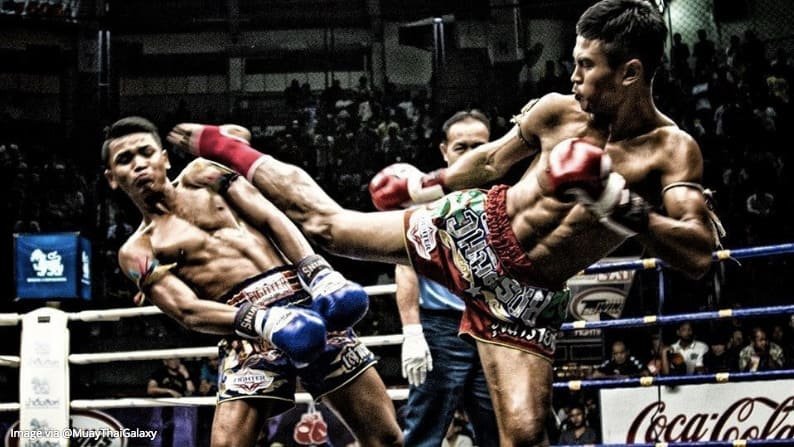
In Thai camps the technique goes by kradot chok, roughly “jumping punch.” Other gyms call it the cobra punch or the diving punch. The Western name came later, borrowed from the comic book hero because the fighter, for one airborne instant, looks exactly like him: one arm out, body horizontal, cape optional.
The mechanics are simple to describe and hard to do well:
- The rear leg drives forward as if a kick or knee is coming.
- The leg snaps back down and plants, and that stamp becomes the push-off.
- The rear hand fires a straight punch while the hips rotate and the body lunges forward, often with both feet briefly off the canvas.
- The fighter lands in stance, guard back up, ready for whatever answers.
The punch itself is usually a cross from the rear hand, although the lead-hand version exists and some fighters throw it off a switch step. The version that matters most in Muay Thai is the rear-hand one, set up by a rear-leg feint, because the Thai game gives you a reason to believe in that feint in the first place.
MMA made the move famous in the West. Bas Rutten threw one against Kevin Randleman at UFC 20 in 1999, and Georges St-Pierre later turned it into a signature weapon. None of that proves it belongs in a Muay Thai ring, where the rules and the scoring play by a very different logic.
Does the Superman Punch Actually Work in Muay Thai?
Yes, with a big asterisk. It works as a surprise. It fails as a habit.
Start with the scoring culture. Thai judges have long rewarded kicks, knees, balance, and visible control over punch volume, and a single punch that does not visibly hurt the other fighter tends to count for less than a clean body kick. So a superman punch that grazes the forehead is not going to win you a round. It has to land flush and it has to matter.
Then consider the opponent. A Muay Thai fighter spends his life reading legs. He checks kicks, he catches kicks, he answers a rising knee with a teep to the belly. That same obsession is exactly what makes the feint dangerous. When your rear leg comes forward, a trained Thai fighter reacts, because ignoring a rear leg in Muay Thai is how people get their ribs rearranged. The reaction is the opening.
Here is the asterisk, though. The jump puts you in the air, briefly committed, with no base. Throw it from too far out and you land short, square, and right on the end of a knee. Throw it twice in a round without changing anything and the second one gets met by a teep to the chest mid-flight, which is about as humbling as this sport gets.
Fighters who come from a heavier hands background tend to use it better, since they already know how to sit a cross down behind the shoulder. If your punching still feels like an afterthought, it pays to look at how boxing fits into Muay Thai before you start jumping at people.
The Kick Feint Is the Whole Trick
The superman punch lives or dies on the feint. Without a believable threat from the leg, the move is just a slow, telegraphed lunge. With one, it becomes a question the other fighter has to answer with his legs while you are already arriving with your hand.
A good feint needs three things. First, it should look like your real kick or knee, with the same hip turn, the same shoulder, and the same chin position. You also need to have landed that kick for real earlier in the fight. And keep the motion short: a half-motion that loads the leg without wasting time up in the air.
That second ingredient is the one beginners skip. You cannot feint a weapon you have never shown. If you have not kicked the body hard in round one, nobody in round two is going to flinch when your leg twitches. The feint borrows credibility from real strikes. Spend some first.
Which feint sells which punch
Not every kick threat produces the same reaction, and each one opens a slightly different path for the punch.
| Feint | What the opponent usually does | What it opens | Main risk |
| Rear-leg teep feint | Drops the lead hand to parry or leans back | Straight line down the middle for the rear cross | He counters with his own teep as you jump |
| Rear knee feint (from range) | Lifts his lead leg to block or shells up low | Head is exposed above a lowered guard | You are close enough to eat a knee if he reads it |
| Rear body kick feint | Raises the lead leg to check, weight shifts back | Punch lands while he stands on one leg | A fast checker returns a kick before you land |
| Low kick feint to the thigh | Lifts the leg or steps back | Short superman over the top | Hardest one to sell, least reaction from veterans |
| Check-and-return (real check, then jump) | Expects the exchange to reset | Punch lands off your own check, very close range | Timing is tiny; mistimed, you jump into his cross |
The teep feint is the classic Muay Thai entry, and it is the one most trainers teach first. It looks almost identical to the real teep for the first few inches, and the fighter on the receiving end reacts to protect his midsection, which is the moment his head becomes available.
The check-and-return variation deserves special mention. You check a real kick with your rear leg, and instead of putting that foot back down in the normal way, you stamp it and launch. The leg is already up, so there is no feint to read at all. That version also goes wrong fastest, so save it until the basic one feels automatic.
Where It All Falls Apart
Everyone likes to talk about the knockout. Fewer people talk about the counters, and the counters are why the superman punch stays a specialty tool in Muay Thai rather than a staple.
- The teep in midair. A calm opponent who reads the feint simply extends his front foot into your chest while you are flying. You land on your back or not at all.
- The step-off cross. He takes one small step to the side, lets you sail past, and hits you with a counter right on the way through.
- The knee. Jump from too short a distance and you are diving head first toward a rising knee.
- The clinch. Land short and square and you have just handed a strong clincher a free collar tie. In a sport that rewards clinch dominance, that trade is terrible.
- The pattern read. Throw it the same way twice, off the same feint, from the same spot, and the second attempt gets answered before you have even left the ground.
The practical answer to most of these is range and follow-up. Throw it from a distance where the punch reaches without you having to overextend, and plan the next strike before you jump. A superman punch followed by a left hook, or by a rear knee as the other fighter covers up, makes the whole thing far less risky.
Position on the Canvas Changes the Math
Where you throw it matters as much as how. In open space, a smart opponent can back straight up and let the jump fall short. Near the ropes or trapped in a corner, he has nowhere to go, and a kick feint forces him to choose between covering the body and covering the head with his back already against something.
That is why the move shows up most often after a fighter has spent a few exchanges walking the other man down. The pressure does the setup work before the feint even starts. If you want to understand how fighters create those trapped moments on purpose, the principles of cutting off the ring are worth studying alongside the punch itself.
Drilling the Superman Punch Without Wrecking Your Knees
The trainer from the Saturday class was right to sigh, but he was also right to hold up the pads. The move is learnable. It just needs to be built in pieces, and a lot of the building happens on the ground rather than in the air.
A progression that works for most people:
- Feint only, 3 rounds of 2 minutes. Shadowbox and throw nothing but teep feints and knee feints. Look in a mirror. If the feint does not look like your real teep, fix that first.
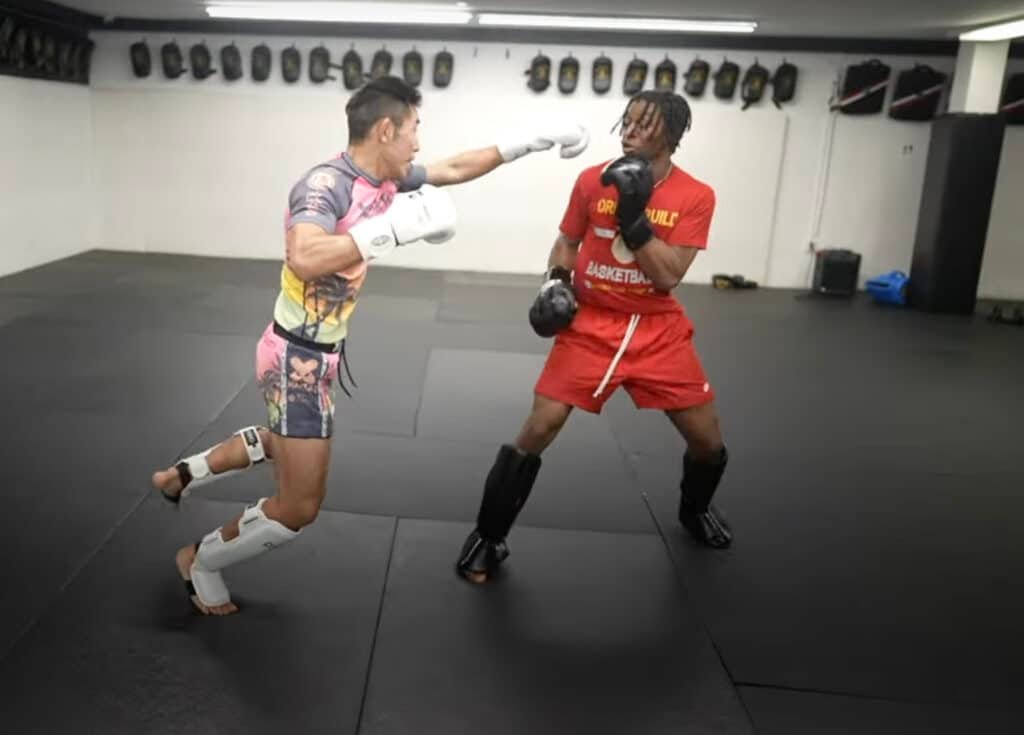
- Feint to grounded cross, 4 sets of 10 per side. No jump yet. Feint, stamp the foot back down, throw the cross. This is really a stepping cross, and it teaches the hip timing.
- Small hop on pads, 4 sets of 8. Add a short forward hop, a few inches, and land in stance. Distance matters more than height.
- Full superman punch, 3 sets of 6. Now let it fly, but only as far as you can land balanced with your guard up.
- Add the follow-up, 3 sets of 6. Superman punch, left hook, then a rear kick or a knee. Never end the drill on the jump.
- Partner reaction work. A partner holds a single pad and occasionally throws a light teep at you when he reads the feint. You learn quickly whether the feint is honest.
Keep the volume low. The takeoff loads the knee and ankle in a way ordinary punching does not, and ten sloppy jumps teach you less than four clean ones.
Once the move feels natural on its own, slot it into longer sequences. Working it into structured Muay Thai combos with reps keeps it from turning into the one party trick you throw whenever you get bored. A body kick, a body kick, and then the feint that looks like a third body kick while the punch is already landing: that sequence, practiced until it is boring, is how the superman punch goes from the back row’s daydream to something that actually works in the ring.