
The first time a coach asked me to throw a switch kick, I did what most beginners do. I jumped. Not a subtle little shuffle, either, but a full, joyful, two-footed leap, the sort of thing you might do on discovering that the ice cream truck has stopped outside your house. By the time I landed and got my left leg moving, my partner had finished yawning, checked the kick, and was gently explaining that the whole point of the technique is that nobody should see it coming.
So let’s fix that. The switch kick is a lead-leg roundhouse that borrows the power of a rear kick by swapping your feet a split second before you throw. Done well, it arrives fast and hard from the side your opponent assumed was safe. Done badly, it looks like a man hopping over a puddle.
What the switch actually does
In a normal orthodox stance, your left foot is forward and your right foot is back. The rear roundhouse (the right leg) is the famous Muay Thai kick: big hip turn, long travel, lots of power. The lead leg is closer to the target, which makes it quick, but it has almost no room to build momentum. A plain front-leg roundhouse tends to land like a polite tap on the shoulder.
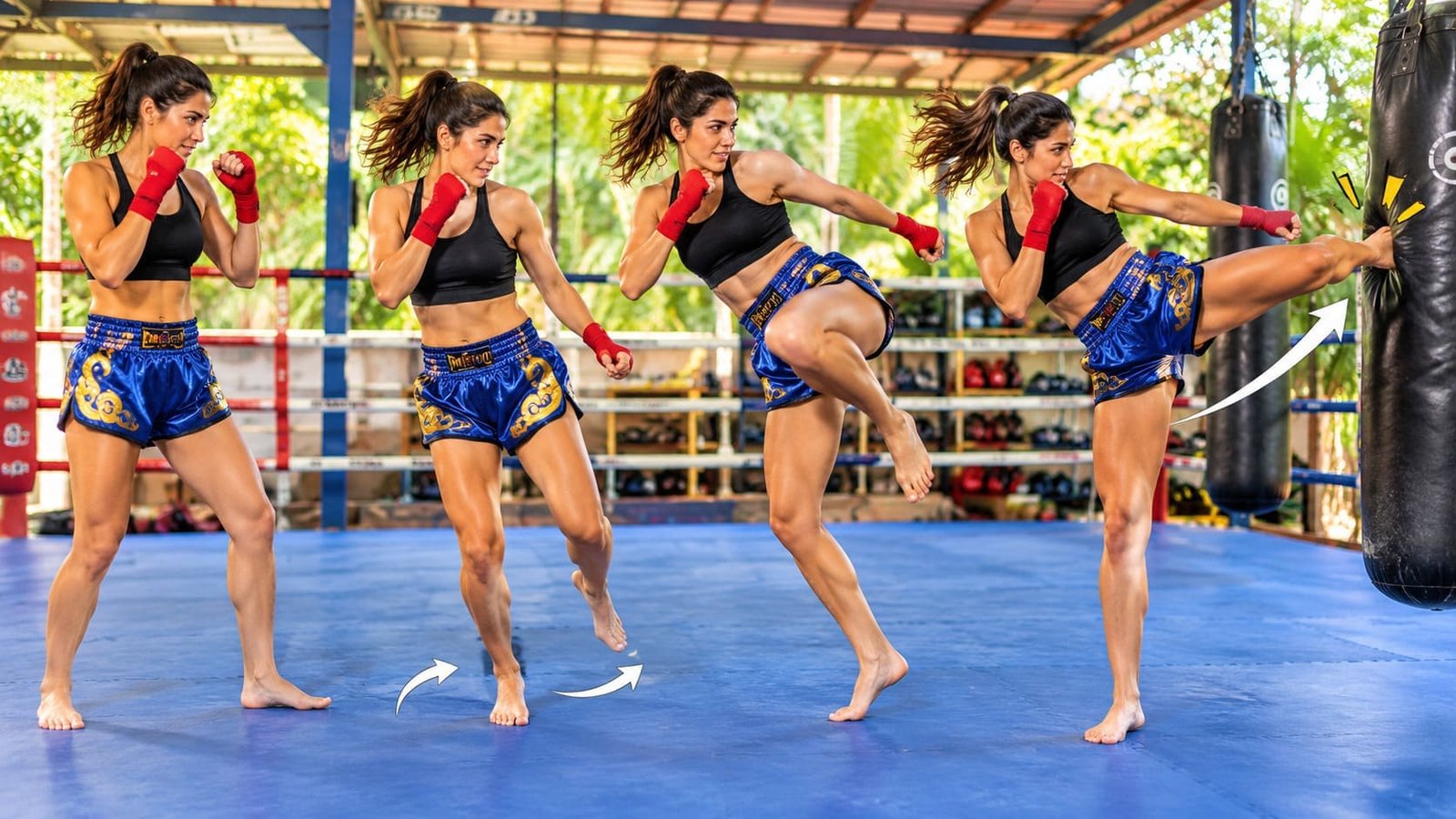
The switch solves that. You bring the front foot back and the back foot forward in one quick motion, which puts your left leg behind you for an instant. Now it has distance to travel and a hip behind it. You kick with it before your opponent has registered that anything changed.
Coaches argue happily about exactly how much power you give up compared with a full rear kick, and the honest answer depends on the fighter. What nobody argues about is the trade: a bit less force in exchange for a lot more surprise and a shorter trip to the target.
How to throw a switch kick, step by step
Think of it as a quick rearrangement of furniture rather than a jump. Your head should stay at roughly the same height the whole time, which is the single best test of whether you’re doing it right.
- Start in your normal stance. Weight roughly even, hands up, chin tucked. If your base is shaky here, everything that follows gets worse, and a quick review of foot position and weight will pay off more than any amount of kicking.
- Switch the feet low and short. Pull the lead foot back and step the rear foot forward at the same moment. The feet barely leave the canvas. Aim to land in a slightly open stance, with the new front foot turned outward.
- Turn out the front foot. That right foot, now in front, should point off to the right at something like 45 degrees or more. This is the pivot you’ll kick over, and if it stays pointing straight ahead your hip can’t open.
- Kick immediately. No pause, no admiring your new stance. The left leg swings up and across, hip rotating through, shin as the striking surface.
- Rise on the ball of the support foot. Turning on the ball of the foot lets the hip come over the top, which is where the power lives.
- Swing the arm and guard the face. The left arm swings down and back for balance, and the right hand stays up by your jaw, because the other fellow may have a kick of his own.
- Return to stance. Either bring the leg back to where it started or let it land forward and continue the attack. What you should not do is let it drift down anywhere it likes and stand there thinking about it.
The whole sequence, from switch to impact, should feel like one movement with a small hitch in the middle. If it feels like two separate events, it probably looks like two separate events.
When a switch kick beats a regular roundhouse
Here is where the technique earns its keep. The rear roundhouse is still the heavier weapon, and nothing in this article is meant to talk you out of it. But there are situations where the switch simply fits better.
The biggest one involves stance matchups. When two orthodox fighters face each other (a “closed” stance), both lead sides line up. A rear right kick in that matchup travels toward your opponent’s lead arm and elbow, which can be a painful place to put your shin. The switch kick with your left leg goes to their open side instead, the right side of the body, where the liver sits. Against a lefty the geometry reverses, and the rear kick suddenly has the open lane. Anyone who trains with a mix of stances should spend time on fighting a southpaw, since the choice between switch and rear kick depends on exactly this.
| Situation | Rear roundhouse | Switch kick |
| Orthodox vs orthodox | Heads toward the lead elbow, often blocked | Lands on the open side and the liver |
| Orthodox vs southpaw | Open lane to the body, best choice | Heads toward the lead arm, usually a poor bet |
| Opponent backing away | Often falls short | Covers distance with the step |
| Opponent pressing forward | Needs room to wind up | Quick enough to beat the step in |
| Maximum damage wanted | Heavier, more hip travel | Somewhat lighter |
| After a jab or cross | Natural finish to a right-hand combo | Natural finish after a left hook or a feint |
A few other moments suit it well:
- When your opponent reads your rear kick. If every right roundhouse is getting checked, a kick from the other side resets their expectations.
- When you need to change angles. The foot switch moves your head slightly and opens a new line, which is useful against someone who has you figured out.
- As a feint. A fake switch, feet swapping with no kick attached, draws a reaction you can punish with a rear kick or a cross. Fighters who show the switch a few times tend to get a lot out of the fake.
The switch works at any height, too. A switch low kick to the inside of the thigh is a sneaky, tiring weapon, and it’s one of several variations covered in this breakdown of the Muay Thai low kick. The body kick is the classic version, though, and the one to learn first.
Common switch kick mistakes (I have made all of them)
Most of these share a cause. The student is so pleased with the switching part that the kicking part gets treated as an afterthought.
The big hop
This is where I started. A tall jump telegraphs the kick, wastes time, and leaves you landing on flat feet with no balance. Keep the switch low enough that an observer watching only your head would barely notice it. Some coaches have students practice with a hand on their own head, which feels ridiculous and works.
Pausing after the switch
You swap feet, settle, and then kick. That settled moment is a gift to your opponent, who now knows exactly what’s coming and from which side. The switch and the kick belong to the same breath.
Forgetting to turn out the new front foot
If the front foot stays straight, the hip can’t rotate through, and you end up kicking with the leg alone. The result is a kick that slaps rather than thuds, and a knee that complains about it later.
Dropping the hands
The arm swing is supposed to be the kicking-side arm. Beginners often let both hands fly apart like a man falling off a stepladder. The rear hand guards your face, full stop.
Kicking from too far away
Because the switch feels like it covers ground, people throw it from outside range and hit air, or connect with the foot instead of the shin. The switch itself doesn’t move you much closer if you do it correctly. If you need distance, add a proper step first.
Throwing it every time
A switch kick is a surprise weapon, and surprises lose something the fourth time in a row. Mix it with rear kicks, punches, and fakes, or your opponent will simply wait for it and catch the leg.
A simple drill to build it properly
Start slowly, with no bag. Stand in front of a mirror and switch your feet back and forth without kicking, watching your head. Once the head stops bobbing, add a turn of the new front foot on each switch. Twenty clean repetitions of that is worth more than a hundred sloppy kicks.
Then move to the heavy bag. Throw a jab, switch, and kick to the body, and reset. After ten or so, add the fake: jab, fake switch, rear roundhouse. The combination teaches your body both paths from the same starting position, so a partner can’t tell which one is coming until it’s already too late to care.
Last, take it to light pad work with a holder who calls “switch” or “rear” at random. You’ll find very quickly whether the kick lives in your hips or only in your good intentions. Mine lived in my intentions for a good few months, so don’t be discouraged if the first sessions look more like dancing than fighting.