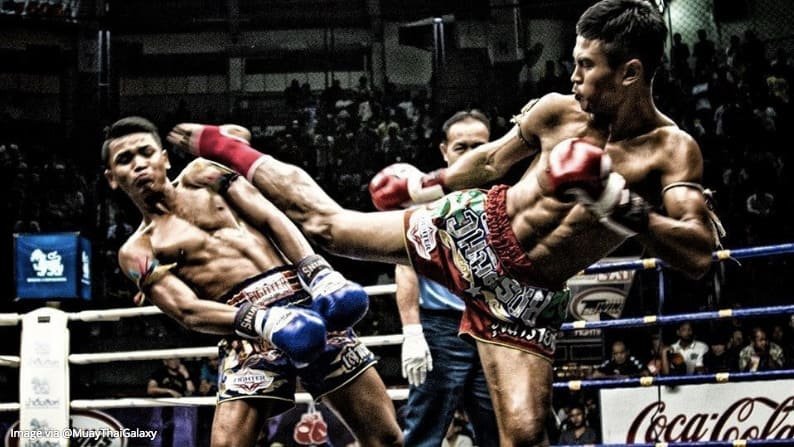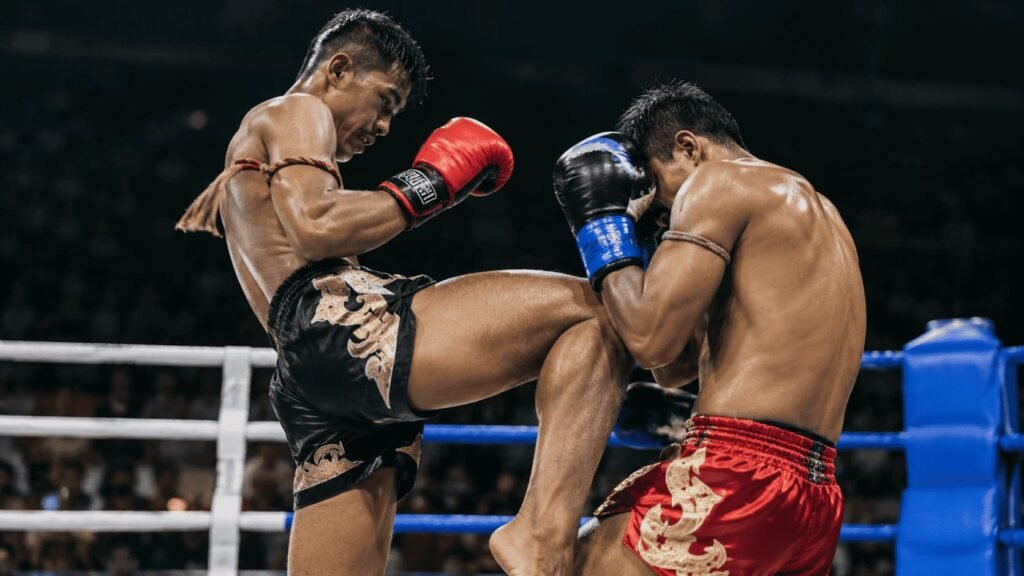
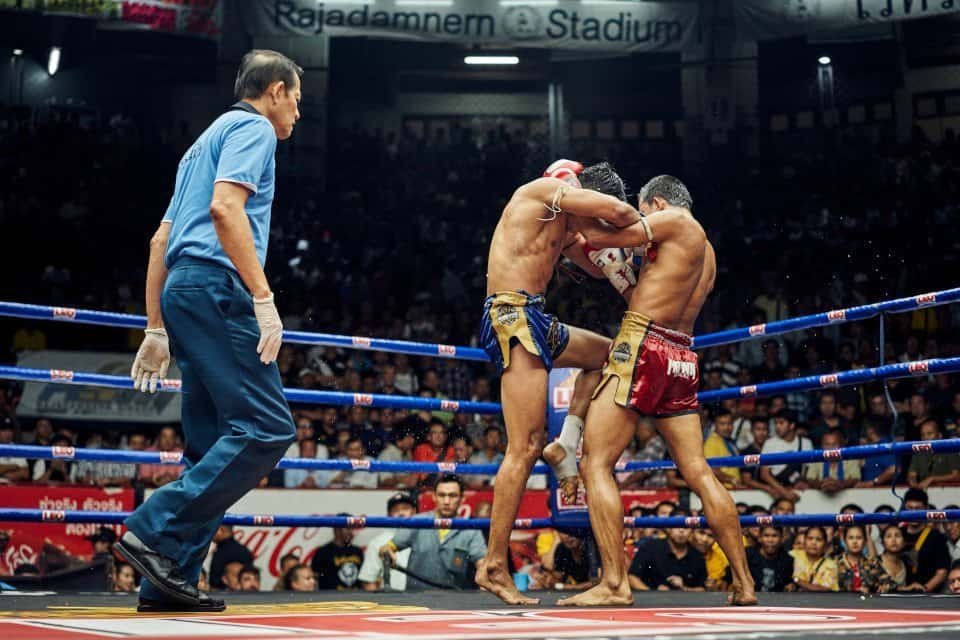
A newcomer at his first Muay Thai card usually enjoys the kicks, admires the elbows, and grows restless when the two fighters lock their arms around each other’s necks and begin what looks like a slow dance at a rural wedding. He assumes nothing is happening. He is wrong, and the Thai gamblers packed near the ring know it, because they are shouting louder than they did during the kicks.
In the Muay Thai clinch the sport stops resembling kickboxing and becomes something older and stranger. So what is clinching in Muay Thai? Two people standing chest to chest, each trying to control the other’s head, arms, and hips, while throwing knees and looking for the moment the other man’s weight goes where it should not. Whoever manages that better tends to win, often without a moment the casual viewer would call exciting.
What follows is the beginner’s version: the grips, the frames, the shove and the turn, and a plain account of what the judges are actually counting while the crowd hollers.
A Short Tour of the Grips
The Thai clinch is a grappling contest with only a few legal handholds, and each has a job. You will hear a trainer call them by a mix of Thai and English, and you will hear “plum” more than all the others combined.
| Grip | Where your hands go | What it does well | What it costs you |
| Plum (double collar tie) | Both palms stacked on the back of his head, forearms squeezing his neck | Pulls his posture down, opens the body and face for knees | Leaves your ribs open if you are lazy with your elbows |
| Single collar tie | One hand behind the head, the other controlling an arm | Steering him in circles, setting up turns | Weaker hold, easier for him to pummel out |
| Bicep control | Both hands cupped on his upper arms | Stops his knees, keeps you safe while you reset | Scores little on its own |
| Underhook / body lock | One or both arms under his armpits, around the back | Hip control, lifting him onto his toes before a knee | Close to his elbows, and the referee may split you quickly |
| Arm over, head frame | Forearm across his collarbone or jaw, other hand on his arm | Makes space, denies his plum | Purely defensive until you do something with it |
A sensible gym teaches bicep control first, because it keeps a novice from getting kneed in half, and the plum second, because everyone wants to learn the plum.
The Plum, Taken Seriously
A good plum resembles a vise more than a leash. The hands lie flat, one stacked over the other on the crown or the back of the skull, never with the fingers interlaced (interlaced fingers invite a sprain). The forearms press inward against the sides of his neck. The elbows squeeze together, and that detail matters more than anything the hands do, because the elbows are what stop him from sliding his own arm inside and breaking the hold.
Then you pull down, not back. Your job is to fold his posture so that his eyes look at the canvas and his hips drift away from yours. A fighter whose head is below his hips cannot throw a meaningful knee, cannot see yours coming, and cannot keep his balance if you turn him.
Your own posture matters just as much. Hips forward, back straight, chin tucked into your chest so he cannot plum you in return. Beginners tend to bend at the waist and hunch, which gives the other man a perfect handle on the back of the neck. Stand tall, as if you were a head waiter carrying soup through a crowded room.
Arm Control: The Quiet Half of the Clinch
A clinch is won with the arms at least as often as with the head. The contest of hand positions has a name among trainers, “pummeling,” and it looks like two men trying to swim through each other. Each fighter snakes his arm inside the other’s to win the better position, usually the inside grip on the neck or an underhook.
The beginner’s rule of thumb is this: inside beats outside. If your forearms are between his arms and his neck, you are in charge. If his are between yours, he is. When he gets the plum on you, the escape starts by pushing one of your hands up through the middle, across his face or under his chin, and replacing his grip with yours.
Arm control also keeps you from being hit. When you hold both of his biceps, he cannot throw an elbow and struggles to set his feet for a knee. You score little from there, but in a five-round fight, time spent safely is not wasted. The deeper exchanges (arm drags, collar ties that switch sides mid-knee, wrist control that opens the elbow) are a subject for later, and our guide to advanced clinch techniques picks up where this one politely stops.
Off-Balancing, or Why the Thai Clinch Looks So Lazy
Here is the part that confuses Western audiences. Two elite Thais in the clinch often seem to be doing very little: a lean here, a step there, a shrug of a shoulder. Then one of them is on the floor, and the man still standing walks back to his corner as if he had just paid a bill.
What happened was balance. Every man standing on two feet has a direction in which he is weakest, and the clinch fighter spends his time looking for it. Four simple tools cover most of what a beginner needs:
- The turn. Holding the plum or a collar tie, you step back and to the side with one foot and rotate him around you like a revolving door. His feet cannot keep up with his head, and he stumbles.
- The push and pull. Shove him backward so that he pushes back to stay upright, then pull him forward into his own effort. Every trainer who has ever lived has said this is “using his strength.”
- The knee as a lever. A knee landed to the body at the exact moment his weight sits on one leg lifts that leg off the canvas. Now he stands on one foot, and a turn finishes the job.
- The sweep off a caught leg or a knee. When he lifts a leg to knee you, a well-timed push on the shoulder, combined with a hooking motion of your own leg, can send him down. Rules vary on how much leg you may use, so learn it from your coach before you try it in sparring.
In the stadiums an elegant dump earns roars, points, and occasionally money changing hands in the stands. A clean off-balance tells the judges one thing clearly: this man cannot stay upright while the other one is holding him.
What Judges Reward in the Muay Thai Clinch
This depends heavily on which rules you are under, and beginners who watch Thai stadium fights and then compete in a Western amateur event are often surprised.
Traditional Thai stadium scoring
At Lumpinee and Rajadamnern, judges watch the clinch the way a horse trader watches a colt: for control, posture, and who looks worse for the experience. Clean knees to the body count heavily, especially knees that visibly move the other man. Holding the dominant position, dragging him around the ring, and dumping him while you stay composed all persuade the judges. A fighter who gets tied up, turned, and thrown several times in a round has lost that round, even if the other fellow landed only a few blows.
Knees have long been a way to rule the stadiums. Dieselnoi Chor Thanasukarn, who stood 6 feet 2 inches in a 135-pound division, took the Lumpinee lightweight title in 1981 and held it for four years, largely by clinching and kneeing. He beat Samart Payakaroon and Sagat Petchyindee along the way and eventually ran out of men willing to face him, which may be the most flattering review any clinch fighter has received. For the knees themselves, from straight knees to the curved ones that sneak around the elbow, see this breakdown of clinch knees that score.
IFMA and most amateur rules
The International Federation of Muaythai Associations uses a more arithmetical approach. Under its rulebook, a round goes first to the athlete who lands more scoring techniques, meaning punches, kicks, knees, or elbows thrown with force against a scoring target. Force only decides things when the count is level. The rulebook also lists “throwing the opponent without striking” among the things that do not earn points, so the grand dump you admired on a Bangkok broadcast is worth nothing on an IFMA scorecard unless a real strike comes with it.
The referee’s “yaek” (break) also comes sooner in amateur and Western events, so the clinch becomes a place to land two or three sharp knees and leave.
Scoring at a glance
| Action in the clinch | Thai stadium judges | IFMA judges |
| Clean knee to the body | Scores well, more if it moves him | One scoring technique |
| Holding the dominant plum without striking | Counts as control | Scores nothing on its own |
| Turning him so he stumbles | Impresses | No score without a strike |
| Clean dump or sweep | Scores and swings the round | Not a point by itself |
| Hip throw or tackle | Not allowed | Listed as a foul |
Your First Month in the Clinch
A beginner’s clinch sessions tend to end with a sore neck and a fresh respect for anyone who has done this since childhood. A few habits speed things up.
Start slow, with a partner your size, and agree on light knees. Drill the plum entry, the elbow squeeze, and the swim back to the inside until they feel dull, because dull is what you want under pressure. Spend as much time escaping the plum as applying it. And wear a proper groin cup: knees in the clinch wander, and the reason Thai camps favor the old steel cup with a jockstrap becomes clear about four seconds after the first stray knee lands.
FAQ
What is clinching in Muay Thai?
Clinching is standing grappling. Both fighters hold each other around the head, neck, arms, or body, trying to control posture and balance while landing knees and, where allowed, elbows.
Is the Thai clinch legal in all Muay Thai events?
The clinch itself is legal in Muay Thai everywhere, which is one of the main differences from most kickboxing rules. How long the referee lets it run varies, and many amateur and Western events break it sooner than Thai stadiums do.
Should a beginner learn the plum first?
Most coaches teach bicep control and posture first, then the plum. Bicep control keeps you safe from knees while you learn how to hold your balance, and the plum makes more sense once you know how to stand in the clinch.
Do throws score in Muay Thai?
In traditional Thai scoring, a clean dump or sweep impresses the judges and can swing a round. Under IFMA rules, throwing an opponent without striking earns no points, and hip throws or tackles count as fouls.