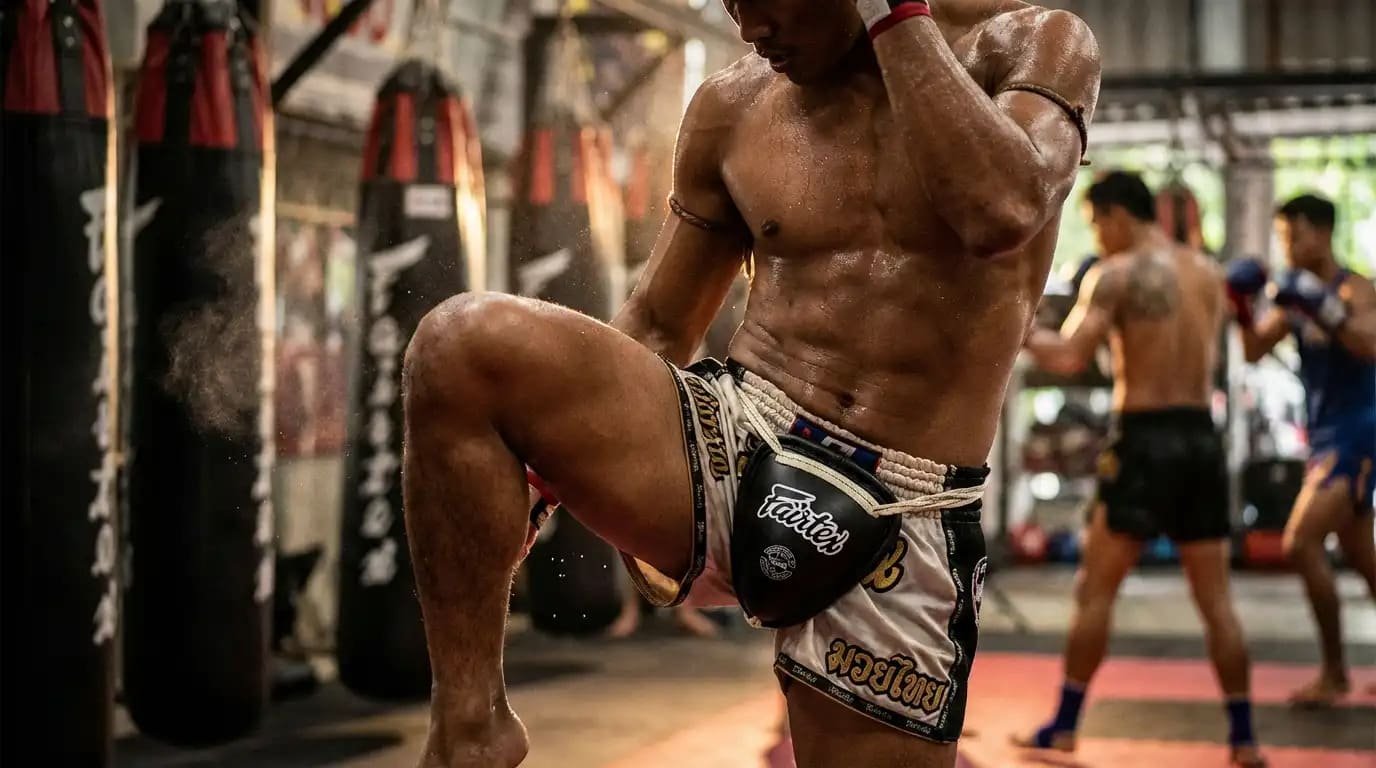
Walk into a gym in Chiang Mai on a clinch day and someone hands you a curved slab of chrome-plated steel with cotton cords trailing off it. It weighs about as much as a full coffee mug. Came up through an MMA gym? Your instinct is to ask where the compression-short version is, and the answer is a shrug toward the changing room.
The Thais call it กระจับ, kra-jap, the same word as the water caltrop, a horned black nut it genuinely resembles. The name is a joke about the shape. The object is not.
Knees travel up the middle
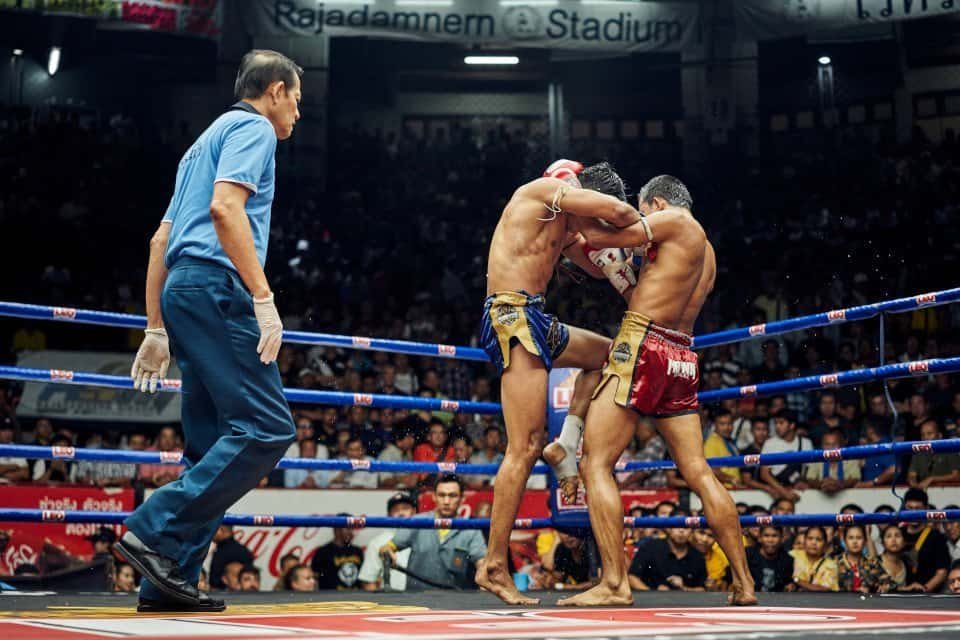
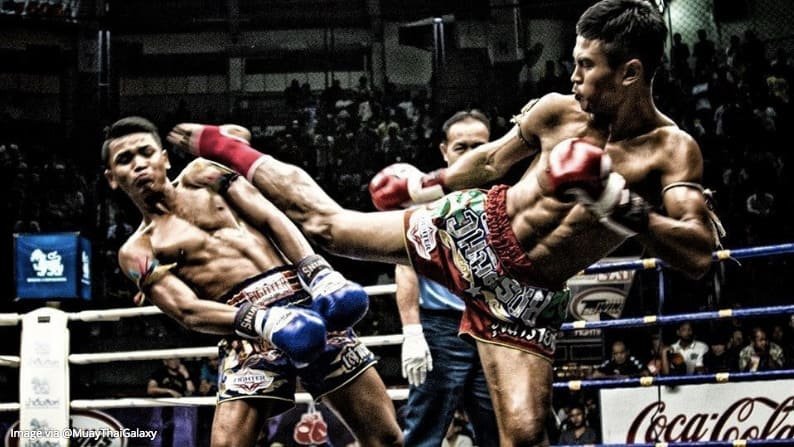
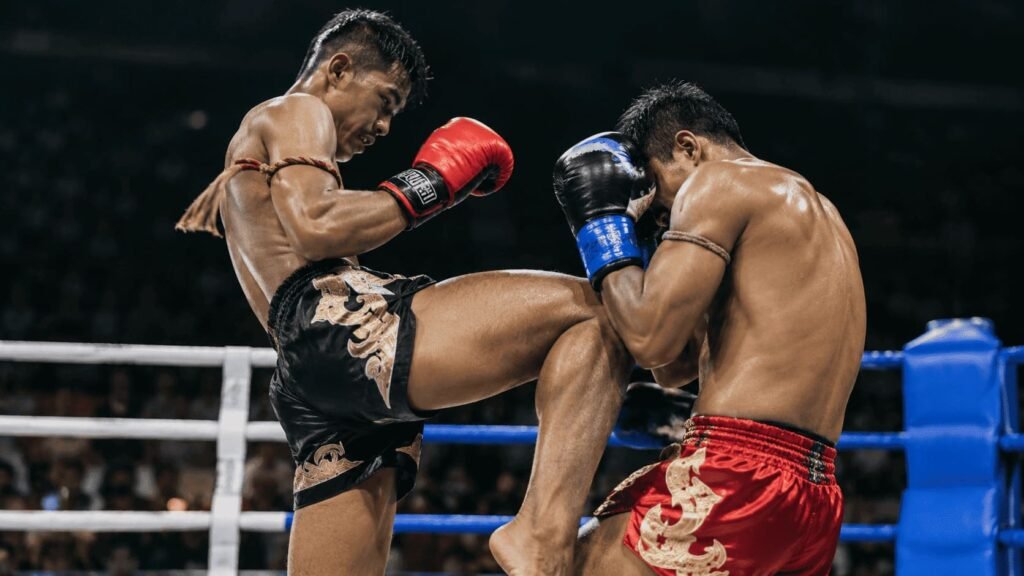
Muay Thai is the only common striking sport where two adults spend whole rounds chest to chest, hands behind each other’s heads, firing knees up the center line. The target is the floating ribs or the soft spot under the sternum. The groin sits on that same line, four inches lower, and a knee that arrives early lands there instead.
Nobody does it deliberately, and that is the part beginners misread. They treat a cup as insurance against bad partners, when the worst groin shots come from good partners with imperfect timing: a teep aimed at the belt that skids low, a knee thrown into a knee-block that slips off the frame, a partner turning into a body kick half a beat late.
Take one flush and your session is over, and everyone is polite about it while you lie on your side by the ring apron. A steel shell turns that same knee into a loud clank and a bruised hip crease, and the round keeps running. Anyone who drills knees in the clinch has felt that difference from both sides.
Four kinds of groin protection, and what each is really for
The Thai steel cup
A stainless or chrome-plated shell, foam and vinyl rolled around the rim, two cotton cords at the waist and two more that pass underneath. Some models swap the waist cord for a wide fabric belt.
Steel does not deform, so a knee spreads across the whole shell instead of punching through to you. What it fails at: anything above the waistband, and on deep knees to the body the rigid top edge digs into the crease where leg meets torso. Comfort is rough at first, two sessions of feeling like you have a soup ladle in your shorts, and then you stop noticing it.
Running in one is miserable, so most people keep a second option for roadwork. Sizing runs small, and Fairtex, Twins, and Sandee all cut theirs differently, so check the stated waist range rather than the letter on the label. Expect $30 to $60.
Plastic cup in a compression short
Molded polymer dropped into a pocket sewn into the front of spandex shorts. Light, breathable, invisible under Muay Thai shorts, and cheap.
The failure mode is the plastic. Hard polymer handles a stray knuckle fine and cracks under a shin, and budget ones split along the molding seam without you noticing until the day it matters. The pocket also lets it ride sideways during clinch, which is exactly when you need it centered. Fine for bag work, drilling, and your first month. Around $20 to $40.
The MMA-style compression jock
Diamond MMA started this category and a dozen brands copied it: a deep hard cup bonded into a compression short, with an integrated jock and four straps anchoring to the back of the waistband. It does not shift, and ventilation beats steel by a mile. Price runs $60 to $100.
Here I have to be straight rather than push the steel line harder. Plenty of experienced fighters swear by these, and the straps fix the one real flaw of pocket cups. The catch is what the design assumes. In MMA the groin is a foul and contact is glancing, so the cup mostly deals with knees from inside someone’s guard. Muay Thai asks the same object to eat full clinch knees from a standing 150-pound athlete, repeatedly, in one session. The good ones cope. The cheap clones do not.
Women’s groin protection
Almost no Muay Thai guide bothers with this, which is odd given how many women train now. The pubic bone bruises, soft tissue swells, and women who clinch regularly will tell you about knees that landed hard enough to split skin. Different geometry, same requirement.
Women’s protectors are polycarbonate or dense foam, cut flatter and wider than a male cup, with more coverage across the pubic bone and less depth. Lobloo makes the best-known one. They sit in a compression short or a light harness.
Borrowing a men’s steel cup, which happens constantly when someone shows up to a fight unequipped, works badly. The shell assumes volume that is not there, so it stands off the body and slides under contact. Budget $25 to $60.
| Type | What it stops | Comfort | Price (USD) | Best for |
| Thai steel cup | Full clinch knees, shins, insteps | Clanky for two weeks, then fine; bad for running | $30-60 | Anyone clinching or sparring weekly |
| Plastic cup + compression short | Stray knuckles, glancing kicks | Best of the four | $20-40 | First month, bag work, roadwork |
| MMA compression jock | Hard impact, never shifts | Very good, hot in summer | $60-100 | MMA crossovers, steel-haters |
| Women’s pelvic protector | Pubic bone impact, clinch knees | Light, needs a snug short | $25-60 | Every woman who clinches or spars |
How the laces actually tie
Briefs or a compression short go on first. The cup sits over fabric, never against skin, for hygiene and because the padded rim will chafe you raw. Tuck everything up and back so it rests inside the shell rather than under the bottom edge.
The upper pair of cords is the waist belt. Pass them around at hip-bone level, not the navel, and tie them at the side or the small of your back, snug rather than cinched. The lower pair comes off the bottom of the shell, passes between your legs, runs up either side of the buttocks, and ties into that same waist cord behind you. That rear tie is the step people skip, and skipping it is why their cup swings. Done right, the shell stays flat when you jump.
Shorts go over the top, though some Thai gyms let students wear the cup outside them during clinch so it can be adjusted without stripping down. Either way works. A knot you cannot undo one-handed while sweating does not.
Do you need one for your first class?
No. Your first class is shadowboxing, bag rounds, pads, and a lot of standing around confused about your stance. Nobody is going to knee you.
You need one sooner than most gear guides suggest, though, because plenty of gyms fold clinch into the ordinary evening class by week two or three. Turn up to the first class without one, then buy something before you clinch. A $25 plastic cup covers the first month if money is tight, and you upgrade to steel once you know you are staying. Buying steel first is no mistake either. It just means you will hate it during roadwork before you have any reason to love it.
This thing lives in a hot bag
Sweat, steel, foam, and a zipped bag in a warm car make a small biology experiment. Two things go wrong: the foam rim sours within a week, and rivets and exposed edges start to pit, even on cups sold as stainless.
Never machine-wash a steel cup: the drum beats the padding off the rim and knots the cords. Wipe shell and rim with a disinfectant wipe or diluted white vinegar after every session, then hang it by the cords somewhere with air moving. Compression shorts do go in the wash, insert removed, cold. If yours already smells, the padding has absorbed it and no spray fixes that. The habits behind gear that doesn’t stink apply here with less forgiveness, because you cannot air out a hollow shell left face-down in a bag.
What the rulebook actually says
Under IFMA rules, the international amateur body, a groin guard is mandatory. Male athletes wear a metal or polycarbonate guard, with a jock strap permitted in addition. Female athletes wear a polycarbonate or foam guard, and chest protection is separately required for senior women. Every athlete brings their own, for hygiene, and a guard that fails pre-bout inspection gets swapped for a loaner from the equipment table.
Regional bodies mirror that wording. Muay Thai Canada uses the same metal-or-polycarbonate language, and most US amateur promotions simply write “groin cups are mandatory” on the required-gear page, then check at weigh-in.
Which points at the one piece of advice worth more than any brand argument. Own yours. The loaner bin at a regional show is a shared box of foam that fifty strangers have sweated into, and you find out you need it about ninety seconds before you walk to the ring.
FAQ
Do you need a cup for Muay Thai if you only do fitness classes?
Not really. Bag and pad classes with no partner contact put nothing near your groin, and a cup will only annoy you through the conditioning rounds. That flips the moment your gym pairs people up for clinch or technical sparring.
Is a steel cup better than a plastic one?
For clinch and sparring, yes, and it is not close. Steel spreads impact instead of flexing into you, and it does not crack. Plastic wins on comfort and price, which is why most serious trainees own both and pick by the session plan.
Can women use a men’s Muay Thai cup?
In an emergency, yes, and it fits badly. Male cups stand off the body, leave a gap low at the front, and shift under contact. A women’s protector is flatter, wider across the pubic bone, and costs about the same.
How tight should a Thai steel cup be?
Snug enough that it stays flat when you jump, loose enough to slide two fingers under the waist cord. If it swings during knees, the culprit is almost always the rear tie, so redo the cords running between your legs and anchor them at the back.