

There’s a specific smell that comes off a gym bag left in a car trunk for three days in July. It hits before the zipper is even fully open, a warm, sour, faintly ammonia-like wall of air that makes passengers ask what died back there. Nothing died. That’s just a pair of gloves, some hand wraps, and a set of shin guards doing exactly what unwashed gear does when left in the dark with no airflow.
Most people blame the sweat. That’s only half right. Sweat itself is nearly odorless, mostly water and salt. The smell is bacteria feeding on it, specifically on the proteins and oils left behind on foam, fabric, and leather, and producing waste compounds as a byproduct. That’s the actual stink. Airing a bag out on the porch for an afternoon does nothing to those bacteria colonies; it just gives the smell somewhere to go for a while before it comes back, usually stronger, because the colony didn’t shrink. It grew.
This matters because it changes the fix. The goal isn’t “let it dry out.” The goal is reducing the bacterial load and the residue they’re eating, item by item, using methods that don’t destroy the gear in the process. Gloves can’t go in a washing machine. Satin shorts melt under dryer heat. Leather shin guards crack if they’re scrubbed and soaked like sneakers. Each piece needs its own routine.
Gloves: The Right Way
Never machine wash boxing or muay thai gloves. The padding is layered foam glued to leather or synthetic leather, and both the glue and the foam structure break down in water and heat. A washed glove might survive one cycle looking fine and then start crumbling from the inside a few weeks later.
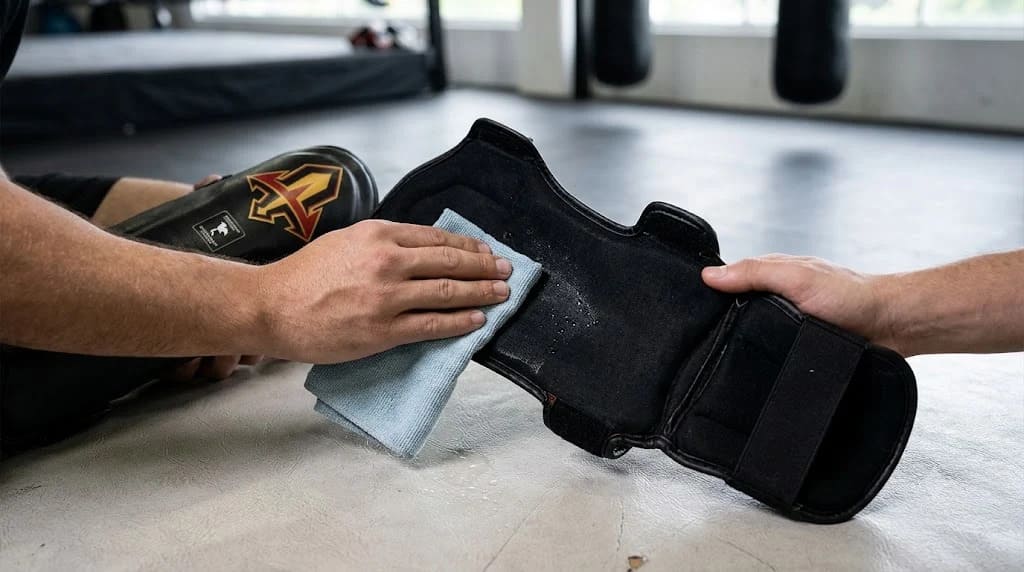
The actual routine is simpler than people expect. After every session, wipe the inside and outside with a damp cloth, or a baby wipe if that’s what’s in the bag, focusing on the wrist area and thumb where sweat pools. A drop of mild soap on the outside leather is fine occasionally; skip it on the inside lining. Then comes the part most people skip entirely: real drying. Stuff each glove loosely with crumpled newspaper or a dedicated glove dryer insert right after use. Newspaper pulls moisture out of the lining far faster than open air alone, and it needs swapping out once it goes damp, not left in overnight. Glove deodorizer inserts, the kind with charcoal or cedar, work as a supplement here, not a replacement for the drying step.
Sun matters more than people give it credit for. A short stint in direct sunlight, gloves propped open on a windowsill for twenty or thirty minutes, uses UV exposure to knock down bacteria on the surface in a way shade never will. Don’t leave them baking for hours; the leather dries out and cracks. A brief dose, done semi-regularly, is the sweet spot.
Shin Guards
Leather and synthetic shin guards are not maintained the same way, and treating them identically is where a lot of gear gets ruined early. Leather guards need to be wiped with a barely damp cloth and conditioned occasionally with a leather-specific product, the same category used on baseball gloves or leather boots. Soaking leather guards or scrubbing them with a brush strips natural oils and leads to stiffening and cracking within months.
Synthetic shin guards, usually a vinyl or PU-coated foam, tolerate a bit more direct cleaning. A damp cloth with mild soap wipes them down fine, and they can handle slightly more moisture without the same conditioning routine. What both types share is the same enemy on the inside: the foam padding absorbs sweat the same way glove foam does, and it needs airflow to dry, not a gym bag zipped shut for two days.
Shorts and Wraps
Muay thai shorts are usually satin or a satin-blend polyester, and that fabric has one hard rule: cold water only, and never the dryer. Heat is what causes the printed designs, the embroidery, and the waistband elastic to crack, fade, or warp. Satin under high heat behaves almost like a plastic surface losing its finish. Wash cold, on a gentle cycle, and hang dry. It takes longer than tossing them in with a normal load, but the shorts that survive years of training are the ones that never see a dryer drum.
Hand wraps are the easiest piece to get wrong by neglect. They spend an entire session pressed directly against skin and knuckles, absorbing more sweat per square inch than almost anything else in the bag, and then get balled up and stuffed away wet. Wash them after every couple of sessions in a mesh laundry bag on a gentle cycle. The mesh bag matters; loose wraps in a machine tangle into a knot that takes ten minutes to undo and stretches the fabric doing it.
Mouthguard Hygiene
A mouthguard sits against gums and teeth for the length of a session and picks up bacteria from the mouth itself, not just sweat. Rinsing it under cold water after every use is the bare minimum, but a proper clean means a mouthguard-specific cleaning solution or a diluted mouthwash soak once or twice a week, followed by air drying in a vented case rather than a sealed one. A sealed plastic case with no airflow is basically an incubator.
The Care Schedule
| Item | After Every Session | Weekly | Monthly |
| Gloves | Wipe down, stuff with newspaper | Deodorizer insert refresh | Brief sun exposure |
| Shin guards | Wipe down | Leather conditioner (leather only) | Check foam padding condition |
| Shorts | Hang to air | Cold wash, hang dry | Check elastic and print wear |
| Hand wraps | Air dry fully | Machine wash in mesh bag | Replace if fraying |
| Mouthguard | Rinse and air dry | Cleaning solution soak | Inspect for bite-through wear |
Worth Buying vs DIY
Glove deodorizer inserts and mesh laundry bags are cheap enough that buying them isn’t really a decision, more of a formality. A two-pack of cedar inserts runs less than a single roll of decent hand wraps, and a mesh bag costs about the same as a bad coffee. Leather conditioner is worth owning if the guards are actual leather; skip it entirely on synthetic gear, where it does nothing useful.
Where DIY wins is the newspaper stuffing and the sun exposure trick, both of which cost nothing and work as well as anything sold for the purpose. Specialty glove dryers with built-in fans exist and do speed things up, but they’re solving a problem newspaper already solves for free. The gap that’s genuinely worth paying to close is the mouthguard case: a vented, ventilated case is a few dollars more than the sealed one that comes free with a cheap mouthguard, and it’s the difference between drying gear and breeding it.
None of this takes more than a few extra minutes per session. The bag that never smells like a car trunk in July is the one that got wiped down and actually opened to dry before it got zipped shut again.

2 Comments