

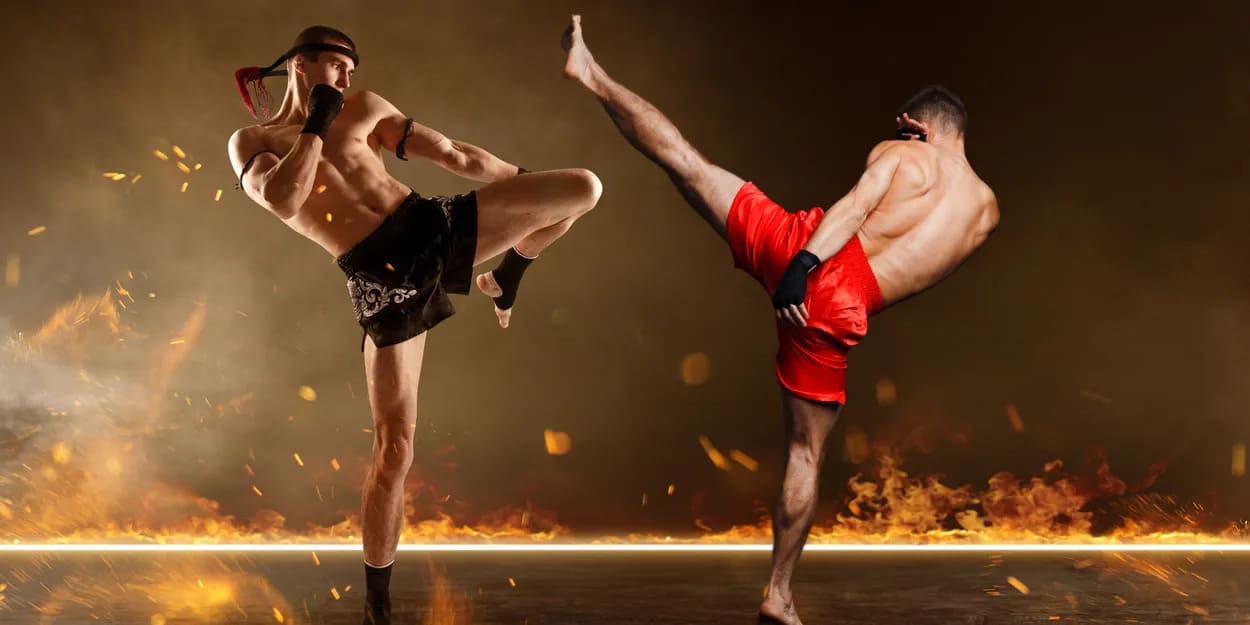
Muay Thai uses eight points of contact and a stadium judging tradition built around clean, damaging strikes. Kickboxing is a broader label for several rulesets, most of which trade the clinch and elbows for a faster, boxing-heavy pace. That’s the short version. The longer version depends on which kickboxing you mean, because the word covers a handful of distinct sports.
The Short Answer
Ask ten gym owners what “kickboxing” means and expect at least three answers. American kickboxing grew out of karate tournaments. Dutch-style kickboxing borrowed its low kicks straight from Thailand. K-1, the Japanese-born spectacle that dominated the 2000s, sits somewhere between the two with its own scoring quirks. Muay Thai, by contrast, is one sport with regional style variations but a single competitive backbone: the stadium system in Bangkok, refined over roughly a century.
So when people ask “is kickboxing the same as Muay Thai,” the honest answer is no, not quite, and also it depends which kickboxing gym is down the street.
Rules and Weapons, Side by Side
| Criterion | Muay Thai | Kickboxing (typical) |
| Striking weapons | 8: fists, elbows, knees, shins/feet | Usually 4: hands, feet (some rulesets add knees, rarely elbows) |
| Elbow strikes | Fully legal, often decisive | Banned in nearly every ruleset |
| Clinch work | Central skill, extended clinching allowed | Brief clinch tolerated in some (K-1), broken up fast or banned outright |
| Sweeps and off-balancing | Legal, scored positively | Usually restricted or banned |
| Low kicks | Legal and heavily used | Legal in Dutch-style and K-1, restricted in older American rules |
| Stance | Narrower, upright, weight-loaded for checking kicks | Wider, bouncier, boxing-influenced footwork |
| Round length/format | 5 rounds, 3 minutes, escalating pace | Typically 3 rounds, 3 minutes, front-loaded pace |
| Judging emphasis | Damage and ring control, later rounds weighted heavier | Aggression, volume, and clean scoring blows, more even across rounds |
| Governing tradition | Thailand stadiums (Lumpinee, Rajadamnern) | Multiple: Japan, the Netherlands, the US, no single home stadium |
| Common overlap sport | Rarely blended into other combat sports directly | Frequently cross-trained with boxing and Muay Thai gyms |
Stance and Rhythm: March vs Bounce
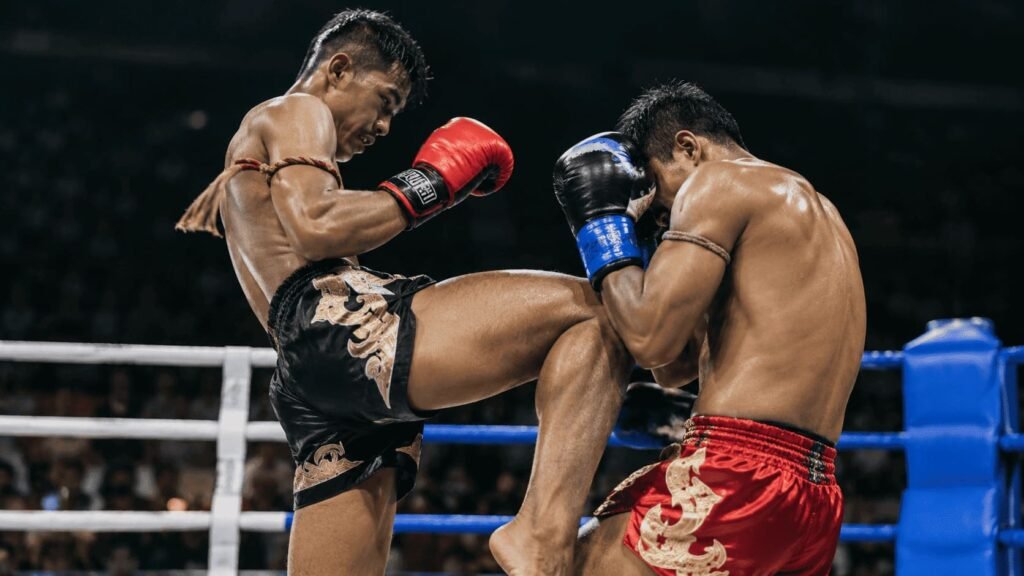
Watch a Muay Thai fighter walk forward and it looks almost unhurried. The stance sits narrower than a boxer’s, weight distributed so a shin can snap up to check an incoming kick without losing balance. Thai fighters call this rhythm the “march,” a steady forward pressure that eats up the clock because stadium scoring rewards the fighter who controls the pace and lands the more damaging shots late, not the one who looks busiest early.
Kickboxing rhythm reads differently. Feet stay lighter, knees bent, weight bouncing slightly on the balls of the feet, closer to what a boxer or karateka would recognize. That bounce exists because most kickboxing formats reward volume and visible aggression from round one. There’s no incentive to save output for the fifth round when there is no fifth round.
The Clinch Gap
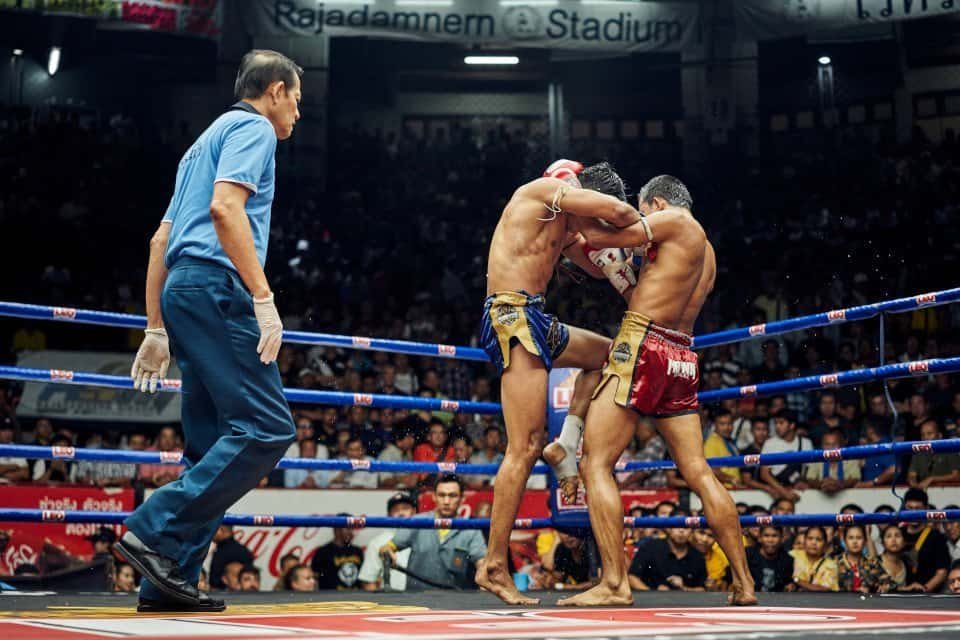
This is the single biggest structural difference, and it explains almost everything else on the list above. Muay Thai’s clinch isn’t a brief tie-up, it’s a discipline of its own, taught for months before a fighter is considered competent. Fighters use it to land knees, off-balance an opponent with a sweep, or simply grind out a dominant position that judges score in their favor.
Kickboxing, in nearly every version, either bans the clinch or limits it to a couple of seconds before referees break it apart. K-1 allowed a single knee from the clinch for a stretch of its history, then tightened that rule over time. American and most European kickboxing federations don’t allow clinching at all. Remove sustained clinch work and you remove the setup for most knee strikes, sweeps, and a whole category of Muay Thai’s scoring opportunities. That’s the gap.
Elbows, Sweeps, and What’s Off the Table
Elbows are the clearest yes/no split between the two sports. Muay Thai allows them in every direction, cutting elbows, spinning elbows, downward elbows off the clinch, and they’re often the strikes that end fights early on cuts. Kickboxing rulesets, across the board, ban elbow strikes. The risk of cuts and the sport’s emphasis on longer combinations made elbows a non-starter for nearly every kickboxing federation that formalized rules.
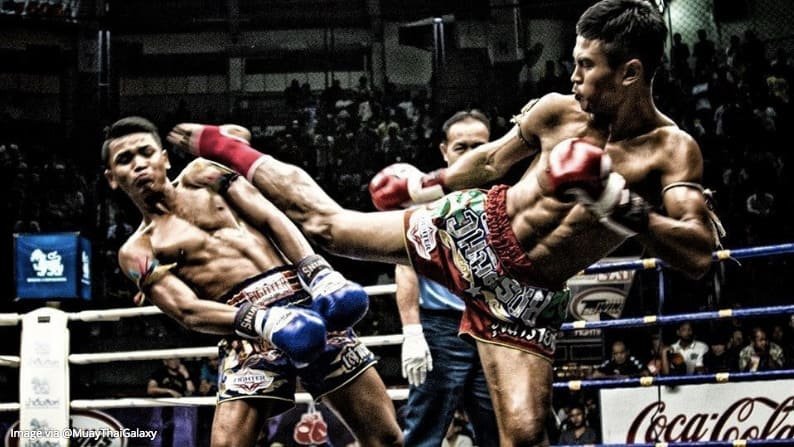
Sweeps sit in a similar spot. A Muay Thai fighter who dumps an opponent to the canvas using a leg sweep from the clinch gets credit for it. Try that in most kickboxing rings and it draws a warning, sometimes a point deduction. Low kicks are the exception that proves the rule here: Dutch-style kickboxing and K-1 both embraced low kicks decades ago, borrowing them directly from Thai fighters, so on that one specific weapon the two sports actually converge.
How the Judges See It Differently
Stadium Muay Thai judging can confuse newcomers watching their first fight. The first two rounds often look slow, almost cautious, because Thai scoring weights the middle and later rounds more heavily and rewards clean, damaging technique over sheer output. A fighter who lands fewer strikes but visibly hurts their opponent, or who dominates the clinch, often wins a fight that looked even on the feet. This site’s breakdown of the 10-point must system covers this in more depth, and it’s worth reading before watching a live card for the first time.
Kickboxing judging leans closer to what Western boxing fans already expect: each round scored close to independently, aggression and clean connects rewarded from the opening bell, knockdowns weighted heavily. There’s less patience for a fighter who coasts early and turns it on late. That single difference in philosophy changes how fighters in each sport are trained to manage a fight’s pace.
Two Family Trees: Stadium Muay Thai and Global Kickboxing
Muay Thai’s competitive lineage runs through Thailand’s stadiums, Lumpinee and Rajadamnern chief among them, with a tradition that predates modern gloved boxing in the country and has stayed largely intact for generations. It’s a national sport with a single home.
Kickboxing has no single home. Japanese promoters in the 1960s and 70s built a kickboxing product partly by pitting local karateka against imported Muay Thai fighters, stripping out elbows and the clinch to fit local tastes and television. Around the same period, Dutch gyms, most famously the lineage that produced schools like Mejiro and Chakuriki, fused Western boxing with Thai low kicks into what’s now called Dutch-style kickboxing, arguably the closest kickboxing gets to Muay Thai in spirit. K-1 later packaged a version of this for a global pay-per-view audience in the 1990s and 2000s, with its own house rules on knees and clinch time. None of these are “the” definition of kickboxing. They’re competing traditions that all borrowed something from Thailand and left something out.
Which Should You Train?
For most complete beginners, kickboxing is the gentler on-ramp. The stance is closer to what a first-timer’s body already does naturally, there’s no clinch to learn before sparring makes sense, and the rulebook is simpler to explain in a single class. Muay Thai asks more of a new student early: shin conditioning, clinch fundamentals, elbow safety, a stance that feels unnatural before it feels efficient.
That doesn’t make kickboxing the “easier” sport at a high level, and it doesn’t make Muay Thai the better choice for everyone either. Someone training purely for fitness and stress relief, with no interest in the clinch, may genuinely prefer kickboxing’s format long-term. Someone drawn to self-defense, or curious how Muay Thai stacks up against a more familiar Western sport in this Muay Thai vs boxing breakdown, usually ends up needing what Muay Thai teaches: the clinch, the knees, the eight-limb range that kickboxing intentionally leaves out.
If both are available locally, sit in on a class at each gym before signing anything. Watch how sparring is run, ask how often beginners get hurt, and notice whether the coaching staff has actual competition experience in that specific sport rather than a black belt in something adjacent.
What if you don’t have to choose? Plenty of serious strikers train both, and the two sports complement each other more than the rulebooks suggest. A Muay Thai clinch game paired with kickboxing-honed hand speed and combination boxing produces a rounder, harder-to-read striker than either sport alone. Several fighters who came up through Dutch-style kickboxing gyms later added a Thai clinch specifically because they felt exposed at close range. There’s no rule against training both on different nights of the week, and plenty of gyms now blend the two curricula anyway.
FAQ
Is Muay Thai considered a form of kickboxing? Loosely, yes, in the sense that Muay Thai fits under the broad “striking sport with kicks and punches” umbrella that the word kickboxing sometimes describes. Competitively, though, they’re treated as separate sports with separate rulebooks, and no major kickboxing federation allows elbows or extended clinch work the way Muay Thai does.
Which is easier to learn as a total beginner? Kickboxing typically has a shorter learning curve at the start, mostly because there’s no clinch to master and the stance feels more familiar to someone coming from little athletic background. Muay Thai rewards patience with its early clinch and shin-conditioning phase, but many students find that phase is also what keeps them hooked.
Do Muay Thai fighters do worse in kickboxing rules, or vice versa? It varies by fighter, but the pattern generally holds that Muay Thai fighters miss their clinch and elbows in kickboxing rules, while kickboxers can find themselves out of position against a clinch they’ve never trained to escape. Fighters who cross over successfully usually spend real time adjusting to the ruleset, not just showing up.
One Comment