

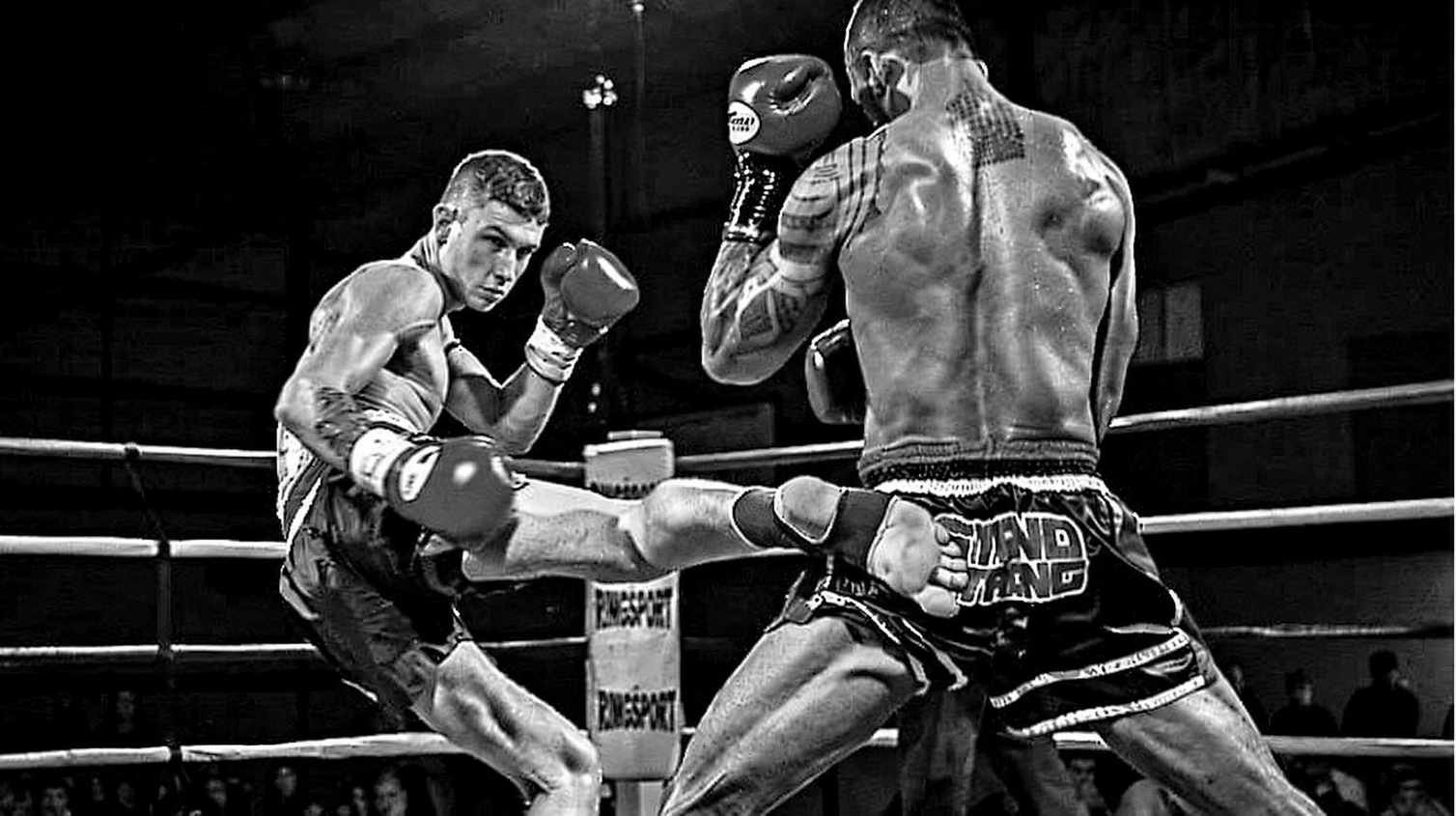
You have seen this ending even if you have never sat ringside. Round three, a fighter walks back to his corner with a hitch in his step, and nobody has touched his head all night. He has taken a dozen kicks to the outside of his lead thigh, his corner is screaming at him to switch stance, and he will not, because he has never trained southpaw. Ninety seconds later the leg buckles on a simple step.
Leg attacks are the least glamorous thing in striking and the most likely to end your night. They also get taught with more confusion than anything else in a North American gym, because the kick your coach shows you came out of Thailand, the combination he puts it in came out of Amsterdam, and the target your partner keeps aiming at came out of the UFC.
What the kick is actually doing to the leg
Two different injuries hide under the phrase “low kick.” The first is mechanical. A shin driven into the outer thigh crushes the vastus lateralis and the iliotibial band against the femur. Fibers tear, vessels bleed into the tissue, the quadriceps stiffens. Nothing dramatic happens on kick one. The damage is cumulative, which is why a fighter looks fine for two rounds and then cannot change direction in the third.
The second injury is neurological and it happens lower down. The common peroneal nerve wraps around the neck of the fibula, just below and behind the knee, and almost nothing covers it there: no thick muscle, barely any fat, skin over bone. Compress it against that bone and it stops conducting for a while, so the muscles that lift the front of your foot go quiet. That is the “dead leg” fighters describe, and at its worst it becomes foot drop.
This is where most guides oversell it. Plenty of calf kicks that drop people never touch the nerve. They smash the lateral head of the calf muscle, the ankle loses its stabilizer, and the leg folds. Coaches like the nerve version because it sounds surgical. In practice you are aiming at a zone the width of your hand, on a moving target.
In Thailand the kick buys rounds, not knockouts
Thai gyms mostly call it te kha, a kick to the leg, and it gets thrown like everything else: step out to open the angle, turn the hip all the way over, swing the shin through like a bat. No chamber at the knee. The arm on the kicking side drops and swings back as a counterweight, the part Westerners skip before wondering why the kick feels weak. Target is the outer thigh, well above the knee, on the meat.
The follow-up matters more than the kick. A man leaning back off a hard leg kick is open for the teep, and a man turned slightly is one step from the clinch, where rounds actually get won at Lumpinee and Rajadamnern. The low kick is almost never the finisher. Its job is to ruin his balance and make him look like he is losing, because that is what the judges and the gamblers behind them are reading.
The Dutch built the same kick into a sentence
Amsterdam rewrote the job description. At Mejiro Gym under Jan Plas the low kick stopped being a control tool and became punctuation at the end of a boxing combination. Rob Kaman, who nobody ever called anything except Mr. Low Kick, finished 77 of his 97 wins by knockout, and took his first WKA world title in September 1983 by stopping John Moncayo in the third with a kick to the leg.
The mechanic is sneaky, and worth stealing even if you never fight kickboxing rules. Throw a left hook. To defend it, your opponent loads his lead side and plants that foot. A planted foot cannot check. The right low kick arrives half a beat later into a leg bolted to the canvas.
Ramon Dekkers took the idea into Thailand and beat Thai champions with it, which is much of why he is still the most famous foreigner the sport has produced. Dutch fighters stay on one leg, four or five kicks to the same spot in a round, until it quits.
Three kicks, side by side
| Version | Target | What it is for | Typical setup | Main risk |
| Thai low kick | Outer lead thigh, above the knee | Wrecking balance and opening the clinch | Thrown cold from neutral, or off a teep feint | Caught and dumped; scores badly if he shows no reaction |
| Dutch low kick | Same outer thigh, sometimes the inside | Accumulating damage until the leg fails | End of a combination, behind a hook that plants the foot | You are in punching range, so you eat the counter right hand |
| MMA calf kick | Lower leg under the knee, over nerve and calf | Taking mobility away fast, sometimes in four connections | Off a jab, or timed on a stance switch | Easy to check, and a bad angle puts your instep into a knee |
The calf kick came in through a different door
Justin Gaethje spent five rounds chopping at Tony Ferguson’s legs at UFC 249 in May 2020 and stopped him in the fifth. Nine months later Dustin Poirier did it to Conor McGregor at UFC 257 and took a second-round TKO out of a man who had never been stopped by strikes. McGregor’s coach John Kavanagh said three or four clean connections were all it took, and compared it to cracking your funny bone. Within a month calf kicks were in the Tuesday class at every gym on the continent.
Then Muay Thai people tried them in sparring and found they mostly did not land. The reason is geometry. An MMA fighter stands bladed with real weight on the lead leg, partly to defend takedowns, and that calf sits out front like a target on a stand. A Muay Thai stance is squarer and lighter on the front foot, because you have to lift that leg to check at any moment. Kick a leg already half in the air and you get shin on shin, and you lose that trade.
Calf kicks are conditional under Thai rules, not useless. They land on someone who parks his weight forward, and they work as a hook that drags the lead leg across the body. Fish for one and you hand a round away.
Do Thai judges even care?
Not much, and this catches Western fighters out constantly. Under Thai stadium scoring, kicks and knees to the body sit at the top, then balance and visible dominance, and punches and leg kicks sit near the bottom. A round full of low kicks that produce no reaction loses to a round with two body kicks and a sweep. Judges watch who winced.
They do count once the damage shows, because limping is a reaction and reactions are what Thai judges reward. Read how the scoring actually works before building a game plan around chopping legs. Under Western and kickboxing rules none of this applies, so the Dutch answer is correct.
Defending it without ruining your own week
Checking is the primary answer, and our guide to checking covers the mechanics. The short version: lift the knee and turn the shin outward so the hard edge meets the kick. Raising your foot off the floor achieves nothing except lifting a soft calf into a shin.
Three other options, in rough order of how often they help:
- Teep the hip as he loads. The kick needs a step and a hip turn. Interrupt the step and it never arrives.
- Step in and jam it. Your thigh lands on his hamstring instead of his shin on your quad, and now you are clinching.
- Catch and sweep. Highest reward under Thai rules, and a fast way to get punched if you are late.
For the ones you cannot avoid, brace the quad hard and turn the thigh a few degrees so the kick lands on the outside face instead of wrapping to the back. A relaxed thigh soaks up far more damage.
Conditioning, and one drill for tonight
You condition your shins by kicking things. Bags, pads, partners’ shins, over years. Bone remodels under load, and the nerve endings in the outer layer get less reactive. Rolling bottles down your shins does not speed that up, it just hurts.
Do this at your next session. Ask a partner to hold a Thai pad low and angled about 45 degrees, at the height of his own knee, then throw jab, cross, left hook, right low kick, ten times through before switching sides. Make the hook loud enough that you feel the moment his weight commits, and land the kick right behind it. Three rounds teaches you more about setups than a month on the heavy bag.
So which one do you train?
Depends entirely on the rules you will fight under, and anyone who says otherwise is selling a curriculum. Full Thai rules: build the Thai version, kick from neutral, land clean on the thigh, and treat it as the way into the teep and the clinch. Western amateur or kickboxing, anything scored on damage and volume: Dutch, all day, and stay on one leg. MMA: calf kicks earn their spot, because the stance you are facing puts the target out front.
The problem over here is that all three get taught in the same six weeks, with nobody saying which ruleset each belongs to. So you throw a Dutch combination at a Thai judge, or a calf kick at a man whose lead foot barely touches the floor. Ask your coach which version he is teaching and why. If the answer is that this is just how we do it, watch a Lumpinee card and a Glory card back to back and work it out yourself.
Questions people actually ask
My shins hurt for days after leg sparring. Am I doing it wrong?
Probably, at least partly. Dull soreness along the outside of the shin bone is normal and fades over months, but sharp pain on the front ridge or the ankle bone means you are landing short. Connect with the lower third of the shin. Pain that lasts past a week and hurts to press in one spot needs a doctor.
Is the inside low kick worth learning?
Yes, and it is underused in Western gyms. Checking one means turning the knee inward, which is awkward and slow, so it lands on people who have drilled outside checks a thousand times. Throw it off a lead hand feint. It steals balance even when it barely hurts.
Do I need shin guards for low kick sparring?
For any sparring where legs are live, yes. Guards protect your partner’s thigh as much as your own bone, and gyms that spar bare shins go so light nobody learns the real version. Get a pair covering the instep, since kicks landing short catch the top of the foot.
How long does a badly kicked leg take to recover?
One hard kick leaves you sore for two or three days. A round of accumulated kicks to the same thigh can leave it stiff for a week or more, and the tightness outlasts the color. Ice and easy movement early, no aggressive massage on a fresh bruise. If the thigh feels hard and swollen rather than tender, see a doctor.