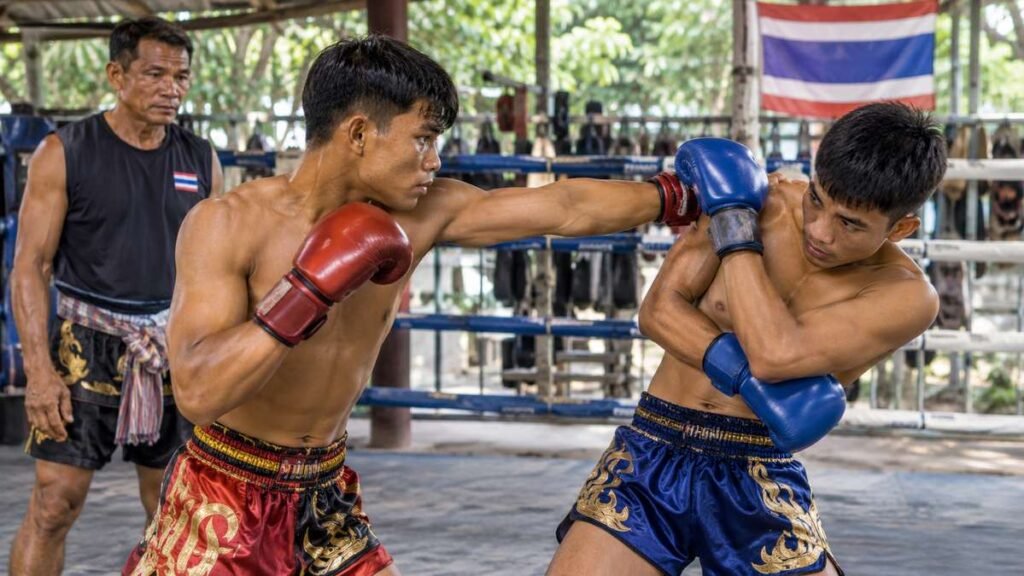

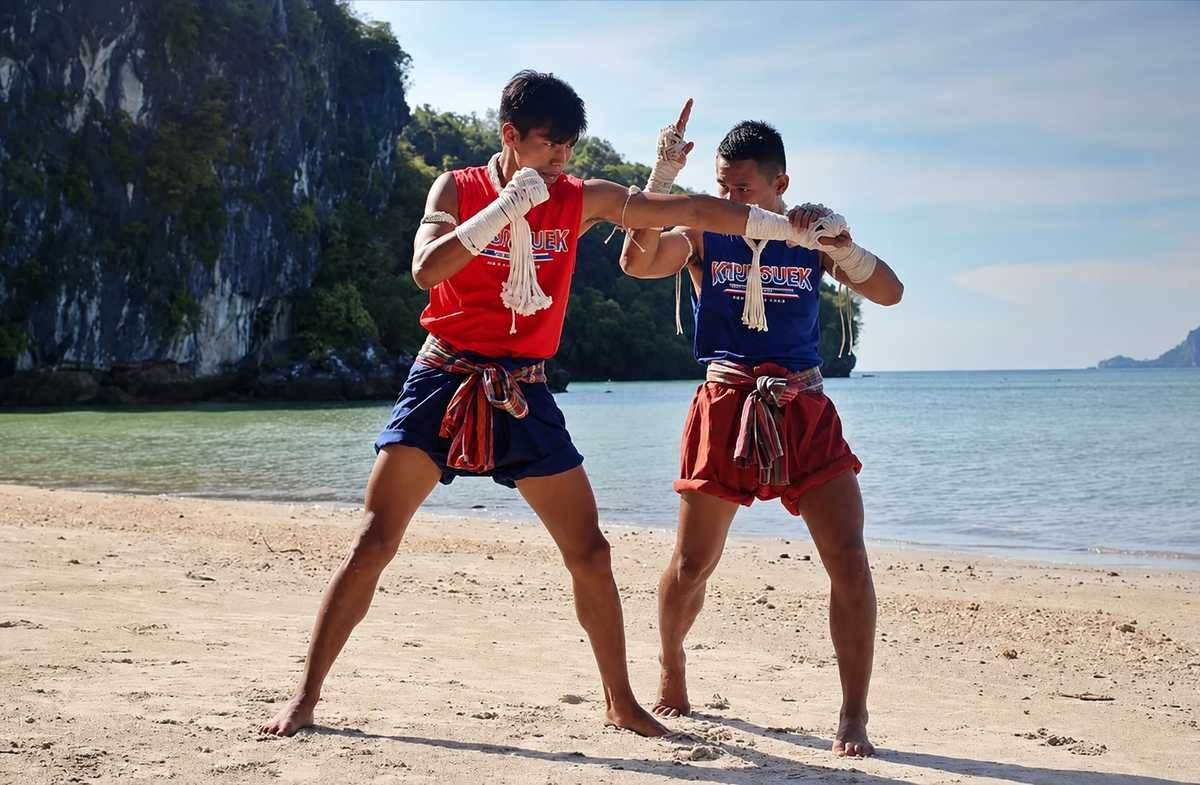
The attacker comes forward with a right straight. The defender steps off the line, turns the fist aside with his left arm, and drives the point of his right elbow into the other man’s shoulder. In Thailand the exchange has an old name: Hong Peek Hak, the swan with a broken wing.
That move belongs to a set called Look Mai Muay Thai, the fifteen “child techniques” of the classical art. They sit one level below the fifteen Mae Mai, the “mother techniques,” and Thai reference texts for schools are blunt about the order of things. You learn the mothers first. Only after that can you train the children well.
Below is the full set of fifteen as Thailand’s Department of Physical Education hands it down, with the attack each one answers.
Mothers and Children: Two Tiers of One Family
The Thai word mai means wood, and by extension a trick or a technique, the way an English speaker might say a fighter has “a move.” Mae means mother. Look means child. The metaphor is precise. A Mae Mai is a root technique, one of the core patterns every Muay Thai student has to own before anything else. A Look Mai branches off from those roots. The Thai description calls the child techniques subtle and intricate, a finer use of the same art.
The masters who organized the system gave each tier fifteen moves, and named them from the Ramakien (Thailand’s version of the Ramayana), from Hindu and Buddhist myth, and from ordinary village life.
| Mae Mai (mother techniques) | Look Mai (child techniques) | |
| Number in the classical set | 15 | 15 |
| Role | Foundation of the art | Refinements that branch from the foundation |
| When you train it | First | Only after the Mae Mai are solid |
| Character | Core defensive and counter patterns | Finer, more varied, often more daring |
| Typical tools | Parries, catches, elbows, knees, kicks | Spinning strikes, sweeps, throws, teeps to the joints |
For reference, the fifteen mothers are Salab Fan Pla, Paksa Waek Rang, Chawa Sad Hok, Inao Taeng Kris, Yo Khao Phra Sumen, Ta Then Kham Fak, Mon Yan Lak, Pak Look Toy, Chorakhe Fad Hang, Hak Nguang Aiyara, Naka Bid Hang, Wirun Hok Glab, Dab Chawala, Khun Yak Jab Ling, and Hak Kor Erawan. Students who can’t perform those cleanly aren’t ready for the list below.
The Fifteen Look Mai at a Glance
Each technique is written as a two-person drill. One side attacks, the other answers. Every answer on the list comes from the defender, which tells you something about the mindset of the old teachers.
| # | Thai name | Rough English meaning | The attack | The answer |
| 1 | Erawan Soey Nga | Erawan lifts its tusks | Right straight to the face | Slip, parry, left uppercut to the chin |
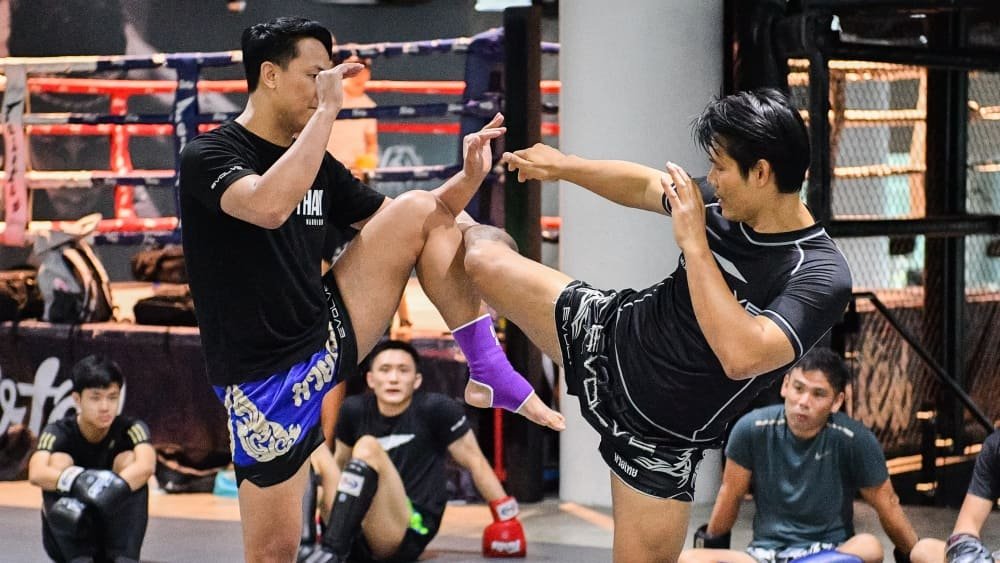
| 2 | Bata Lub Pak | The foot wipes the face | Opponent walks in to punch | Right teep straight to the face |
| 3 | Khun Yak Pa Nang | The giant carries off the lady | Straight punch to the face | Step outside, wrap the waist, hip throw |
| 4 | Phra Ram Nao Sorn | Rama draws the bow | Downward elbow at the forehead or crown | Absorb and cover, counter with the right hand |
| 5 | Kraisorn Kham Huay | The lion crosses the stream | Kick to the chin | Turn away, teep the standing thigh |
| 6 | Kwang Liew Lang | The deer looks back | Opponent advancing, guard up | Side teep, then spinning heel kick |
| 7 | Hiran Muan Paen Din | Hiran rolls up the earth | Right swing kick to the neck | Forearm block, spinning back elbow |
| 8 | Nak Mud Badan | The naga dives to the underworld | Right kick to the neck | Duck under, teep the back of the knee |
| 9 | Hanuman Tawai Waen | Hanuman presents the ring | Right straight to the face | Sidestep, parry, double uppercut |
| 10 | Yuan Tod Hae | The fisherman casts his net | Right teep to the face | Step outside, sweep the leg aside, kick the inner knee |
| 11 | Tayae Kam Sao | Bracing the pillar | Right kick to the neck | Arm block, low turn, teep the standing leg |
| 12 | Hong Peek Hak | The swan with a broken wing | Right straight to the face | Step in, parry, right elbow to the shoulder |
| 13 | Sak Puang Malai | Placing the garland | Right straight to the face | Step in, parry, right elbow to the sternum |
| 14 | Thon Kwad Lan | The old monk sweeps the yard | High kick, or a square stance | Duck the kick, sweep the standing leg |
| 15 | Farn Look Buap | Slicing the gourd | Right straight to the face | Step inside, parry, uppercut elbow to the chin |
Some translations are loose by necessity. Yuan in number 10 literally means a Vietnamese man, the net fisherman of old river life, and the Thai names carry echoes English can’t hold.
Answers to the Straight Punch
Six of the fifteen deal with a punch coming straight down the middle. The old teachers plainly saw the straight right as the most common threat.
Erawan Soey Nga is the simplest. The defender twists his body to the side to slip the fist, knocks it away with the right hand, and fires a quick left uppercut into the chin. Erawan is the three-headed elephant ridden by the god Indra, and the uppercut is the tusk coming up.
Hanuman Tawai Waen begins the same way but goes lower. The defender steps his right foot to the side, parries the incoming right with his left fist, and sinks his body under the line of the punch. From that crouch both fists come up together into the chin. In the Ramakien, the monkey general Hanuman kneels to deliver Rama’s ring to the captive Sita, and the double uppercut rises from a kneeling shape.
The other four trade the fist for an elbow or a throw. Hong Peek Hak steps the left foot in close, parries with the left arm, and smashes the right elbow into the attacker’s right shoulder. Sak Puang Malai uses the right foot to close, parries with the left arm, and aims the right elbow at the sternum instead. Farn Look Buap steps diagonally inside, parries with the left arm, and brings the elbow up under the chin like a blade slicing a gourd. Khun Yak Pa Nang is the outlier. The defender steps diagonally to the outside, lets the punch miss, then moves the right foot in tight, wraps the right arm around the attacker’s body, and throws him over the hip.
All six share a principle. The defense and the counter happen as one motion, with no pause between them. Anyone who has studied how counters get decided early will recognize the logic: the defender has already chosen his reply by the time the fist leaves the shoulder.
When the Kick Comes Instead
Five techniques answer kicks, and here the child techniques get acrobatic.
Hiran Muan Paen Din meets a right swing kick aimed at the neck. The defender’s right foot steps in toward the kicking leg, the right forearm comes up to take the impact, and the defender spins to drive a back elbow into the chin or face. The name comes from the demon Hiranyaksa, who in myth rolled up the earth like a mat and carried it off.
Nak Mud Badan takes the same neck kick and goes under it. The defender bends low so the leg sails overhead, then slides in a right teep to the back of the attacker’s left knee. The naga, the great serpent of Thai temples, dives down into the underworld, and the fighter dives with it.
Tayae Kam Sao is sturdier. The defender steps slightly to the right, holds the left arm up to block the kick, drops and turns a little, and teeps the attacker’s standing leg with the left foot. The goal written in the Thai text is to put him flat on his back.
Kraisorn Kham Huay handles a kick to the chin by turning the body away from it, then thrusting the left foot into the thigh of the attacker’s supporting leg. Thon Kwad Lan answers a high kick by walking into sweeping range while ducking, letting the foot pass over the head, and sweeping the standing left leg with everything the defender has. If the opponent is simply standing square, the same sweep takes out the lead leg.
These moves make a strong case for studying defense across all eight limbs before trying anything fancy. Each one starts with a block, a duck, or an angle, and the counter only works if that first piece holds.
The Pre-Emptive Pair and the Elbow from Above
Two techniques don’t wait for the attack to land at all.
Bata Lub Pak is the one the Thai text singles out as seizing the rhythm first. The opponent walks forward to punch, and before he gets there the defender snaps a right teep into his face.
Kwang Liew Lang starts the same way and keeps going. The defender launches a side teep with the right foot to knock the advancing opponent off balance, drops that foot forward to plant it as the new base, turns with it, and lands a heel kick to the sternum or chin. The deer glancing back over its shoulder is the spin.
Yuan Tod Hae answers a right teep to the face. The defender steps diagonally to the outside, uses the right arm to push the leg off course, pivots on the right foot, and kicks up with the left into the inside of the knee.
That leaves Phra Ram Nao Sorn, the only technique here built around an elbow coming down. The attacker closes and raises one or both elbows to crash them onto the forehead or top of the head. The defender bends his knees and dips his head a little to soften the blow, lifts his left arm to cover the face and meet the elbow, and counters with a right punch. Rama drawing his great bow is the image: one arm up, the other firing.
Drilling Look Mai Without Getting Hurt
Few gyms outside Thailand teach these as a formal set. If you want to work through all fifteen, a few habits help.
- Earn the mothers first. The Thai sources are firm on this, and they’re right. A spinning elbow off a blocked kick is useless if your block collapses.
- Drill in the attacker-defender format. One partner feeds the exact attack listed, at walking pace, and the other answers. Rotate after five clean repetitions on each side.
- Leave the throws and sweeps for mats. Khun Yak Pa Nang, Tayae Kam Sao, and Thon Kwad Lan all end with a body hitting the floor.
- Tap the joints, don’t kick them. Nak Mud Badan and Yuan Tod Hae target the knee. In training, touch the spot and move on.
- Pay attention to your feet. Nearly every Look Mai begins with a step: outside, inside, diagonal, or in close. Fighters who hop on their toes tend to arrive late and off balance, which is exactly why Thai fighters glide rather than bounce.
Pick one technique from each group, straight punch, kick, and pre-emptive, and spend a month on those three before adding more. Hong Peek Hak, Tayae Kam Sao, and Bata Lub Pak make a good first trio. All three are low-risk and use tools you already own.