

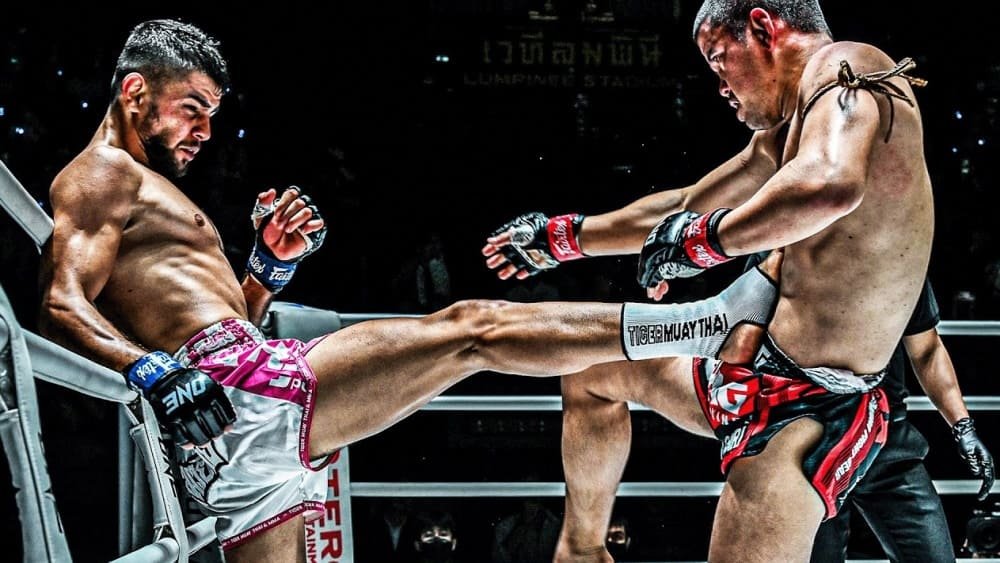
Stand at the edge of a sparring round in almost any gym and count the hand flicks. A beginner will produce forty or fifty of them across two rounds and get nothing back: no flinch, no guard shift, no weight moving off the front foot. The effort is real. Nobody answers the question because nobody heard it asked.
Here is the part that takes people a year or two to accept. Power does not create openings against anyone with a bit of experience, because a guard that is up stays up whether you hit it hard or gently. Information creates openings. A feint is a question you ask with your body, and the answer, meaning whatever your partner does in the two tenths of a second after you ask it, tells you what to throw. Most gym feints ask nothing at all.
What actually sells a feint
Weight comes first. A real cross rotates your hip and pushes your base forward a few inches, so if your feet stay glued and only the arm moves, the other person’s peripheral vision reads noise instead of threat. Show the shift. Load the hip, let the lead shoulder travel, then cut the punch off before the elbow extends.
Your eyes are the second half of it, and the cheapest to fix. Beginners feint at the head while staring at the ribs, or feint low while their chin points straight ahead. Experienced opponents pick that up without being able to say why. Look where the fake is going.
Rhythm is the one nobody teaches. A feint has to arrive on the beat where a strike would actually arrive, inside your normal working tempo, not as a separate wiggle you perform and then reset from. Throw two rounds of shadow work where every third punch stops halfway and you keep moving on the same count. That is the feel you want.
Now the honest part, because this is where most guides oversell it. A perfectly sold feint does nothing against a fighter who has decided in advance not to react. Pressure fighters in the Rodtang mold walk through fakes on purpose, eat the information cost, and make you deal with volume instead. Against that kind of opponent, feints only start working once you have hurt them somewhere, which is a different conversation.
The hand that goes high so the shin can go low
Fake at eye level, kick the thigh. The mechanic is simple: a jab feint pulls the lead hand and elbow up, and the moment that elbow lifts, the outside of the thigh has nothing over it. Step the lead foot out thirty to forty-five degrees as the fake lands so your hips have room to turn, then send the rear low kick through the leg rather than at it.
There is a second version that works better on experienced people, and it is close to free. Show the low kick itself. They check, because checking is a drilled reflex and reflexes are easy to trigger twice in a row. Their leg has to come back down, and the half second while that foot is landing is the least defended half second in the sport. Kick then. Thais have been robbing legs with this since long before anyone filmed it, and it still lands on guys who know exactly what you are doing.
Step in, break it off, teep
The step feint is the least glamorous setup on this list and probably the most useful. You take a half step into range as if you are committing to a combination, then stop. What happens next is pure information. If they reset backward, they are a mover, so the teep is wasted and you should be cutting angles instead. If they hold their ground and load a counter, they have just planted their weight over both feet, which is exactly the posture a properly loaded teep is built to punish.
Small detail worth stealing: angle that half step slightly outside their lead foot rather than straight up the middle. Straight on, your teep hits hip bone and does nothing. From half a foot outside, the same push lands on soft ribs and folds them.
Why changing tempo beats adding motion
Beginners try to get trickier by adding movement. Better fighters subtract time. Run the first two shots of a combination your partner has already seen at your normal pace, then fire the third with the usual micro-pause deleted, so it arrives before their defense is scheduled to be there. Saenchai built a career on this kind of tempo theft, and none of it requires unusual athleticism.
The reverse also works. Freeze for half a beat in the middle of a combination that was flowing. Most people’s hands drop slightly when the pressure stops.
The false level change
Bend the knees and drop your chin line four or five inches, hands slightly lower, like a body shot or a clinch entry is coming. Elbows follow the head down almost every time. When they do, the head kick or the rear straight has a lane it did not have a moment ago.
One warning that keeps people’s noses intact: never dip into someone who knees. Level changes against a clinch-heavy fighter buy you a knee on the way in, and they will take that trade all night.
Give them a read, then break it
Everything above is a single exchange. The setup that actually wins fights runs across rounds, and it works because the human brain is a pattern machine that cannot help itself.
Stadium Muay Thai gives you room for this by design. Five rounds of three minutes with two minutes of rest between them, and the scoring weighted toward the back half, means rounds one and two are not wasted when they look uneventful. They are the setup. You throw the same jab into rear body kick three or four times in round two, never disguised, never varied, and you let it land or get blocked. It does not matter which. What matters is that your opponent files it, and by round three his rear elbow starts drifting down toward the ribs the instant your jab moves, because his body has learned what comes after the jab.
Then in round four the jab comes and the kick does not. The elbow is already low, the head is exposed, and the shot that lands is the one you have been paying for since the first bell. Samart Payakaroon made a whole style out of this, and it is the core of what Thais call muay femur, the technical fighter who wins on reads and timing rather than on volume. The Thai phrase for the tricky end of that spectrum, lok lor, comes from words meaning to deceive and to lure, which is a fair description of the whole method.
Two things about this that most articles skip. First, you have to be willing to spend early rounds not winning. That is genuinely uncomfortable if you came up in a gym culture that rewards busy hands, and it is a bad idea if you are fighting on a three-round Western card where every round is scored and there is no time to build anything. Second, the read you plant has to cost you something to be believed. A pattern you only ever half-throw is not a pattern, it is a tell, and good opponents will read the tell instead of the trap.
Watch how a fighter’s corner talks between rounds three and four at Lumpinee or Rajadamnern. A lot of that conversation is about which read the opponent has taken and what breaks it.
Does your feint actually work? Test it in two minutes
Stop guessing. Put a partner in front of you, gloves up, and give them one instruction: defend normally, do not attack. You get one two-minute round in which you are not allowed to land a single strike. Feints only. Film it on a phone propped on your bag.
Then watch it back and count. A feint counts as successful only if you can see a change in the video: the guard tightens, the shoulders shift back, the lead leg lifts, the feet reset. Anything else was a twitch. Most people who have trained under a year come in somewhere under one in five, and seeing that number on video does more than any amount of coaching.
Round two of the drill: your partner defends normally and now you get one real strike for every five feints, chosen based on what the feint told you. That constraint is the whole skill in miniature, and it is the version worth repeating weekly.
Judges give you nothing for the fake
Worth being blunt here, because gyms with a point-fighting bias sometimes reward busy movement. A feint scores zero. Thai judges evaluate the round as a whole and weight damage, balance, and who was dictating, so movement that never becomes a strike reads as hesitation, not as skill. Western officials often score in a more moment-to-moment way, and the difference between what Thai judges reward and what Western panels reward catches a lot of amateurs out.
The practical version: a feint that does not have a strike attached to it within about a second is just cardio you paid for.
Practicing against a partner who won’t play along
Cooperative drilling ruins feints faster than anything else. Your training partner knows the fake is coming, reacts because he is being polite, and you walk away thinking you have a weapon. Then you spar a stranger and nothing moves.
Fix it by removing his incentive to help. Constraint games are the tool: he gets to score only with the lead hand while you may use everything, so he has to stay engaged and reactive rather than compliant. Or he plays pure defense but is told to react as little as physically possible, which turns your feints into a genuine test instead of a performance. Rotate partners often. A feint calibrated to one person’s flinch is worth almost nothing against the next.
And accept that some rounds you will ask twenty questions and get twenty non-answers. Those rounds are still information, just the expensive kind.