

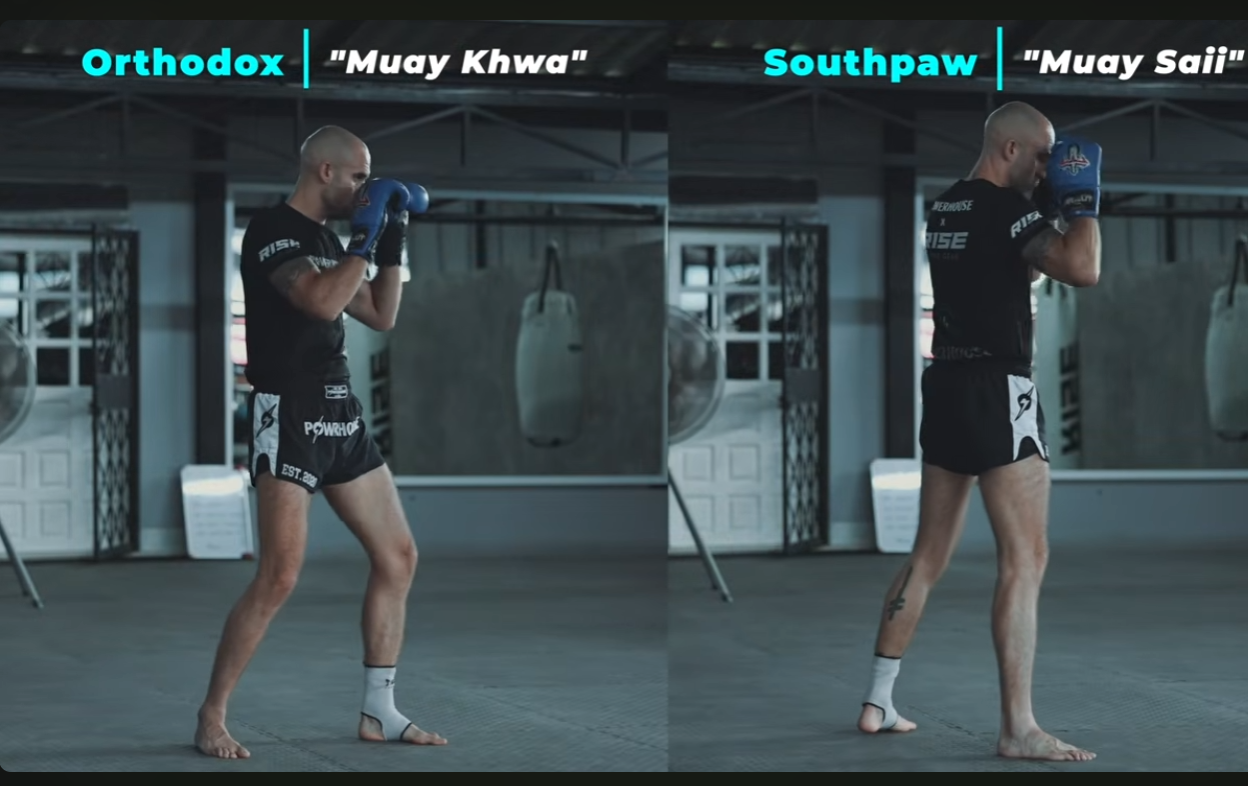
Most beginners get swept in their first month of sparring for one reason. They’re standing wrong before they even throw a strike. Not a bad hook. Not a kick that loses balance halfway through. Just a stance, squared up like a boxer, weight parked on the front leg, hands riding low, waiting to get picked apart by a check kick nobody saw coming.
This isn’t a small technical detail buried in chapter four of some manual. The stance is the foundation everything else sits on. Get it wrong and every kick, every clinch entry, every attempt to catch a leg falls apart at the root. Get it right and half the “advanced” problems beginners struggle with, balance, timing, defense, start solving themselves.
Muay Thai Stance vs Boxing Stance
A boxer leans into the fight. Weight sits closer to 60/40 on the lead leg, the torso blades away from the opponent to shrink the target, and the guard rides low along the cheekbones because head movement handles most incoming punches. It works beautifully for a sport with no kicks, no knees, and no clinch.
Muay Thai throws that blueprint out. Weight distribution runs closer to 50/50 between both legs, because a fighter leaning on the front leg gets that leg caught, kicked, or swept before the first exchange even develops. The stance sits more square to the opponent than a boxer’s blade, since kicks arrive from angles a sideways stance can’t cover. Hands ride noticeably higher, near the temples rather than the cheekbones, because elbows and forearms are doing defensive work against kicks, not just punches. And the front foot stays light, almost floating, ready to check a low kick or snap out a teep without a weight transfer first.
Foot Position, Step by Step
Start with the feet roughly shoulder-width apart, maybe a touch wider. Too narrow and a push kick topples the stance instantly. Too wide and pivoting for a roundhouse turns into a slow, grinding effort.
The lead foot points forward, angled somewhere between 10 and 20 degrees inward toward the centerline, not dead straight ahead. The rear foot turns out further, typically 30 to 45 degrees, heel slightly raised off the floor. That rear foot angle is not cosmetic. It’s what allows the hip to rotate fully into a kick without the ankle fighting the rest of the leg.
Distance between the feet, front to back, tends to run just short of a full stride. Long enough to create range and defensive depth. Short enough that a quick step doesn’t require rebuilding the whole stance from scratch.
Weight Distribution and the Rear Heel
Here’s the detail almost every beginner misses: the rear heel barely touches the ground. It floats, resting on the ball of the foot, cocked and ready. A rear heel glued flat to the floor can’t pivot fast enough to throw a rear roundhouse or a rear teep without a half-second delay, and in a sport built on kicks, that half-second is the difference between landing first and eating a counter.
Weight should feel evenly split, close to 50/50, adjusting only slightly forward or back depending on whether the next intention is to kick or to retreat. A fighter camping too far back can’t close distance. One camping too far forward gets his lead leg read and swept within the first round.
Hands and Guard
The guard sits higher than in Western boxing, hands near the temples, elbows tucked to protect the ribs from low kicks that sneak underneath a dropped guard. Palms usually face inward, fists loose rather than clenched tight, because a relaxed hand reacts faster than a tense one.
The lead hand often extends slightly, not fully, functioning as a range-finder and a light frame against incoming punches or a clinch attempt. The rear hand stays glued near the jaw. Elbows don’t flare out. Flared elbows open the ribs to a round kick, and that’s an invitation Thai fighters rarely decline.
The Marching Rhythm
Watch any experienced Thai fighter move and it rarely looks like bouncing. Boxers bounce on the balls of both feet. Muay Thai favors a marching rhythm instead, a controlled, almost patient shift of weight from foot to foot, small steps that keep the stance intact between exchanges. That rhythm keeps hips loaded for a kick at any moment without telegraphing which leg is about to fire.
Stance archetypes vary even at the highest level, and it’s worth noticing why. Samart Payakaroon, still cited as one of the most technically gifted Thai fighters, built his stance around patience: light on his feet, low output, letting opponents commit first before countering with precision. Compare that to Dieselnoi, a towering knee fighter whose stance leaned forward and aggressive, built to close distance immediately and smother opponents in the clinch with his knees. Same sport, same base stance principles, completely different expression depending on the game plan. The lesson for a beginner isn’t to copy either extreme. It’s to understand that stance adapts to strategy once the fundamentals are locked in.
5 Stance Mistakes (and How They Get Punished)
Thai fighters, even at the gym level, are trained from day one to read a stance before reading a strike. Every mistake below gets punished specifically, not randomly.
- Squaring up like a boxer with too much forward weight
- A flat rear foot with no pivot ready
- Weight glued entirely to the front leg
- A guard that drops too low
- Standing frozen with no march or rhythm
Mistake 1: Leaning Too Far Forward
A stance loaded onto the front leg looks aggressive but collapses under pressure. Thai fighters exploit it with a low kick to the lead thigh, then a sweep the moment the fighter tries to check without weight to spare. The front leg has nothing left to defend with because it’s already carrying the body.
Mistake 2: A Flat Rear Foot
When the rear heel sits flat on the floor, the hip can’t rotate through a kick cleanly, and worse, it can’t rotate away from one either. A fighter with a flat rear foot gets caught reaching for a kick that’s actually a feint, off balance for the real strike that follows a half-beat later.
Mistake 3: Weight Stuck on the Lead Leg
This is the sweep magnet. Any experienced Thai fighter, sensing a static front leg, will fake a kick, wait for the flinch, then step in and dump the fighter’s balance with a simple foot sweep or a shove timed to the exhale. Once on the ground or stumbling, the follow-up rarely misses.
Mistake 4: A Guard That Drops
Tired arms droop. So do overconfident ones. Either way, a low guard invites the exact strike Muay Thai built the higher hand position to prevent: kicks and knees that sail past a boxing-style guard because that guard was never designed to stop them. A dropped hand near the hip is an open lane to the jaw.
Mistake 5: Standing Completely Still
No march, no weight shift, feet frozen between exchanges. This reads instantly to a Thai fighter as an easy read. Static feet can’t check a low kick reactively; they can only eat it. The fighter standing still becomes the training dummy in a live sparring session.
Southpaw Notes
Southpaws follow the same principles in mirror: rear foot and hand reversed, right foot forward instead of left. The one adjustment worth flagging is angle management against an orthodox opponent. Southpaw versus orthodox changes which kicks land clean and which get jammed by the opposite stance, so footwork drills should include time facing both stances, not just the mirror.
Drills to Build Your Stance
- Wall drill: stand in stance with the front knee lightly touching a wall, check that the rear heel is raised, hold for 30 seconds, repeat
- Mirror check: shadowbox slowly in front of a mirror, pausing between strikes to verify the stance resets correctly
- Push test: have a partner apply light forward and backward pressure to the shoulders, testing whether the stance absorbs it without stumbling
- March holds: practice the marching rhythm for full rounds with no strikes at all, just footwork
FAQ
How wide should a Muay Thai stance be? Roughly shoulder-width or slightly wider, with the feet separated front to back by close to a full stride. Too narrow sacrifices stability against push kicks; too wide slows down pivots.
Should the front foot be flat or on the toes? Mostly flat, resting naturally, but light rather than weighted. The rear foot is the one that stays up on the ball of the foot with the heel raised.
Is the stance the same for kicking and for clinch entries? The base is the same, but a clinch entry usually narrows the stance slightly and drops the level a touch to get under the opponent’s frame. The fundamentals of weight distribution don’t change.
How long does it take to build a solid stance? Weeks of conscious drilling before it holds up under pressure, and months before it becomes automatic under fatigue. Shadowboxing with regular stance checks speeds this up considerably.
Should beginners bounce or march? March. Bouncing burns energy fast and can compromise balance when a kick lands. The marching rhythm common in Muay Thai keeps a fighter grounded and ready to check or counter at any moment.
Anyone still building the fundamentals before tackling stance work should start with a proper beginner’s guide to Muay Thai training, and fighters curious about exactly how these stance differences play out against a boxer can dig into the breakdown of Muay Thai versus boxing.
2 Comments