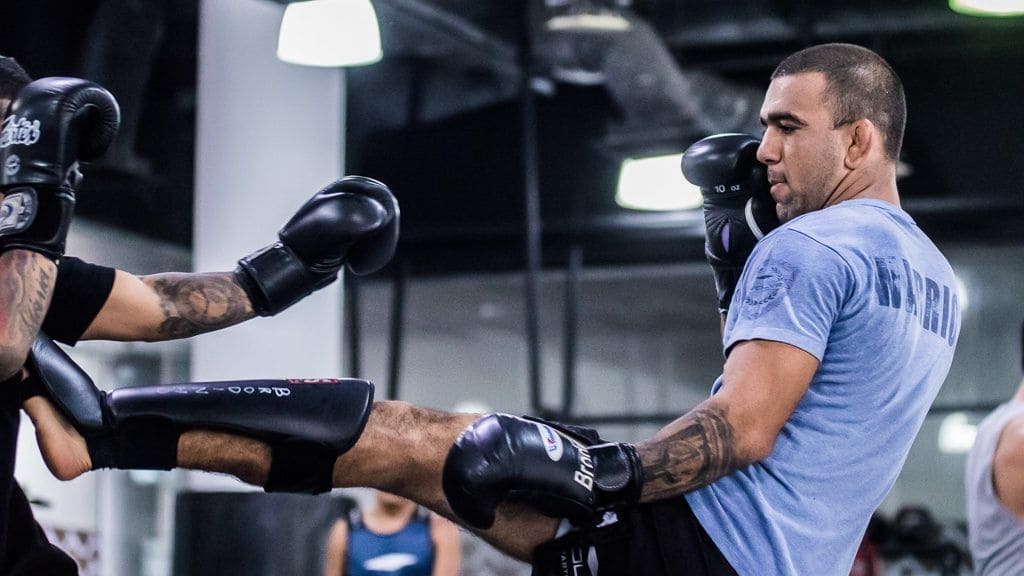
A fighter surges forward, chin down, ready to close the distance and let the hands go. Before he gets there, a bare foot lands flat on his hip and stops him cold. He staggers half a step back, resets, tries again. Same result. By the third attempt he’s hesitating before he even moves, and the crowd at the gym is snickering. Nobody threw a punch. Nobody threw a kick that actually landed with force behind it in the way people usually picture Muay Thai violence. That’s the teep, and it just won the exchange without anyone getting hit hard.
Ask ten Muay Thai fans what makes the sport dangerous and most will say elbows, or the low kick that turns a thigh purple. Few mention the teep, the push kick that looks almost polite compared to everything else in the art of eight limbs. That reputation undersells it badly.
What Is a Teep
The teep (from the Thai “teep trong,” meaning straight kick) is a pushing kick thrown with the ball or flat of the foot, usually aimed at the opponent’s hip, midsection, or face. A roundhouse or a knee wants to hurt someone. The teep wants to interrupt them, shove them off balance, and reset the distance on the kicker’s terms.
That’s why trainers in Thailand call it the jab of the legs. A boxing jab rarely finishes a fight on its own. It sets up everything else, measures distance, and keeps an opponent honest. The teep does the same job with the lead leg, snapping out fast and retracting just as fast, costing almost nothing in balance or recovery time. A fighter who teeps well can control an entire round without ever loading up on a hard strike.
Teep vs. Front Kick (Karate/TKD)
People who train other striking arts sometimes assume a teep is just a front kick with a different name. It isn’t, and the difference matters if the goal is actually to use it well.
A karate or taekwondo front kick chambers the knee high and snaps the shin through the target, often aiming to injure or knock the opponent back with pure force. The teep chambers lower and faster, drives through the hips like a shove, and lands with a flatter foot. Where a TKD front kick wants penetration, a teep wants displacement. Push the ribs, push the hip, push the whole body off its base. A slow teep gets caught. A fast one lands, pushes, and the foot is already back on the ground before the opponent can grab it.
Four Teep Variations
Fighters rarely lean on just one version. The teep splits into four distinct tools, each suited to a different moment.
Front teep. The lead leg does the work here. It’s the bread-and-butter version, fast and low commitment, thrown constantly just to keep an opponent honest and measure range.
Rear teep. The back leg brings more power into it, since the hips and the leg’s full extension add real force behind the push. It loads slower and telegraphs more, so it works best as a surprise or a finishing shot rather than a constant jab.
Side teep. A sideways-angled push kick, often aimed at the opponent’s lead leg or hip to check their base or shut down their movement to one side. Less common, but useful against fighters who circle heavily.
Jumping teep. A hop-in push kick that closes distance suddenly, usually to the chest or face. It sacrifices some control for surprise and range, and works best against opponents who are backing up predictably.
Five Ways to Use the Teep Tactically
The teep does more work than most fans give it credit for. Coaches who build a fight plan around it usually lean on these five applications.
- Managing distance. A teep to the hip or midsection keeps an aggressive opponent at the end of the fighter’s own range, forcing them to reset instead of closing in.
- Breaking rhythm. Fighters who like to walk forward in a set pattern get disrupted the moment a teep interrupts their footwork mid-stride.
- Stopping combinations before they start. A teep thrown the instant an opponent plants their lead foot can cut off a combo before the first punch even leaves.
- Setting up power shots. A teep to the body that folds an opponent forward, even slightly, opens the head for a follow-up right hand or left kick.
- The face teep as an insult. In Thailand, a teep to the face carries cultural weight beyond the physical effect. It’s read as a small act of disrespect, a way of saying the opponent isn’t worth a real strike. Fighters use it deliberately to provoke a reaction or needle a more aggressive opponent into overextending.
Distance and rhythm control end up mattering more over five rounds than any single hard shot.
How Judges Score the Teep
Western fans watching Thai stadium fights sometimes wonder why a fighter who landed a spectacular kick still lost the decision. Traditional Thai scoring doesn’t weigh strikes by how flashy they look. It weighs them by effect and control.
A body teep that visibly staggers an opponent, forces them to catch their balance, or breaks their forward momentum reads to Thai judges as a fighter dictating the fight. That single push carries more scoring weight than three jabs that land clean but do nothing. The logic follows the broader philosophy behind Thai scoring, where dominance and composure across a round outweigh volume. Anyone unfamiliar with how that scoring actually works round by round can check the site’s breakdown of the 10-point must system in Muay Thai for the full picture.
It explains why some of the best pure teep fighters in Thailand rack up decision wins without ever looking flashy on a highlight reel. They aren’t trying to finish anyone. They’re trying to make the other fighter look like he can’t get anything started.
Drilling the Teep
On the bag, the teep trains best in short, fast sets rather than heavy grinding reps. Ten to fifteen teeps per round, focused on snapping the foot back the instant it makes contact, builds the retraction speed that separates a good teep from a catchable one. Alternating lead and rear teeps within the same combo also trains the hip rotation each version actually needs.
With a partner holding Thai pads or a kick shield, the drill gets more useful once footwork enters the picture. One partner advances slowly while the other teeps to control distance, stepping back or pivoting after each kick instead of standing flat-footed. That mirrors the actual job of the teep in a real exchange, which is never a single strike but part of constant spacing.
A simple partner drill worth running every session: the pad holder throws a slow jab, and the kicker has to intercept the punch’s timing with a front teep before the jab lands. Timing like that doesn’t come from shadowboxing. It comes from reps against a live, moving target.
How Do You Counter the Teep?
A teep looks passive right up until it lands, and that makes it beatable for anyone paying attention to timing rather than the kick itself.
Catching the kick is the most direct answer. Scooping the foot with both hands the instant it lands turns the tables completely, since a fighter who just teeped is standing on one leg with nowhere to go. From there, a sweep, a shove, or a step-in knee all become live options. Catching a teep also tends to drag the fight straight into range where the clinch takes over, and fighters who’ve drilled clinch entries convert a caught teep into real damage far more often than those who haven’t.
Cutting the angle works too. Instead of meeting the teep head-on, stepping off at 45 degrees while it’s in flight lets the kick sail past instead of connecting square. It takes practice to read the hip cue that signals a teep is coming, but once a fighter sees it, the angle step becomes almost automatic.
Pressure with feints also disrupts teep-heavy opponents. A fighter who throws fast, low-commitment feints forces the teep-happy opponent to either commit to a real kick, which opens them up, or hold back and lose the very distance control the teep was supposed to give them.
FAQ
Is the teep considered a strong strike in Muay Thai? Not in terms of raw power. Its value comes from range control and disruption, not from hurting the opponent directly, though a well-timed body teep can knock the wind out of someone.
Can beginners use the teep effectively? Yes, and it’s often taught early precisely because it doesn’t require much power or flexibility, just timing and a fast retraction.
What’s the difference between a teep and a push kick in other arts? The mechanics overlap heavily, but Muay Thai’s teep is built around constant, repeated use for range control rather than as an occasional finishing tool.
Why do some fighters teep to the face instead of the body? Beyond the technical value of disrupting an opponent’s head position, a face teep carries a cultural undertone in Thailand as a subtle show of disrespect, often used to bait an angrier, sloppier response.
How do you stop getting teeped over and over? Catch it when possible, cut angles when the kick is already in flight, and use feints to force the opponent into throwing something more committed than a teep.
2 Comments