
In 1963, a delegation of Japanese karateka traveled to Thailand to test their striking art against Muay Thai fighters in a series of exhibition bouts. Several of them left with battered legs and a hard lesson about a martial art most had never studied closely. That trip is still cited today, more than sixty years later, whenever people argue about which style hits harder or which one actually works.
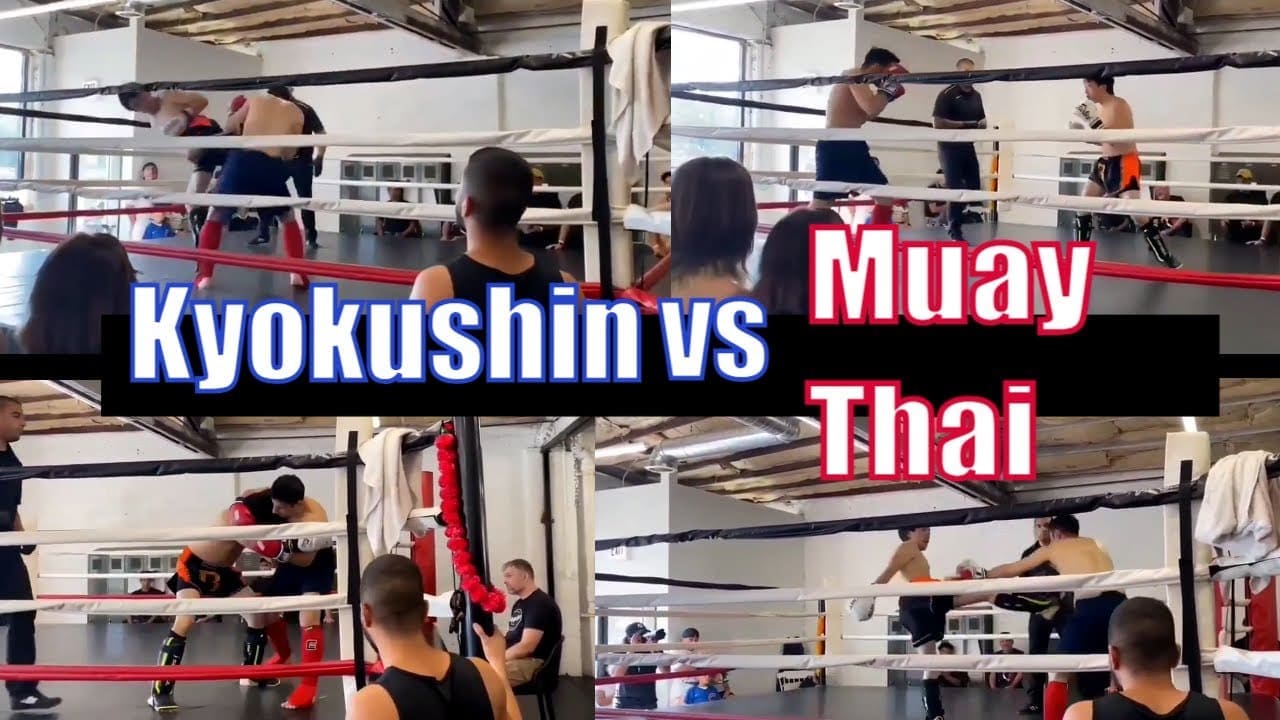
The karate vs Muay Thai debate, or muay thai vs karate depending on which side is asking, resurfaces constantly online, usually framed as a simple win-or-lose question. It rarely is. Karate is not one thing, Muay Thai has absorbed decades of ring evolution, and the honest answer depends heavily on which version of each art gets compared.
Which Karate Are We Talking About?
Ask ten people what karate is and you’ll get ten different pictures. That’s part of the problem with most karate vs Muay Thai comparisons: they treat karate as a single, uniform system when it’s really a family of styles with very different rules. Some versions stop the moment a clean strike lands and reset the distance. Others let two fighters trade real power for three-minute rounds.
Shotokan, the most widely practiced karate style in the world, is largely a point-based sport. Sparring stops the instant a clean technique lands, contact is light or controlled, and matches reward speed and precision over sustained pressure. A Shotokan practitioner can train for years without ever absorbing a full-power low kick to the thigh.
Kyokushin sits at the other end of the spectrum entirely. Founded by Masutatsu Oyama in the 1950s, it’s a full-contact style where fighters strike each other at genuine power, knockdowns happen, and matches are won by attrition as much as technique. Kyokushin fighters condition their bodies specifically to absorb punishment, and their sparring looks far closer to kickboxing than to the karate taught in most neighborhood dojos.
This distinction matters more than almost anything else in the comparison. A Shotokan stylist and a Kyokushin fighter share a name and some historical roots, but they’ve trained for two completely different combat realities. Lump them together and the whole conversation falls apart before it starts.
The 1963 Thailand-Japan Matches
The exhibition matches held in Thailand in 1963 are widely referenced in martial arts history, though the surviving accounts vary in detail and are best treated as general history rather than a precise scoreline. What’s generally agreed on is this: a group of Japanese karate fighters, trained in styles that emphasized single strong techniques and limited leg attacks, traveled to Thailand to compete against Muay Thai boxers under conditions closer to Thai rules than to Japanese karate tournaments.
The results reportedly did not go well for most of the visiting karateka. Low kicks to the thigh, a weapon barely used in Japanese karate at the time, caused serious problems for fighters whose stances and training hadn’t prepared them for that kind of attack. The matches are frequently cited by martial arts historians as a turning point, not because of any single dramatic upset, but because they exposed a real technical gap.
That gap didn’t stay unaddressed for long. Within a few years, Japanese promoters and karateka began developing what became known as Japanese kickboxing, a hybrid system that borrowed heavily from Muay Thai, including its low kicks and its use of the shin as a weapon. Kyokushin karate itself moved toward more full-contact sparring around this same period. The 1963 matches are commonly pointed to as one of the sparks behind that shift, even if the full historical record of exactly how and why is harder to pin down than the popular version of the story suggests.
Range and Stance Differences
Traditional karate, particularly the Shotokan lineage, favors longer range and deep, grounded stances built for generating power in short bursts. Fighters load a technique, commit, and reset. The stance is often wide and low, which works well for stability against a single frontal attack. It’s built for one clean exchange, not for a five-round battle of attrition.
Muay Thai works differently. Fighters stay more upright, weight distributed to allow rapid switching between kicks, knees, elbows, and clinch entries. The Muay Thai stance is built around constant readiness to check a kick, close distance, or pivot away, not around loading one big shot and holding ground.
Range tells a similar story. Karate point-fighting rewards distance management and a single scoring blast. Muay Thai comfortably operates at kicking range, punching range, and clinch range, sometimes within the same exchange. That range flexibility, more than any single technique, is why Muay Thai fighters tend to control distance in cross-style matchups.
The Low Kick Problem
Here’s where the stance difference stops being theoretical. A traditional karate stance, especially the deep, rooted versions taught in Shotokan and similar styles, plants significant weight on the lead leg. That’s fine against punches and even against high kicks aimed at the head.
It’s a serious liability against a low kick.
Muay Thai’s roundhouse kick to the outer or inner thigh doesn’t need to be blocked in the conventional sense. If it isn’t checked correctly, or not checked at all, it lands on muscle and bone with the full swing of the hip behind it. A stance built for stability against straight-line attacks isn’t naturally built to lift a leg and check a kick coming in low from an angle. Repeated leg kicks, unfamiliar to most traditional karateka, can shut down mobility within a few rounds even against a fighter with faster hands.
This is precisely the problem the 1963 matches are remembered for. It wasn’t that Muay Thai fighters were simply tougher. It’s that the low kick attacked a part of the body traditional karate training rarely addressed, and stances built for a different kind of fight had no good answer for it.
Full-Contact Karate: Closer Than You Think
None of this means karate as a whole loses that gap. Kyokushin and other full-contact styles have spent decades incorporating exactly the kind of conditioning and low-kick defense that point karate lacks. Fighters from these backgrounds train leg checks, absorb real contact, and often cross-train directly with kickboxing or Muay Thai coaches.
It’s also well known that a fair number of successful MMA fighters started in karate, particularly full-contact and Kyokushin-adjacent styles, before adding grappling and Muay Thai to their toolkit. Their striking often keeps a distinctly karate flavor: unusual angles, counter-timing, and stances that look different from a typical Muay Thai base, even while performing well inside a modern mixed ruleset.
The real fault line in this comparison isn’t karate against Muay Thai. It’s traditional point karate against everything else, including its own full-contact cousins.
Who Should Choose What
Someone drawn to precision, speed, and a sport built around clean scoring will likely enjoy Shotokan or a similar point-style karate. It rewards discipline and technical sharpness, and the injury profile tends to be lower.
Someone who wants full-contact sparring, a complete striking toolkit, and training that translates directly to self-defense or combat sports should lean toward Muay Thai, or a full-contact karate style willing to absorb its lessons. The low kick alone justifies the choice for most people interested in real fighting ability over point-scoring. Building tolerance for that kind of contact isn’t automatic either; shin conditioning takes months of patient work regardless of which side of a low kick a fighter ends up on.
Neither art is lesser for being different. They were built to answer different questions.
FAQ
Is Muay Thai better than karate? It depends on the goal and the karate style in question. For full-contact fighting and self-defense against low kicks, Muay Thai has a clear practical edge over traditional point karate. Against full-contact styles like Kyokushin, the gap narrows considerably.
Can karate beat Muay Thai in a real fight? A skilled full-contact karate fighter with good leg-check defense stands a real chance. A traditional point-karate stylist with no low-kick experience faces a steep disadvantage, which is roughly the story the 1963 exhibition matches are often used to illustrate.
Why do Muay Thai low kicks give karate fighters trouble? Many karate stances plant weight on the lead leg for stability, which limits the quick, defensive leg lift needed to check an incoming low kick. Without specific training against low kicks, that gap becomes a fast, repeatable target.