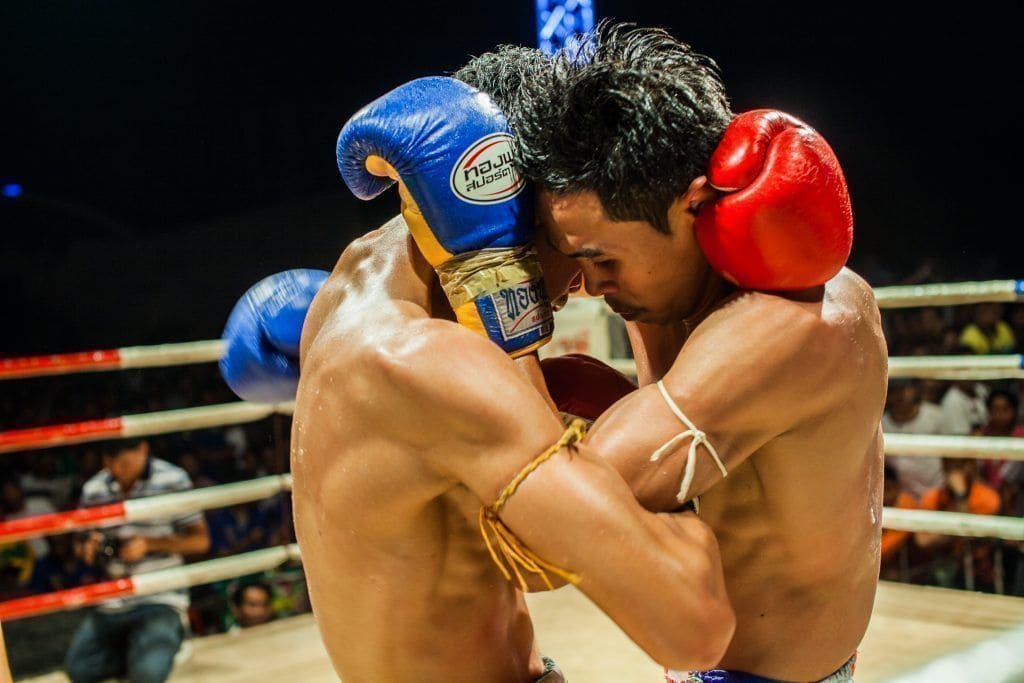
Yes and no. Muay Thai has grappling on your feet, in the clinch, but none on the ground.
That split confuses a lot of people who come from BJJ or judo, or who just watched a fight and saw two men locked up trading knees like it was a wrestling match. The confusion is fair. “Grappling” usually means throws, takedowns, and fighting for position with your hands on another person’s body, and Muay Thai does plenty of that. It just draws a hard line the moment a fighter hits the canvas.
The Clinch: Standing Grappling
Watch any Lumpinee card and the clinch eats up a huge chunk of the round. Fighters fight for double collar ties, single-collar with an underhook, or a wrist grip that lets them off-balance the other guy before a knee lands. This is grappling. It’s just vertical grappling, closer to the tie-up phase of Greco-Roman wrestling than to anything on a BJJ mat.
Referees let the clinch run far longer than Western boxing or kickboxing crowds are used to. A skilled clincher can control an opponent’s head and hips for ten or fifteen seconds at a stretch, walking them into the ropes, off-balancing them, then ripping off a knee or elbow the second an opening shows. That control gets scored. A fighter who dominates the clinch without landing a single visible strike can still win a round on a Thai scorecard. Judges read it as control of the fight, not just damage.
Legal Sweeps and Dumps
Sweeps are where the confusion around “throws” usually starts. A Muay Thai sweep uses a straightened leg, driven behind the opponent’s planted foot or across both ankles, to knock them off balance and down. Done well, it looks dramatic. The opponent’s feet go out from under them and they land flat on their back in front of a roaring crowd.
The dump is the clinch cousin of the sweep. Instead of a leg, the fighter uses the upper-body control already built in the clinch, off-balances the opponent forward or backward, and lets gravity finish the job. Neither move involves lifting an opponent off the ground. Neither involves rotating them through a hip, the way a judo throw does. Both stay inside a narrow, well-defined toolkit that every Thai stadium fighter drills for years before it looks effortless in a real fight.
What’s Banned (and Why)
Anything resembling a judo throw is out: hip throws, shoulder throws, lifting an opponent and rotating them over your body. Joint locks are banned outright too, no armbars, no wristlocks, nothing that isolates a joint and cranks on it. And once someone is down, the fight stops. Ground-and-pound doesn’t exist in Muay Thai. A downed opponent gets a count, not a follow-up strike.
This wasn’t always the rulebook. Muay Boran, the older and rougher predecessor art, allowed a wider range of grappling exchanges, closer to what shows up in catch wrestling than to anything scored today. When Thailand modernized the sport in the 1920s, moving fights into a roped ring with gloves, timed rounds, and a formal scoring system, officials stripped out most of the ground-based and joint-lock material that had defined the older style. Safety was one reason. The other was making the sport legible to judges scoring standing exchanges inside a fixed time limit. A joint lock or a scramble on the ground doesn’t fit neatly into a system built to reward damage and control at range, so it got cut.
Why Sweeps Score So Well
Ask a Thai judge what they’re watching for and “who controlled the exchange” comes up before “who landed the hardest shot.” A clean sweep answers that question instantly. One fighter is standing. The other is flat on the canvas, looking up at the lights. There’s no ambiguity left for the judge to sort through, no need to weigh a partial knee against a partial elbow from thirty feet away.
That’s why experienced fighters treat sweeps almost like a scoring shortcut. Landing four or five hard leg kicks in a round takes real cumulative damage to register with a judge glancing up now and then. One well-timed sweep, especially in the closing seconds before a bell, can flip a close round on paper no matter what happened in the two minutes before it. Fighters and trainers know this. Clinch-heavy gyms in Thailand spend nearly as much mat time drilling off-balancing entries as they do drilling knees.
Muay Thai vs Grappling Arts
Compare that toolkit to Brazilian jiu-jitsu and the gap is obvious. BJJ lives on the ground. Guard passing, submissions, positional escapes, an entire grammar of movement happens after two bodies hit the mat, exactly where Muay Thai’s rulebook says stop. A BJJ practitioner crossing into Muay Thai has to unlearn the instinct to follow an opponent down and instead treat any fall as the end of that particular exchange, not the start of a new one.
Judo sits closer, at least in spirit. Both arts fight for grips and off-balancing before committing to a technique, and both reward a clean, decisive takedown on the scorecard. The difference shows up in what’s allowed once contact is made. Judo’s arsenal runs through dozens of hip and shoulder throws that require rotating an opponent through your center of gravity. Muay Thai strips that down to leg sweeps and dumps: no lifting, no rotation, just off-balancing and gravity doing the rest.
None of this means a nak muay is helpless if a real fight ends up on the pavement. Ring rules and street reality are different problems, and a fighter who trains only inside the roped square can get caught out the moment an attacker changes levels for a leg. That gap is exactly why serious gyms treat street self-defense as a separate skill set worth training on its own, one that lives outside the stadium rulebook rather than inside it.

One Comment