
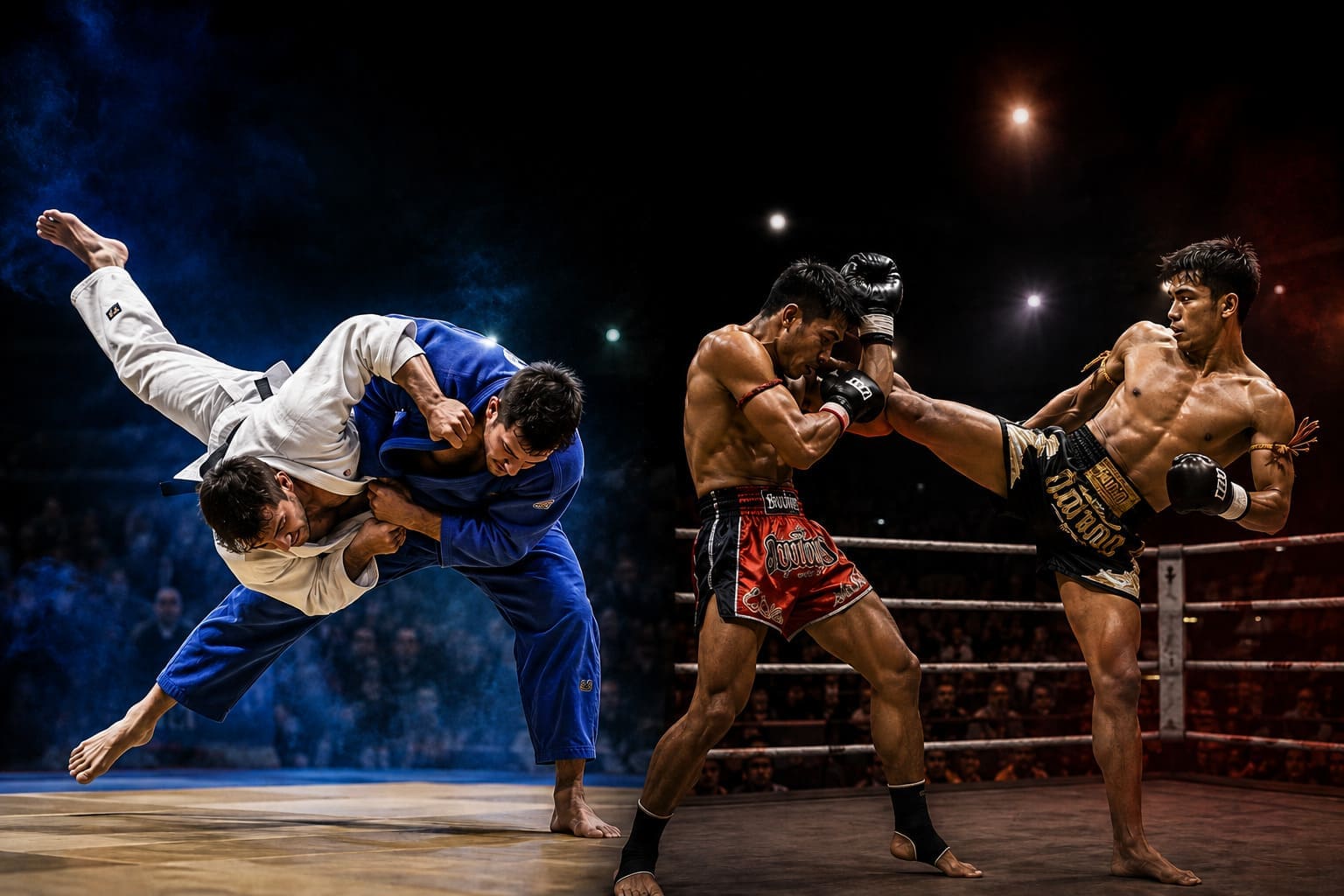
One art wants to put you on the mat. The other wants to hit you before you’re close enough to be put anywhere. Of all the matchups in this comparison series, judo and Muay Thai sit the furthest apart. Most of the pairings here share some overlap, a bit of clinch work, a few common ranges. This one doesn’t. A judo class spends its time on grips, footwork, and off-balancing an opponent until gravity does the rest. A Muay Thai class spends its time on pads, shins, and finding angles to land an elbow. Neither art particularly cares what the other one is doing.
That contrast is exactly why the comparison is worth making. When two systems disagree this completely about what a fight even is, the scenario-by-scenario breakdown tends to be more honest than the usual “both are great, pick what feels right” conclusion.
Total Opposites: How Each Art Works
Judo builds around kuzushi, the principle of breaking an opponent’s balance before the throw ever happens. A judoka spends years learning grip fighting: hand position, sleeve control, the tiny tugs and pushes that get an opponent leaning the wrong way for half a second. That half second is the whole art. Once balance breaks, a throw like o soto gari or seoi nage finishes the job, and the fight often ends on the ground with a pin or a submission.
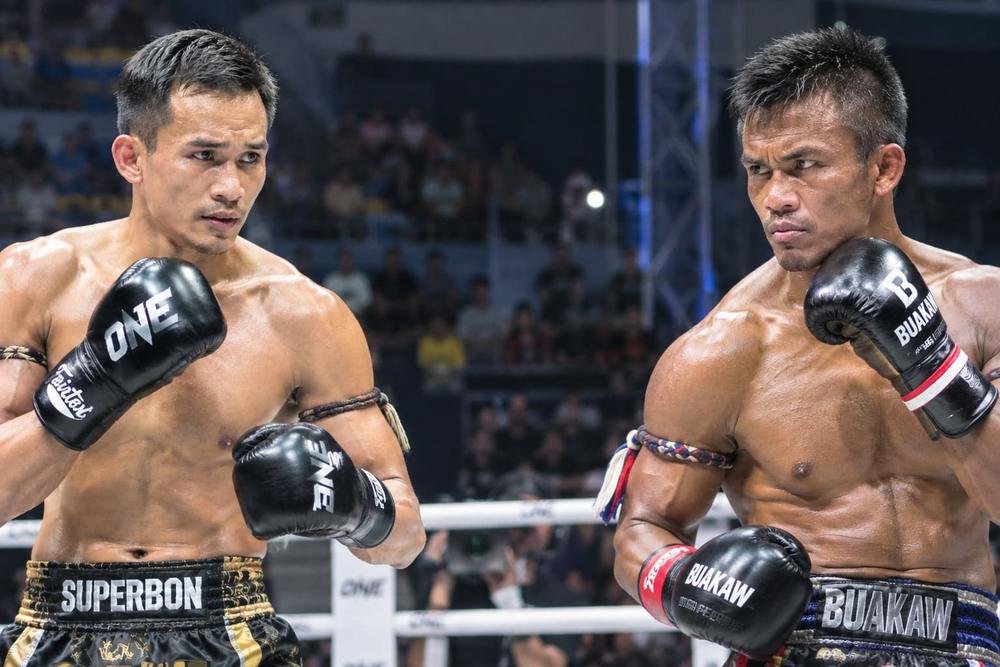
Muay Thai has no interest in balance-breaking through grips. It’s built on range and weapons: jab and cross at distance, teeps to interrupt an advance, round kicks that come in low or high, knees and elbows once things close in. Fighters train to keep their feet under them, not to use grips against an opponent’s stance. The clinch exists in Muay Thai too, but it’s a striking clinch, meant to control a head or an arm just long enough to land a knee, not to set up a throw.
Put simply: judo studies balance to remove it. Muay Thai studies distance to close it.
Self-Defense Scenarios Compared
Here’s where the honest answer gets complicated, because the “better” self-defense art depends heavily on the setting.
Picture a confrontation in a parking lot on an open summer evening. Distance is available, both people are in t-shirts, and striking range matters. Muay Thai’s tools translate cleanly: a teep to create space, a low kick to slow movement, elbows if things get close. The training emphasizes exactly the kind of quick, decisive damage that ends a street altercation fast.
Now picture the same confrontation in January, both people bundled in heavy coats. Grips suddenly matter more than strikes. Thick winter clothing gives judo’s gi-based grip training a real, practical advantage that rarely gets mentioned outside forums: a coat collar is functionally similar to a judo gi lapel, and a trained grip fighter can use it to off-balance and throw someone who has never been thrown in their life. This is a genuinely underrated point. Most self-defense comparisons assume open-space striking is always the answer, but layered clothing changes the math more than people expect.
There’s also the multiple-attacker scenario, which favors Muay Thai almost without exception. Judo’s core strategy, taking a fight to the ground, is a liability when a second or third person is involved. Staying upright and mobile matters more than a clean throw when you can’t see who else is standing behind you.
For Kids: Why Judo Often Wins
For parents choosing a first martial art for a six or seven-year-old, judo tends to win the comparison, and not by a small margin. It’s Olympic-recognized, which gives it a built-in structure of belts, weight classes, and age-appropriate competition that many dojos have refined over decades. The falling itself is taught as a skill before anything else. Kids learn ukemi, safe breakfalling, often for months before they ever attempt a throw, which builds body awareness that carries over into every other sport a child plays.
Muay Thai for young children is a harder sell. Reputable gyms won’t let kids near live sparring, and pad work with strikes carries a different risk profile than grip-based randori. That doesn’t make Muay Thai unsuitable for kids entirely; plenty of gyms run excellent no-contact conditioning classes for younger age groups. It just means judo’s competitive structure and softer entry point give it the edge for a first-timer under ten.
Injury Rates: The Surprise
Here’s the part that surprises people who assume grappling is automatically the “safer” category. Judo is not a gentle art. The injury pattern in judo skews heavily toward falls and throws gone wrong: shoulder separations, knee ligament tears, and the occasional concussion from a bad landing on a hard mat or an opponent’s poor break-fall. A body slammed to the ground with real force, even a padded one, absorbs a lot of impact in a single instant.
Muay Thai’s injury profile looks different but isn’t automatically lighter. Shin bruising, cuts from elbows, and the cumulative wear of repeated low-kick exchanges add up over a career, though acute single-incident injuries are less common outside of actual fight night. The counterintuitive takeaway: judo, often assumed to be the “safer, more controlled” discipline, can carry a comparable or even higher rate of acute injury than people expect, simply because throws generate more force in a shorter moment than most strikes do in sparring. Neither art is dangerous by design. Both carry real risk when trained hard, and dismissing judo as the low-risk option undersells what a bad fall can do.
When the Styles Meet: Clinch vs Grip
The scenario every fan of both arts wants to see: a Muay Thai fighter’s clinch against a judoka’s grip fighting. It’s a genuinely fascinating technical puzzle, not a settled argument.
A Thai clinch specialist wants a double collar tie, elbows framed inward, hips square to deliver knees. A judoka wants sleeve and lapel control to break posture and set up a throw. Whoever wins the initial grip exchange often dictates the entire clash. If the judoka gets a strong collar grip first, a throw can end things almost immediately. If the Muay Thai fighter denies that grip and gets underhooks instead, knees start landing before any throw gets set up. Neither side has an obvious structural advantage; it comes down to who wins the first few seconds of hand-fighting, which is arguably why this specific matchup gets debated more than almost any other in the self-defense literature around real-world encounters.
Fighters who’ve cross-trained tend to describe it the same way: the person who controls the grip controls the outcome, regardless of which base art they started in.
Training Both
None of this means picking one art and ignoring the other forever. Plenty of serious fighters cross-train judo and Muay Thai specifically because the gap between them is the point. A striker who spends a few months learning to sprawl, grip fight, and fall safely closes one of the biggest holes in a pure striking game. A judoka who adds basic clinch and knee work gains an answer for the moment an opponent refuses to grip at all.
Start with whichever art matches your actual goals. Competition-minded kids often do better starting in judo. Adults focused on practical striking usually get more immediate payoff from Muay Thai. Either way, the two arts complement each other better than almost any other pairing in combat sports, precisely because they don’t overlap. That’s rare, and it’s worth taking advantage of.