Sparring night, the one southpaw in the room starts wrapping his hands, and three people suddenly remember they promised to hold pads. Every gym has this guy and this reaction. Everyone explains it the same way too: lefties are just awkward. That explanation is wrong, and believing it is the reason most orthodox fighters never get around to fixing the problem.
The southpaw edge is arithmetic
Left-handers run at roughly one in ten of the population, and gym rosters usually look about the same. Follow that number through to training reps. A southpaw works open stance in every partner drill, every clinch round, every minute of light sparring, starting in week one. A year in, they have solved that puzzle several hundred times. The orthodox fighter across from them has met it maybe twice a month, usually late in a session, usually while losing.
That is the advantage. Not the angle itself, not some quality baked into left-handedness. Drop a southpaw into a room with four other lefties on the mats and the edge shrinks inside a couple of months, because now everybody is getting reps.
The arithmetic cuts the other way as well, and this is where most southpaw guides oversell things. Lefties get worse coaching by default. Your kru has held maybe ten thousand rounds of pads for orthodox fighters and a few hundred for you, so the mitt angles sit slightly wrong, combinations come out in whatever order his hands remember, and nobody in the room can mirror the opponent you will actually meet in a fight. Plenty of experienced southpaws are genuinely poor in closed stance against another lefty, for the simple reason that they have almost never done it.
Open stance, described the boring way
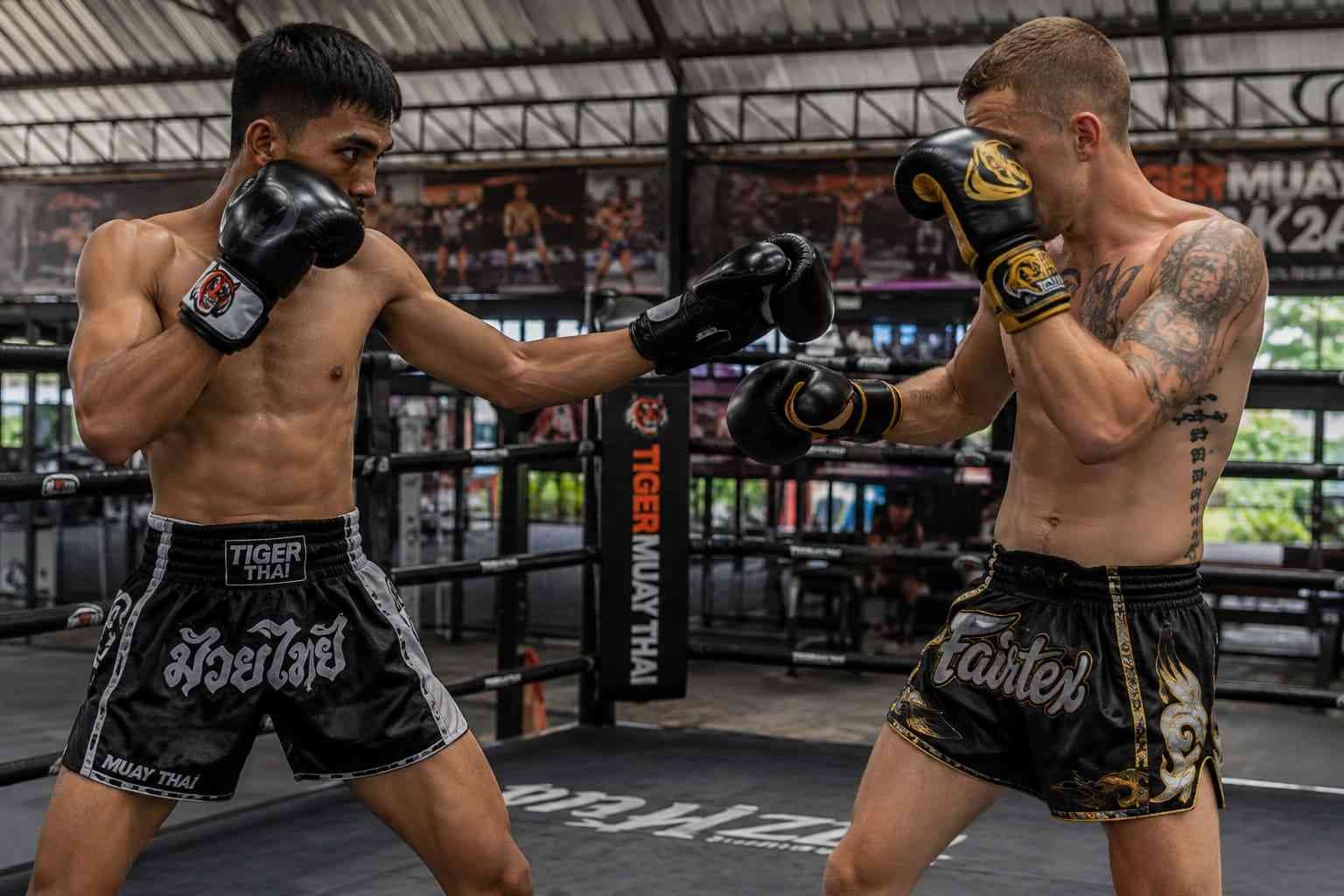
Open stance means one orthodox fighter and one southpaw: left foot forward against right foot forward. Both lead feet end up pointing toward the same side of the ring, and both rear power weapons sit outside the opponent’s guard instead of behind it. In closed stance your cross has to cross their centerline and thread between two gloves. In open stance your rear hand and rear kick run down a lane outside their lead shoulder, into the half of the body a normal guard was never shaped to cover.
Everything after that comes down to feet. Whoever puts their lead foot outside the other’s lead foot gets their hips pointed at the target and owns the lane for their rear weapons. Whoever ends up on the inside loses the angle on their own back hand and has to reset before anything works. High-level fighters spend entire rounds on this and very little else. Watch Nong-O, who fights orthodox despite how many people assume a technician that slick has to be a lefty: the lead foot slides out, the lead hand pins the opponent’s lead hand, and only then does the right side fire.
Try it in your next class. Before you throw anything in an open-stance drill, look down and put your lead foot outside your partner’s. Notice how much further their rear hand has to travel to reach you now. Then hand the position back on purpose and feel the same thing done to you. Two minutes of that beats a month of reading about angles, and it works whichever stance you happen to be standing in. If your base is loose to begin with, sort out foot position and weight first, because none of the footwork below survives a stance you cannot hold.
Which weapons open up, and what they cost
The table reads from the southpaw side. Mirror the sides and it applies to you as an orthodox fighter without a single change to the logic.
| Weapon | Why it opens up in open stance | What it exposes |
| Rear left roundhouse to the body | Lands on the flank outside their lead arm with no guard in the path | You are airborne on the same side their cross is loaded, and a miss turns your back toward it |
| Straight left | The gap between their lead shoulder and chin sits open the moment your lead foot is outside theirs | Even feet means their rear hand has the identical lane going the other way |
| Rear left low kick to the inside of their lead thigh | Their lead leg is turned toward you and clumsy to check on that line | Caught on a shin it hurts you more than them, and a short one drops you into range of the cross |
| Lead right teep | Same-side lead feet make it the fastest tool for winning the foot battle from range | Almost nothing, which is why good southpaws throw it constantly; a lazy one gets caught and dumped |
| Jab to the open side | Travels over the top of their lead hand into the open half of the face | Thrown flat it drags your lead shoulder across and clears the road for their rear kick |
| Lead right hook | Nothing opens it up; the head only looks close from there | Squares your hips and parks your ribs directly in front of the rear kick |
| Rear left elbow off the entry | You arrive already standing on the open side, so the elbow crosses no guard | A miss buries you in the clinch on their strong side |
The lead hook is a trap
Look at that sixth row again, because it catches almost everyone. In open stance the opponent’s head sits slightly off toward your lead hand, close enough that the hook feels free. Throw it and your hips rotate square, which drops your whole body flat in front of a rear kick you will not see, because your own arm covers the view. Southpaws bait this constantly. Orthodox fighters bait it too, and the fix runs both ways: throw the hook after your head has moved off the centerline, or after a teep has broken their base, and not before.
Part two, the orthodox answer
Now flip the chair around. You are orthodox, the lefty is in front of you, and the advice you will get from the guy taping his hands next to you is “circle away from the power hand.” True, and useless on its own.
Circle to your left, and mean it
Move toward your own lead-hand side. That takes you away from the left cross and the left kick, and it takes you toward the outside of their lead foot, so the two goals turn out to be one movement. Small steps. Lead foot first, rear foot following, never a wide sweeping arc, because a big circling step is exactly how people get caught mid-stride by the left roundhouse. Square your feet up again every two steps or you will drift into a stance you cannot kick from.
The jab is the whole game
Orthodox fighters throw the jab at a southpaw, it collides with their lead right hand, and after a few rounds of that they quietly stop throwing it. Wrong conclusion. The jab in open stance goes outside their lead hand rather than through it, and it earns its keep as a tool for controlling their lead arm more than as a scoring shot. Pawing at the hand, pushing it down, tapping the shoulder, all of it buys the half second you need to walk your foot outside theirs. Thais call the controlled, technical style muay femur, and at beginner level this unglamorous hand-fighting is what it looks like.
Deal with the left kick before it arrives
Their rear left roundhouse into your body is the shot that wins them rounds, and it lands on your open right side where nothing is covering. You have three answers, worst to best. Catch it with the right arm and step in, which is standard practice in Thailand and hands them nothing on the scorecards. Check it, which means being able to check kicks cleanly rather than lifting a knee half a beat late. Or make the kick expensive: fire your right low kick into their lead leg every time they load it. Nothing else an orthodox fighter throws in open stance lands as reliably, and it is the answer people skip, because chopping a leg feels less satisfying than landing a punch.
Throw, then leave
The most common intermediate mistake in open stance is finishing a combination standing exactly where you started it. Against a southpaw that is an invitation, since their power weapons are already aimed at that spot. Step off at an angle after your last shot, toward their lead side, and the left hand has nothing to hit. Coaches say “angle out” so often that it stops carrying meaning, so make it concrete: rear foot moves first, about forty-five degrees, before your hands come down.
Should a left-hander be switched to orthodox?
Plenty of gyms still put naturally left-handed beginners in orthodox stance on day one and never explain the reasoning. Some of that reasoning holds up. A strong left in the lead gives you a jab and a lead hook that most orthodox fighters never bother to build, closed stance is what you will be in for nine out of every ten rounds you ever spar, and a coach who teaches one stance well will get more out of you than a coach teaching two badly. Old-school Thai training leaned ambidextrous anyway. The single-stance obsession is a more modern habit than most people assume.
Some of it is just convenience. Switching every lefty in the room means the coach never has to reverse a pad combination or relearn a hold, which is easy for him and expensive for you, because the rear-leg roundhouse is the highest-scoring weapon in stadium Muay Thai. Park a natural left kicker’s best leg out front for three years and you have paid a real price, not made a stylistic choice. Sam-A Gaiyanghadao’s Thai nickname translates as Left Hand Wildfire. Yodsanklai Fairtex built an entire career on one left kick that everybody in the building could see coming. Samart Payakaroon, a four-division Lumpinee champion who then went and won a WBC world title in boxing, fought southpaw in both sports.
Plenty of good coaches disagree with me here, and their track record with beginners beats my opinion. So here is the compromise worth arguing for in your own gym: if a new lefty’s left kick is visibly the better one after a month of pad work, leave them where they are.
Switch-hitting, and when it is worth the time
Saenchai turned stance switching into something close to a party trick, which is why half of every gym tries it in month two and none of them can do it. The version worth learning early is smaller and much duller. Kick and teep off your other leg, and stop there. Five minutes at the end of your bag rounds, opposite stance, kicks and teeps only, nothing with the hands.
Six months of that gives you a switch kick that actually lands and a teep that stops a pressure fighter walking you down. It also puts you in the open-stance problem from the other side, which does more for your understanding of the matchup than any amount of watching fight breakdowns.
Full switch-hitting inside a fight is a separate project and it costs years. Superlek, orthodox, steps into southpaw mid-exchange because more than 170 professional fights have told him when the risk pays. You have eleven months of Tuesday classes. Win the foot position first, in both stances, against everybody in the room. Which stance you are standing in matters far less than whose lead foot is outside whose.