
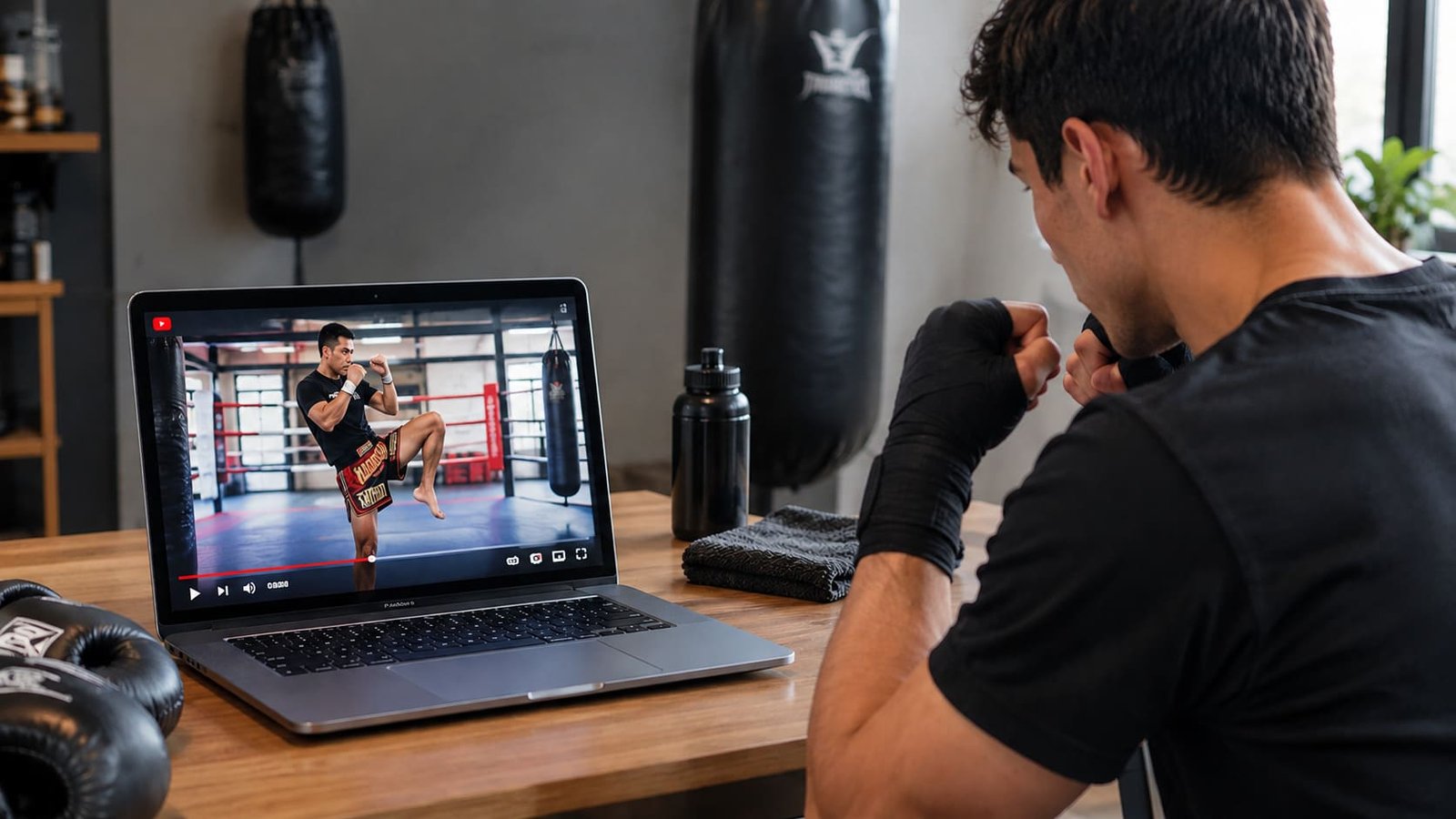
Every few days somebody posts a garage clip and asks for a critique. Three months of tutorials behind them, phone propped on a paint can, and the replies come back with the same three notes: slow down, your hands drop after every punch, your kick starts from your shoulder. None of that was in the videos they watched. The videos showed a correct rep and moved on, which is the whole problem in one sentence.
The honest answer sits between the two camps that shout loudest. Video will not make you a fighter, and it will not ruin you for life either. What it teaches is roughly half the sport: the half you can practice alone.
What survives the trip through a screen
Split the sport into solo-executable and contact-dependent. Everything on the left can be performed correctly by one person in an empty room. Everything on the right exists only in relation to another person, which is why no camera angle fixes it.
| Transfers well through video | Does not transfer, no matter the instructor |
| Shadow work mechanics. Hip rotation, heel turn, the path your arm travels. The shape does not need an opponent. | Timing. Knowing when to throw is a response to somebody else’s rhythm, and there is none in your living room. |
| Conditioning and roadwork. Running, skipping, core work, mobility. A screen prescribes this as well as any coach standing over you. | Distance. Range is learned by being slightly too close and slightly too far, hundreds of times, and feeling it. |
| Fight IQ. Watching Lumpinee and Rajadamnern cards, reading why a fighter switches to knees in round four. Genuinely learnable at home, and most beginners skip it. | Pressure. Behaving like yourself while somebody advances on you is a separate skill, trained only under stress. |
| Vocabulary and culture. Teep, sok, khao, the wai kru, how scoring works in Thailand. Pure information, so pure transfer. | The clinch. Grip fighting is felt through forearms and hips. Watching it without a partner is like reading about swimming. |
| Bag work. A bag gives real feedback on contact: the sound, the swing, whether you kept your balance. | Taking a shot. Getting hit and not panicking is the one thing you cannot rehearse, download, or shortcut. |
| Stance and guard. Foot position and weight distribution are static enough to copy from a good demonstration and check on film. | Defensive reflex. Nobody throws anything at you, so nothing gets built. The biggest hole in self-taught strikers. |
The specific damage self-teaching does
Six items in that right column, five of which need a second body in the room. Coaches who receive self-taught students describe an oddly consistent set of faults, regardless of which channel the person learned from.
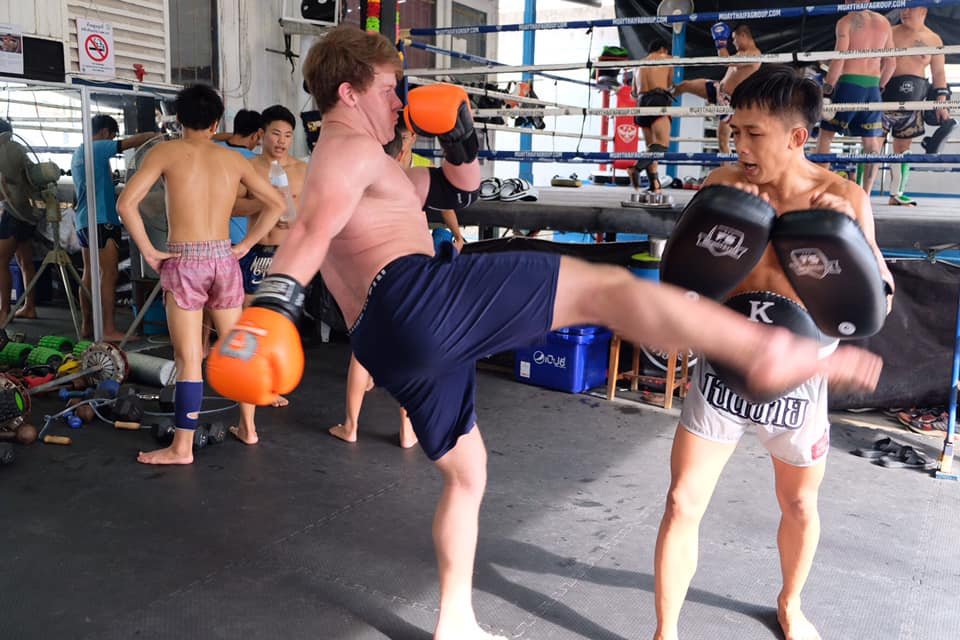
The kick telegraph comes first: loading the hips, dropping the arm on the kicking side, sometimes a little chambering hop before the leg leaves the floor. On a bag it costs nothing, so it never gets punished, so it becomes the kick. Right behind it is the pivot. The support heel refuses to turn, the foot stays flat and pointing forward, and the shin arrives at a fraction of the power it should carry. Both faults are invisible from the inside. You feel like you kicked hard.
Then the hands: punching at half extension, letting the rear hand drift out front instead of resting on the cheek, and the classic self-taught tell of watching your own feet through a combination. Add the missing flinch response and you get somebody who moves reasonably well and freezes the first time a jab comes at their nose.
Here is where most guides oversell the danger. The “you’ll be ruined forever” line does not hold up. Plenty of coaches say the opposite: a beginner who spent three months shadowing correctly picks up pad rounds faster than someone who has never stood in a stance, and a habit built without live pressure behind it is soft. It comes apart in six weeks of real classes. Unpicking one that survived two years of sparring is the hard job. If a gym is within reach, go. If not, video is a defensible way to spend the waiting time.
Who is actually teaching you?
Muay Thai instruction online has a credentials problem nobody polices. A large slice of the tutorial content comes from people whose entire competitive history is a gym membership, and the format rewards confidence over accuracy: clean lighting, a mic, a firm tone, and a technique they were shown once.
Two filters cut through most of it. Can you find footage of the instructor being hit by someone competent? Anyone looks sharp on pads. And does the material come from a Thai source, or somebody documenting one? Sylvie von Duuglas-Ittu’s Muay Thai Library is the standout: hundreds of hours of unedited sessions with Thai krus and former stadium champions, filmed as the session happened rather than as a polished lesson. What to avoid is the channel explaining fifteen techniques at surface depth, because that format exists to produce uploads, not students.
Filming yourself is the whole trick
Video in is worthless without video out. The self-taught trainee who improves is the one who watches himself, not the one who watches instructors. The protocol takes ten minutes.
Set the phone at hip height, roughly ten feet away. Hip height matters because head-height footage flatters your kicks and hides your foot position, where most of your errors live. Film from the open side first, the side your lead shoulder faces, then reshoot the same set from straight on. Two angles, same combinations, two minutes maximum, three techniques. Nobody reviews a forty-minute session honestly. Play it back at quarter speed and check three things in this order:
- The support heel. On every roundhouse, does it turn past ninety degrees before the shin arrives? If not, the pivot is your priority and nothing else matters yet.
- The return path. Does the rear hand come back to the cheekbone before the next strike starts? Watch the hand, not the punch.
- The tell. Freeze the frame just before each kick launches. If your arm has already dropped or your shoulder has already dipped, you have a telegraph, and a bag will never tell you about it.
One focus per week. Not three, one. Put your clip beside a reference clip of a Thai fighter shot from a similar angle, on the same screen rather than ten minutes apart, because your memory of what you just saw is generous and wrong.
Do remote coaching and video review services work?
Partly, in the area you would predict. Paid video review earns its money on mechanics: a coach watching quarter-speed footage catches the flat foot, the dropped hand, and the lazy retraction faster than you ever will. It does nothing for timing, distance, or defense, since those faults never appear on a clip of one person hitting air.
Cheaper option almost nobody uses: message a gym you eventually want to attend and ask a coach to look at ninety seconds of your shadow work. Plenty say yes. They would rather receive you with a half-decent teep than spend your first month deleting things.
Twelve weeks with nothing within driving distance
This is a study plan, not a workout. Conditioning is covered in our 8-week at-home program, and another set of reps here would help nobody. What follows is what you learn, in what order, and what you film.
- Weeks 1 to 3, stance and teep only. Two techniques for twenty-one days sounds absurd, and it is the reason this works. Film once a week from the open side, after reading up on the common stance errors so you know what you are looking at.
- Weeks 4 to 6, the roundhouse. Just the kick and the step back into stance. Heel pivot is the only checkpoint that counts. Watch one full stadium fight a week and count how many kicks land clean.
- Weeks 7 to 9, hands and guard. Jab, cross, shell, and the habit of returning to the cheek. Film both angles now, since hand faults hide from a side view.
- Weeks 10 to 12, putting it together. Three combinations, no more. Study one fighter instead of technique compilations, and pick somebody built like you rather than the flashiest highlight reel available.
By week twelve you have taken almost everything video has to give. Your shapes will be decent, your engine will be real, and you will know more about the sport than half a beginner class.
The line you cannot cross alone
And then it stops. Not gradually, all at once. Everything left needs a partner: clinching, checking kicks, reading a feint, learning that your chin lifts when you get tired. Twelve weeks of honest solo work is roughly the ceiling, and sitting at that ceiling for a year undoes what the first three months bought, because the faults have had time to set with nothing pushing back.
So budget for it. A gym two hours away once a week beats a perfect home setup seven days a week, and a training partner who knows less than you is worth more than another tutorial. If neither is possible yet, keep filming, keep the technique count low, and treat the whole thing as preparation rather than training. The screen got you to the door. Somebody has to hit you before you walk through it.
FAQ
Can you learn Muay Thai without a gym?
You can learn mechanics, conditioning, terminology, and how to read a fight. You cannot learn timing, distance, clinch, or defense, and those separate a trained person from someone who knows the moves. Treat solo work as a head start, not a substitute.
How long can I train at home before I need a coach?
Around three months of focused solo work before returns flatten out. After that, most of what is left requires another person in the room, and continuing alone cements faults that nothing is testing.
Are paid online Muay Thai courses worth the money?
The good ones are, if the material was filmed with Thai coaches or active fighters rather than assembled from technique compilations. What decides the outcome is whether you film yourself and review the footage. Buy the course, skip the review habit, and you bought entertainment.
Will I build bad habits I can never fix?
Some, yes: a flat support foot, telegraphed kicks, hands that drop on the return. Fixable ones, though. Faults built without live pressure behind them break down within a couple of months of real coaching, so the fear of permanent damage is overstated.