
Most people pick a gym the way they pick a dentist: closest one, four-and-a-half stars, decent parking. Eleven months later they can throw a kick that looks fine on a bag and falls apart the second someone moves. The trial class did not warn them, and it was never going to. A trial class is a sales appointment with pad work in it, and any gym paying commercial rent knows how to run a good one.
So audit the things a trial class is not built to show you.
Read the schedule before you read the reviews
Open the timetable on the website. Ninety seconds there beats an hour of five-star testimonials.
Count how many weekly sessions are actual Muay Thai and not cardio kickboxing, “fitness striking,” or a bag class with a playlist. Check whether there is a fundamentals class, then check the more revealing thing: whether the schedule ever lets a beginner into the general class. A gym that keeps newcomers in a beginner track forever is selling a fitness product with Thai vocabulary on it, and a gym that drops a first-timer into the advanced session has no plan for you at all.
Then look at who teaches what. Serious gyms publish coach names next to classes. If the head coach appears twice a week and everything else says “staff,” you are paying for a name you will rarely stand in front of.
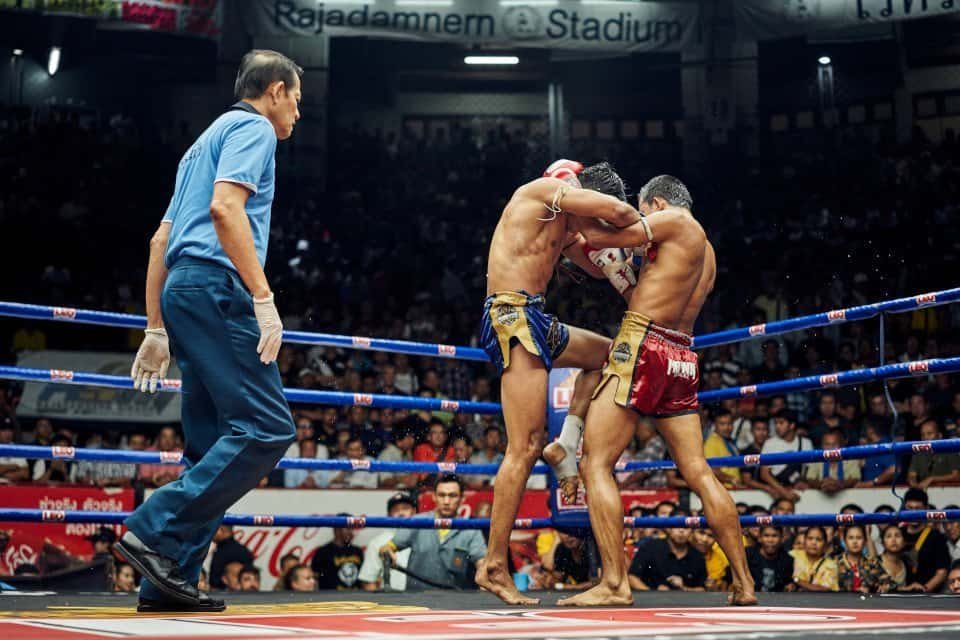
One more line to scan: clinch. Look for a clinch class, or a note that clinching happens inside regular sessions. Clinch is where an enormous share of the sport lives, and it is the first thing a gym drops when it wants classes to feel pleasant and low-contact.
What to watch during the trial class
You are not there to enjoy the workout. You are there to collect four observations.
How long the warmup runs
Ten to fifteen minutes of rope, shadow, and joint prep is normal. Some Thai-influenced gyms open with a solid five rounds of skipping and nobody complains. If thirty minutes of a sixty-minute class goes to burpees, mountain climbers, and ab circuits, you signed up for a bootcamp that happens to own gloves.
How the pads get held
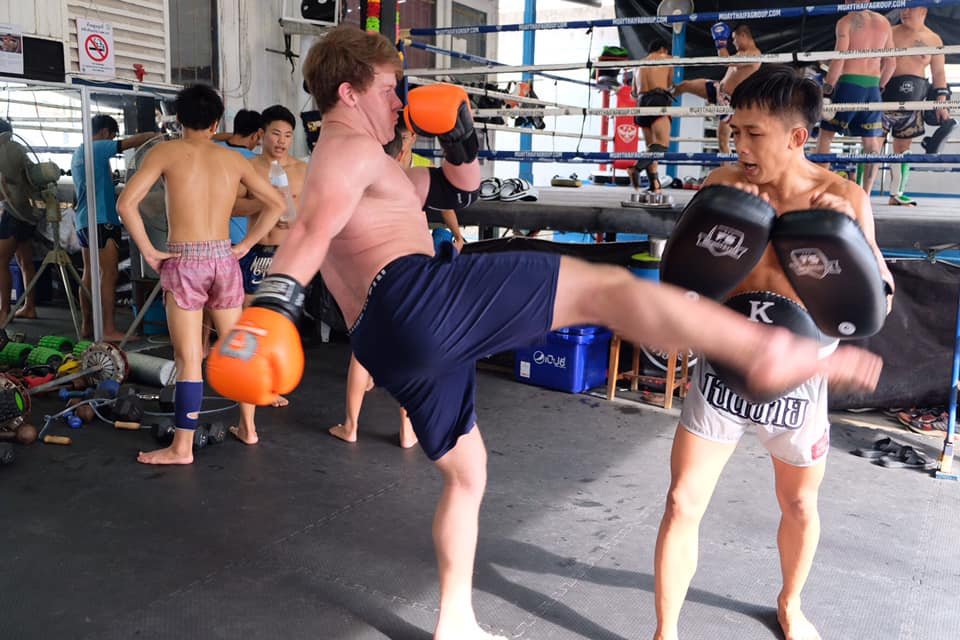
Watch a pad round between two regular members. Are the holders meeting the kick with the pad, or letting it thud into a limp arm? Do they reset the partner’s guard, call combinations, throw a counter back? Pad holding is a taught skill at decent gyms, and sloppy holding across the whole room means nobody ever taught it.
Whether anyone corrects you
Here is the most predictive thing in the whole hour. Did a coach walk over and fix something specific about your stance, your kick, your hands? Not a shouted “nice work” from across the mats. An actual adjustment. A coach who ignores a first-timer for a full class is treating the six-month members the same way, and you can see it in how they move.
What sparring looks like, if it happens at all
Two opposite failures live here. A gym where nobody spars produces people who have never had a hand thrown at their face, and that gap shows up the first time it happens. A gym where every session ends in hard rounds produces a slow, steady pile of concussions and quiet dropouts. What you want is light technical sparring with a coach on the floor, partners matched by size, and somebody getting told to bring it down when they start winging punches. Ask when beginners are allowed in. Several months is a normal answer. Week one is not.
The money questions, asked out loud
Ask these at the desk before anything gets signed, and ask them as plain questions rather than apologetic ones:
- Is this month-to-month or a contract? How many months?
- How do I cancel, and what does canceling cost me?
- Is there an initiation or registration fee on top of the first month?
- What is included: open mat, sparring nights, clinch, loaner gear?
- Is there a surcharge for sparring class, or for the fight team?
- What does an hour of private coaching cost?
Across US and Canadian cities, unlimited memberships cluster in a narrower band than people expect, and drop-ins usually land around twenty to thirty dollars. What swings wildly is everything bolted around the monthly fee. The ranges are broken down properly in the guide to what classes cost, so treat this section as the contract half of the question.
Listen hardest to the cancellation answer. A two-month cancellation fee attached to a twelve-month auto-renewing agreement is common at franchise-model gyms, and members typically discover it in month three, when a knee goes or a job moves. Get the answer by email, not verbally. Front desk staff who go vague on the cancellation terms have already told you what the terms are.
Asking about lineage without sounding like a cop
You are allowed to ask a coach who taught them. Frame it as curiosity, because it usually is: “Where did you train? Who was your kru?” Coaches with a real answer light up. It is one of their favorite subjects.
What you want is a chain that leads somewhere verifiable. Years at a named camp in Thailand. A named coach in North America. An amateur or pro record you can look up. Students who compete under a sanctioning body, whether that is USMF, IKF, or a WBC Muaythai card. Names over the door mean less than they look: a gym called Sityodtong or Fairtex may hold a genuine affiliation, as Mark DellaGrotte’s Boston gym does through Kru Yodtong’s camp, or may have licensed a logo. One question settles it.
Now the honest counterpoint, because this is where most gym-picking guides go absolutist. Plenty of excellent coaches never fought. Reading a fighter and holding pads for eight rounds without ruining the timing are separate skills from competing, and some of the best corners in the sport had short, unremarkable careers. What does not survive scrutiny is the full set: no fight background, no students who compete, and no coach of their own they can name.
Belts, stripes, and a ranking system Muay Thai never had
Thailand has no belt system. Rank shows up as an armband in some camps, and every colored-belt curriculum you see in North America was invented here, which we cover in detail in the piece on Muay Thai and belts.
Treat grading as an orange flag rather than a red one. Some genuinely good gyms run a ranking ladder because hobbyists stick around longer when progress is visible, and the coaching underneath it is fine. The version to walk away from charges a testing fee for each level, builds the whole curriculum around the next test, and has nobody in the building who has ever fought.
Red flags and green flags
| What you are looking at | Bad version | Good version |
| Coach background | No record, no students competing, certificate from a two-day seminar | Names a kru, a camp, or a record you can verify; has cornered fights this year |
| Sparring policy | Every class ends in hard sparring, or nobody spars at all | Light technical rounds, coach supervising, beginners held back a few months |
| Class time budget | Half the hour on conditioning circuits | Ten to fifteen minutes of warmup, the rest on technique, pads, and drilling |
| Beginners | Nobody corrects the new person all class | A coach fixes your stance in the first twenty minutes |
| Contract | Twelve-month auto-renew, cancellation fee, terms explained verbally | Month-to-month, or a contract whose cancellation clause they will email you |
| Clinch | Never appears on the schedule | Its own class, or built into regular sessions |
| Ranking | Paid belt tests, curriculum built around gradings, nobody fights | No grading, or an armband system nobody charges for |
| Equipment | Cage but no ring, three bags for thirty people, no Thai pads | Ring or ring space, enough bags, belly pads and Thai pads in use |
Competitor gym or hobbyist gym? Both can be the wrong building
A fight-team gym runs on a different clock. Morning runs, hard rounds on a fixed night, and a coach whose attention flows toward whoever has a card date in six weeks. If you want to compete, that room will get you there faster than anything else. If you have a desk job, a commute, and a kid, you will spend a year feeling like furniture.
A hobbyist-focused gym flips it. Better onboarding, cleaner changing rooms, more evening classes, and a ceiling you hit somewhere in year two.
The question that separates them takes five seconds: how many people from here fought this year, and where? A gym with a fight team names shows and dates immediately. A gym without one gives you a story about someone who used to train there. Neither answer is disqualifying, but hobbyists who join fight teams by accident tend to quit inside four months.
A two-week test for a gym you already joined
Say you signed already. Give it ten sessions and keep a note on your phone with three columns.
First, count the individual corrections. Every time a coach adjusts something specific about your technique, log it. Across ten sessions you want at least five. Zero means the gym is supervising you, not teaching you.
Second, note how you left. Ordinary soreness is the job. A headache, a bruised orbital, or a limp from a partner who could not control a kick is a policy problem rather than bad luck, and it will repeat.
Third, write down any named technique you can do now that you could not do on day one. A rear-leg teep, a proper check, one combination that lands clean in a pad round. Nothing on that list after ten sessions points at the instruction.
Ten sessions is roughly two weeks of training. Walking away costs you two weeks. Staying because you already paid costs you the year this article is trying to save.
FAQ
How many trial classes should I take before joining a gym?
Two at minimum, on different days, with different coaches on the floor. A Saturday fundamentals class and a Tuesday evening general class can feel like two separate businesses. A gym that offers one trial and then walks you into a sit-down meeting to sign has told you something.
Is a belt system a red flag at a Muay Thai gym?
Not on its own. Thailand does not use belts, so any grading ladder is a Western addition, but some solid gyms run one to keep hobbyists engaged. Worry when testing costs money, when class content is organized around the next grading, and when no one at the gym competes.
How soon should a beginner start sparring?
Most reputable gyms hold new people back for a couple of months while stance, guard, and basic defense settle in. Some gate it behind a fitness standard instead, like five clean rounds of skipping. Being invited to spar in your first week is not a sign of confidence in you, it is a sign nobody is managing the room.
Should I train at a dedicated Muay Thai gym or an MMA gym with striking classes?
A dedicated gym almost always gives you more clinch, more elbow and knee work, and coaches who came up in the sport. MMA gyms often teach striking shaped for cage rules, which quietly removes the clinch game and changes the stance. Train wherever the coaching is better, and check the schedule for clinch before you decide.